
When the wind picks up across an open span, every fitting on the line is either carrying tension or merely holding weight. At the pole where the span terminates, the anchor tension clamp takes the full pull of the conductor. Picking the wrong clamp family at that point risks slippage, sag, and an unplanned outage.
RaxPower has built pole line hardware since 2003, and clamp selection questions still land on our engineering desk almost every week. This article compares anchor tension clamps with the three families they get confused with: suspension clamps, bolt-type strain clamps, and preformed dead-end grips. Each section keeps one question in view: which load path is the fitting actually designed to carry?
Key Takeaways Before You Compare Clamp Families
Keep these four lines.
- Load direction separates the families: tension clamps anchor full line tension, suspension clamps carry vertical weight only.
- Wedge-type clamps suit LV ABC and fiber drops without special tools.
- Bolt-type strain clamps take bare MV conductors to roughly 100 kN duty.
- Preformed grips terminate ADSS and OPGW while spreading bending stress.
What an Anchor Tension Clamp Does on the Line
An anchor tension clamp is a wedge-type dead-end fitting that terminates a cable and transfers its full horizontal tension into the pole or bracket. A typical unit consists of three parts: a shell, one or two wedges, and a bail for the pole-side attachment. Installed at span ends and angle positions, it holds directional changes up to 90 degrees.
The load path explains the design. Every newton of conductor pull, whether from cable weight, wind pressure, or thermal contraction, arrives at the clamp and must leave through the bail into the pole hardware. That is the opposite job from a supporting fitting, which only receives a downward force on a straight run.
The wedge is the clever part. As line tension rises, the wedge pulls deeper into the shell and grips the conductor harder, so the clamp self-tightens under load. Installation needs no torque tools: insert the wedge, seat the cable, and slide it home, which preserves the jacket on ABC and figure-8 cable.
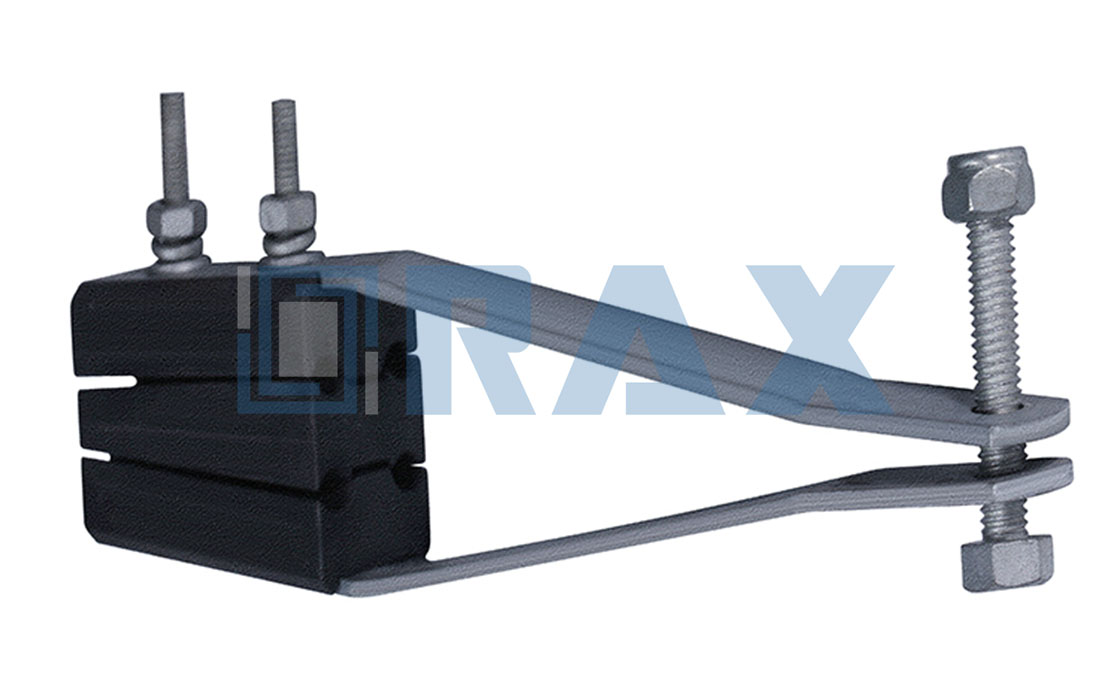
On the pole side, the bail loops onto whatever the structure offers. Hooks, pole brackets, and crossarm eyes all work, which is one reason the family spreads across rural distribution, building wall drops, and telecom messenger terminations with the same basic part.
Ratings for these LV ABC and fiber models stay in a compact band. Catalog tables list cable steps from 6 mm to 20 mm with minimum breaking loads of 500 to 600 daN, which is 5 to 6 kN. The same tables rate continuous service from -60°C to +60°C and list NF C 33-041 and EN 50483 as reference standards for LV ABC hardware.
The Four Clamp Families and How They Grip
Clamp families split along one seam: how they grab the conductor and which force they hand back to the structure. Four designs cover almost every distribution and telecom job.
Wedge-Type Clamps for Insulated Cable
This is the family described above: plastic or aluminum shells with self-tightening wedges for 0.6/1 kV ABC, service drops, and figure-8 fiber. Because the wedge bites without crushing, the cable jacket stays intact through years of wind cycling. Weather resistance comes from UV-stabilized engineering plastics on the wedge pair.
Insulated wedge variants extend the principle to covered main-line conductors. Catalog models accept cable diameters from 8.5 mm up to 33 mm. Grip strengths run from 3.4 kN to 28.2 kN, with failure loads reaching 52.1 kN across the size range. Voltage ratings on those models span 1 kV, 10 kV, and 20 kV classes, and the rated service window runs from -40°C to +60°C.
Bolt-Type Strain Clamps for Bare Conductors
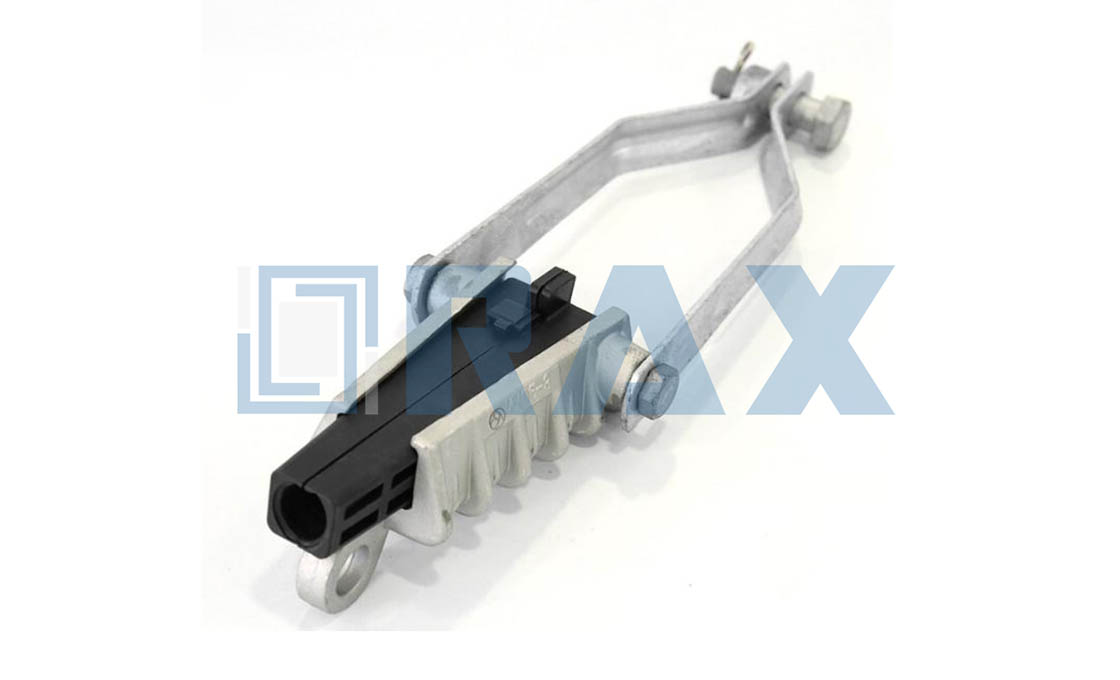
Bolt-type tension clamps such as the NLL and NLD series grip bare conductors between plates secured by two to four bolts. The NLL range covers conductor diameters from 5 mm to 32.6 mm with tension loads from 68 kN to 93 kN per size. Series ratings reach about 100 kN at the top of the range. Aluminum alloy bodies serve lines up to 35 kV, while malleable iron NLD clamps take the heavier duty. Grip strength is specified at not less than 95% of the conductor breaking force, with compliance references including IEC 61284, BS 3288-2, and ASTM A153.
Preformed Tension Grips for Fiber and Long Spans
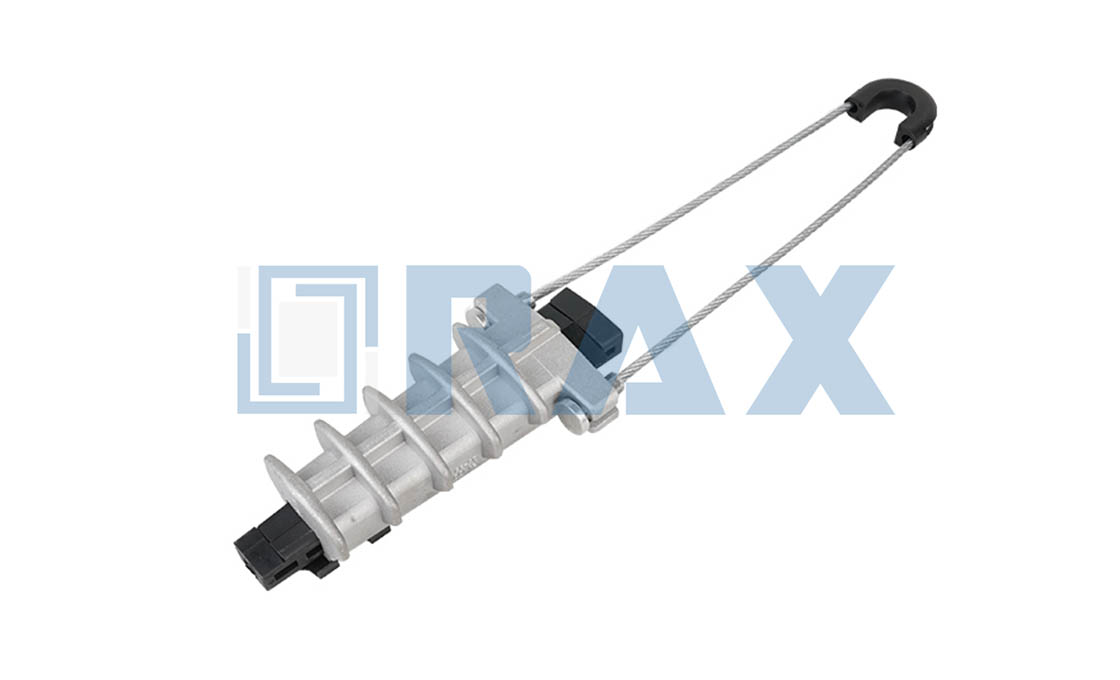
Preformed tension clamps replace rigid jaws with helical rods that wrap the cable in a matched spiral. Datasheets rate grip above 95% of cable RTS for ADSS, OPGW, and OPPC, with 9 mm to 16 mm cable ranges and span capability beyond 500 m. Because the rods spread load along several diameters of cable, bending stress stays low at the termination. A full assembly stacks preformed dead ends with armor rods, shackles, thimbles, and extension links, so the tension path carries no sharp bends.
Suspension Clamps That Only Carry Weight
Suspension clamps hang the conductor at intermediate supports and are built in aluminum alloy or ductile iron. They accept vertical load, permit limited movement for thermal swing, and suit straight runs rather than terminations. Asking one to dead-end a span is the classic specification error. The family itself is broad: standard, helical, angled, corona-free, and trunnion types cover special mounting positions and electrical duty cases.
Side-by-Side: Specs That Decide the Choice
The table below compresses the decision to the five lines that change with each family. Treat the figures as ordering anchors from the referenced catalog pages rather than universal constants.
| Family | Grip principle | Typical load duty | Cable or conductor range | Installation |
|---|---|---|---|---|
| Wedge anchor clamp (plastic shell) | Self-tightening wedge in a shell | 5-6 kN breaking load | 6-20 mm ABC, figure-8, ADSS drop | Tool-free slide-in |
| Bolt-type strain clamp (NLL/NLD) | Plates forced by 2-4 bolts | 68-93 kN, series to about 100 kN | 5-32.6 mm bare conductor | Torque wrench |
| Preformed tension clamp | Helical rods wrap the cable | Above 95% of cable RTS | 9-16 mm ADSS, OPGW, OPPC | Hand wrap |
| Suspension clamp | Suspends and secures the cable | Vertical support only | AAC, ACSR, ADSS per model | Simple bolting |
Two contrasts deserve attention. First, the load numbers are not close. A 5-6 kN wedge clamp would fail quickly on a heavy transmission dead-end. An NLL clamp, in turn, is oversized for a slim service drop cable. Second, only the preformed grip is gentle by design, because its gripping length spreads stress instead of concentrating it at one jaw line.
Reading the table also means separating breaking load from working load. Utilities deliberately specify hardware so the everyday tension sits well below the rated breaking value, leaving margin for ice, wind, and installation shock. That margin, not the raw catalog peak, is what keeps a termination quiet for decades.
Where Each Clamp Family Fits in the Network
On LV ABC networks, wedge-type anchor tension clamps terminate spans at the last pole, at service crossings, and at angle positions up to 90 degrees. Their plastic wedges and galvanized bail match the 0.6/1 kV ABC class covered by the NF C 33-041 family of specifications.
On bare conductor distribution above that class, bolt-type strain clamps own the dead-ends, section poles, and right-angle turns where full tension meets the structure.
Fiber routes add a third pattern. Preformed tension grips terminate ADSS and OPGW at tension and terminal towers, while smaller wedge clamps hold figure-8 drop cable at the building wall. Suspension clamps then support the same cables between those anchor points.
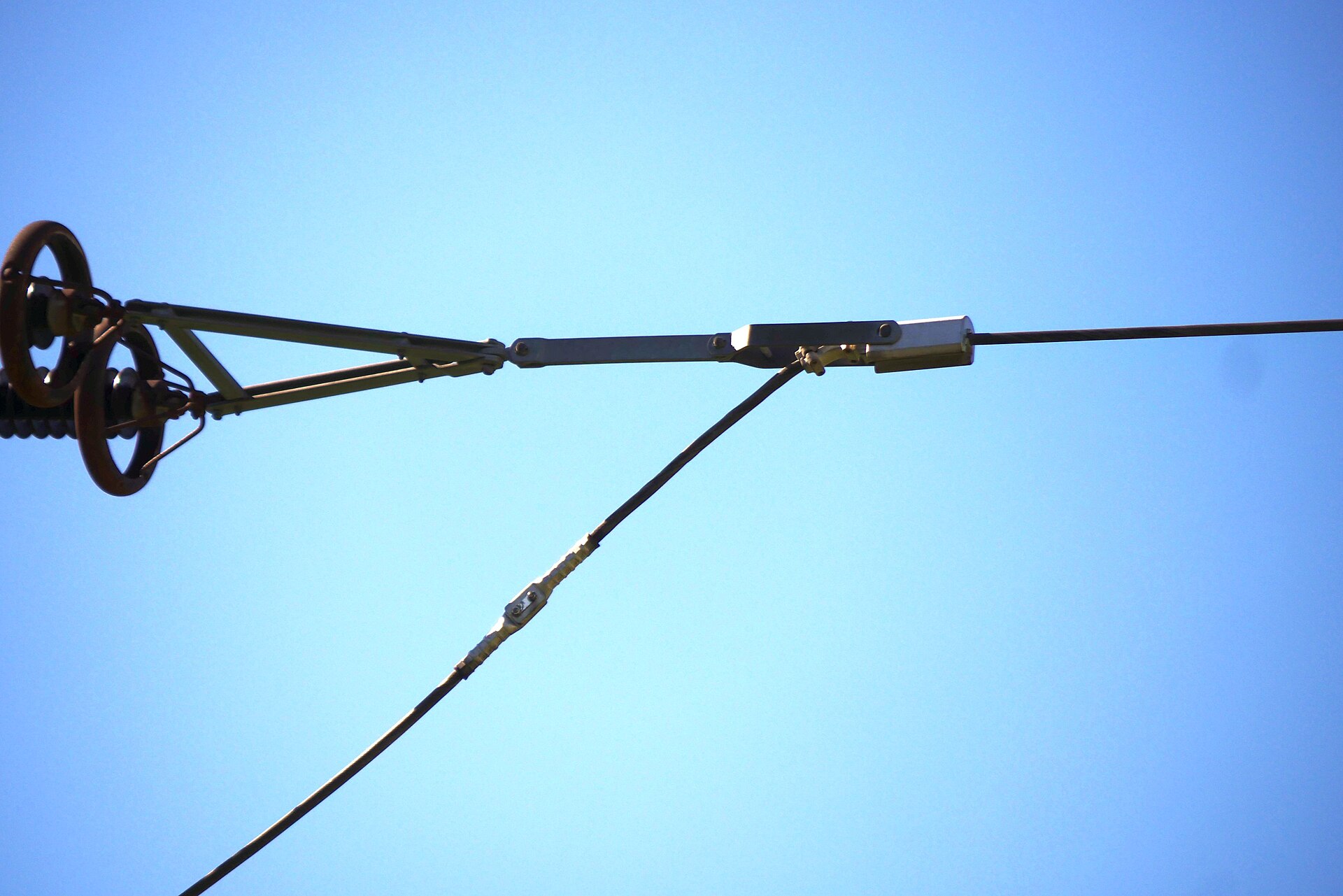
- LV ABC span end: wedge clamp sized to the bundle diameter.
- MV bare line dead-end: bolt-type NLL or NLD matched to conductor and load.
- ADSS or OPGW run: preformed tension grip at every tension and terminal structure.
- Straight intermediate supports: suspension clamp, letting the conductor move.
Span geometry refines the mapping. Short urban spans keep tensions modest, so light wedge hardware usually covers the terminations. Long rural spans raise daily tension and swing wider in wind. That pushes bare lines toward heavier bolt-type fittings, and fiber toward preformed grips. Catalog span capability for those grips reaches 100 m to beyond 500 m.
Installation Speed and Maintenance in the Field
Installation labor is where the families separate most visibly. A wedge clamp seats in seconds with no tools. A preformed grip wraps by hand with no special tools either. A bolt-type clamp needs a torque wrench plus a documented re-torque pass after the conductor beds in.
When the same crew strings both an ABC bundle and a bare MV feeder, the wedge clamp jobs leave the torque kit in the truck. That difference compounds across a village-wide build. In our experience, the re-torque pass on bolted clamps is the step most often missed on busy sites.
Maintenance mirrors the pattern. Wedge and preformed designs are fit-and-forget under normal loads, while bolted joints belong on the annual patrol list. Training hours follow the same slope. A new line worker can learn to seat a wedge correctly in one morning. Correct bolt sequencing and torque values need a full briefing and a printed schedule.
The same discipline applies before hardware ever leaves the store. A clamp pulled from the bin should be checked against the cable schedule rather than memory, because neighboring diameter steps look identical at arm’s length. Five seconds of reading at the store beats a second climb up the pole.
Which Clamp Family Should You Choose?
Decide from the span position inward, and the answer usually selects itself.
- Dead-ending ABC or figure-8 cable: wedge-type anchor clamp, sized to the jacket diameter.
- Dead-ending bare MV conductor: bolt-type strain clamp from the NLL or NLD table.
- Terminating ADSS or OPGW: preformed tension grip rated above 95% of cable RTS.
- Supporting anywhere between anchors: suspension clamp, matched to the conductor diameter.
The costly mistake runs in both directions. Over-specifying puts a 90 kN strain clamp on a drop cable that a wedge unit would hold comfortably, and the budget pays for strength that never gets used. Under-specifying is worse, because a lightweight fitting asked to hold full feeder tension fails without asking permission.
A suspension clamp supports a conductor the way you would carry a heavy pipe balanced on one shoulder: secure, but free to shift. Only a clamp that grips the end of the load can take the pull. Keep that picture, and the families stop blurring together.
RaxPower manufactures the three tension-side families under one roof, from hot-forged bolt-type bodies to helical rod sets, with ISO 1461 hot-dip galvanizing and ISO 9001 process control behind them. Match the family to the load path first, and the hardware will outlast the span it holds. The tension and suspension fitting range gathers every option on one shelf.
Failure Modes Worth Checking During Inspections
By the time a misapplied clamp announces itself, the story is visible from the ground. A dead-end held by a suspension clamp shows conductor creep toward the span and a polished shine where the cable slides. An undersized wedge clamp leaves the jacket flattened at the mouth, and a dry bolted joint shows rust weep at the threads.
None of these start as manufacturing problems. They start as family-choice problems, which is why the load-path comparison above matters more than any single part number.
Frequently Asked Questions About Anchor Tension Clamps
Is an anchor tension clamp the same as a dead-end clamp?
The names overlap heavily. Anchor tension clamp usually names the wedge-type fitting for ABC and fiber cable, while dead-end clamp covers the wider duty including bolt-type and preformed terminations. All of them carry full line tension rather than vertical support.
Can a suspension clamp replace an anchor tension clamp?
No. A suspension clamp carries vertical weight and deliberately allows movement, so it cannot restrain horizontal tension. Used at a dead-end, it invites conductor slippage and sag. Termination points need a wedge clamp, a bolt-type clamp, or a preformed grip.
How do I size an anchor tension clamp for my cable?
Match three values: the clamp’s cable diameter range, its minimum breaking load against your span tension, and the standard your network specifies. For LV ABC hardware, catalogs list diameter steps such as 6-10 mm through 14-18 mm with 500-600 daN breaking loads.
What does grip strength above 95% RTS mean?
RTS is the rated tensile strength of the cable itself. A grip strength above 95% RTS means the fitting holds nearly the full breaking load of the cable. The hardware, not the cable, stops being the weak link when the span loads up.
Which standards apply to anchor tension clamps?
For LV ABC, NF C 33-041 and the EN 50483 series define the requirements, and manufacturers list them on wedge clamp datasheets. For overhead fittings generally, IEC 61284 sets the mechanical requirements and test procedures that tension and suspension equipment reference.
Quick Answer: Which Clamp Goes Where
- A wedge-type anchor clamp transfers the full horizontal tension of ABC, figure-8, or ADSS cable into the pole at dead-ends and angle positions up to 90 degrees.
- Suspension clamps carry only vertical weight on straight runs and must never terminate a span.
- Bolt-type strain clamps (NLL/NLD) dead-end bare conductors with loads from 68 kN to about 100 kN.
- Preformed tension grips terminate ADSS and OPGW above 95% RTS while spreading bending stress along the cable.