
Picture the last pole on a new feeder route. The conductor arrives under full tension, and the crew has one job left: end the span cleanly at the structure. The cable’s strain has to stop right there, not travel into the pole top or across the hardware.
An anchor tension clamp is the dead-end fitting built for that moment. It grips the cable, carries its full running tension, and transfers the load into the pole, tower, or wall bracket. The term covers two hardware families: polymer wedge clamps that dominate fiber routes, and bolted aluminum alloy clamps that hold distribution conductors. RaxPower manufactures both from its Hebei plant, where 170+ specialists work the engineering and forging floor.
Quick definition: an anchor tension clamp, also sold as a dead-end or strain clamp, terminates an overhead cable and holds its full mechanical tension at a pole, tower, or wall.
Anchor tension clamp applications include ADSS and figure-8 fiber routes, ABC bundle dead-ends, service drops anchored to poles or walls, and bare-conductor dead-end or angle positions on distribution lines.
Two families do the work. Polymer wedge clamps install by hand and tighten themselves under load. Bolted aluminum alloy clamps in the NLL series serve conductors from 5 to 32.6 mm, with tension loads up to 100 kN.
Standards to quote: IEC 61284 for overhead line fitting requirements and tests, with ASTM A153 or ISO 1461 covering hot-dip galvanized steel parts.
- What an Anchor Tension Clamp Actually Does
- How the Grip Holds Without Crushing
- Anchor Tension Clamp Applications Across Overhead Networks
- ADSS and Figure-8 Fiber Routes
- ABC Distribution and Service Drop Dead-Ends
- Matching Clamp Family to Conductor and Load
- Installation Points That Protect the Cable
- Inspection Habits That Extend Service Life
- Procurement Notes for Utility and Telecom Buyers
- Frequently Asked Questions About Anchor Tension Clamps
What an Anchor Tension Clamp Actually Does
Every overhead cable manages two kinds of load. Suspension hardware carries the cable’s weight through the middle of a span, letting it hang and move with wind and temperature. A dead-end position is different: the fitting there must hold the cable’s full running tension and pass it into the structure.
That is the anchor tension clamp’s job. It terminates the span, grips the cable hard enough that nothing slips, and leaves the pole or bracket to react the force. Get the clamp right and the termination stays boring, in the best possible way. Get it wrong and the cable creeps, abrades its jacket, or surrenders the tension the sag charts assumed.
Two construction families do this work. Polymer wedge clamps close around light, all-dielectric cable by hand, as on most wedge type anchor clamps. Bolted clamps, cast and forged from aluminum alloy, close around larger conductors under wrench torque and hold far higher loads.
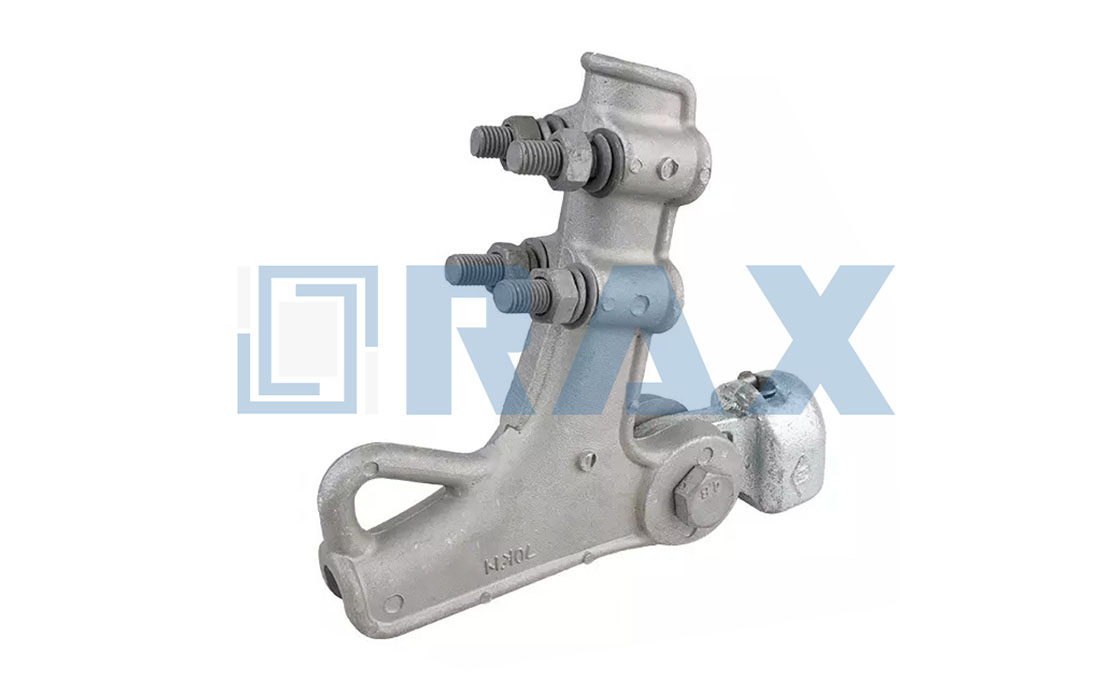
The distinction matters when you specify. A wedge clamp cut for a 12 mm ADSS jacket cannot hold a bare ACSR dead-end. A bolted clamp built for 26 mm conductor is clumsy overkill on a fiber drop. The rest of this page maps which family belongs where, and what each one needs to hold.
How the Grip Holds Without Crushing
The wedge family is a study in simplicity. A conical housing, usually glass-fiber reinforced, accepts the cable from the front, and two polymer wedges with serrated faces sit behind it. Pull the cable under tension and the wedges travel deeper into the cone, as if the load were tightening its own vise.
Grip force therefore scales with line tension. At slack the wedges sit loose enough to position by hand; at full load they lock. Clamping pressure spreads around the jacket instead of concentrating at one bolt point, which is exactly what delicate all-dielectric cable needs from its hardware.
Bolted clamps take the other road. An aluminum alloy body carries a bridge or keeper that two or more bolts press down onto the conductor. Grip is set by bolt torque and contact area rather than wedge angle, and the load path runs through metal rated against the conductor’s breaking force.
Both approaches share one rule. The cable’s outer surface takes the clamping pressure, so grip geometry, not raw force, decides whether a termination survives wind, ice, and a decade of thermal cycling.
Anchor Tension Clamp Applications Across Overhead Networks
Ask where anchor tension clamp applications concentrate and the answer is wherever a cable must end, turn, or be gripped on purpose. Five scenarios cover most procurement baskets.
| Scenario | Cable | Clamp family | Field note |
|---|---|---|---|
| ADSS backbone routes | All-dielectric round ADSS | Polymer wedge anchor | Short spans, loops stored at the pole |
| FTTH drop runs | Figure-8 self-supporting drop | Wedge clamp with messenger slot | Tap-offs from aerial distribution |
| ABC service drops | Two or four core insulated bundle | Service anchor clamp | Anchors at pole or wall bracket |
| Distribution dead-ends | Bare ACSR or AAAC | Bolted NLL series | Full running tension at line ends |
| Angle and substation entrances | Bare conductor | Bolted NLL series | Angle poles up to 90 degrees |
The pattern to notice: fiber and service scenarios are diameter-matched and tension-light, while bare-conductor dead-ends are load-matched and tension-heavy. The same product name covers both, which is why selection discipline matters more than catalog branding.
ADSS and Figure-8 Fiber Routes
All-dielectric self-supporting cable carries no metallic strength member, so its hardware cannot bite with metal teeth and cannot introduce a conductive path. Polymer wedge anchor clamps were designed around that constraint. They pair glass-fiber reinforced housings and polymer wedges with a soft bail that ties to the pole bracket, as catalogued across the fiber optic cable hardware line.
Manufacturers band these clamps by jacket diameter. Supplier datasheets for ADSS anchor clamps quote routes up to 100 meters, with slack loops stored at the pole for splicing and future taps. Anchor tension clamp applications on fiber routes therefore cluster at pole positions: line ends, mid-route tension points, and loop storage at joint locations.
Figure-8 drop cable adds a messenger to the same logic. The clamp grips jacket and messenger together, so the drop hangs from its own strength member rather than from the fibers. The wedge geometry also keeps the small jacket from ovalizing.
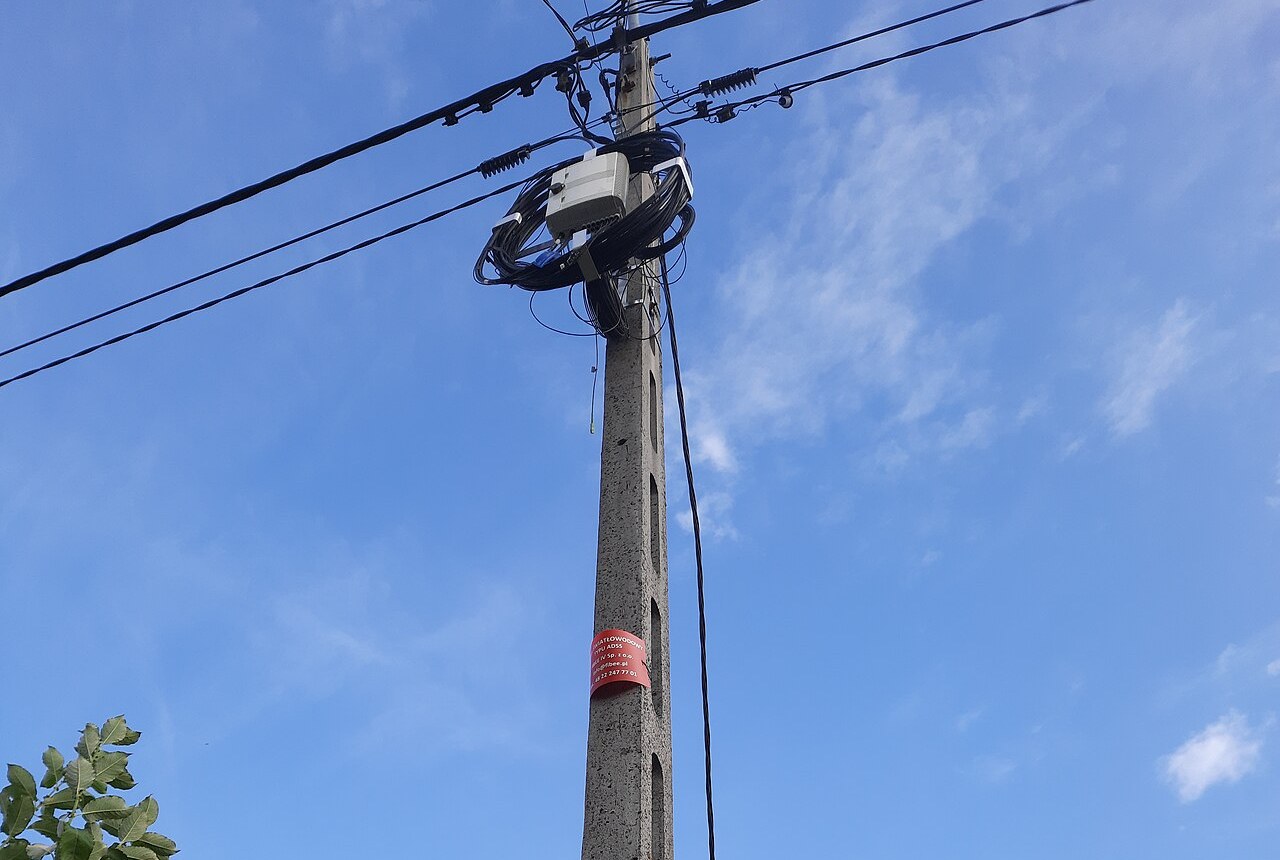
When the route leaves the backbone and turns toward a subscriber, the same clamps follow it. Aerial fiber, in practice, is a chain of anchor points joined by slack.
ABC Distribution and Service Drop Dead-Ends
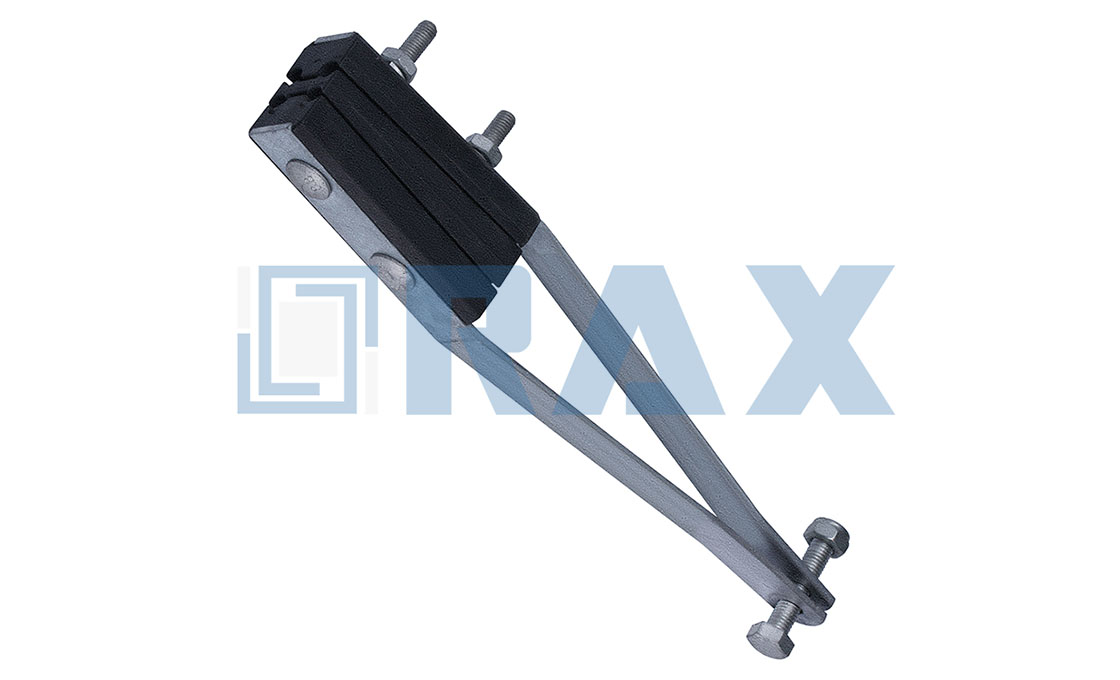
Aerial bundled cable, and the service drop that leaves it, create the dead-end points most people actually see from the street. A two or four core insulated bundle crosses from the pole to the customer’s wall bracket. Both ends are anchor tension clamp applications: the cable terminates, the tension stops, and everything downstream hangs slack into the meter position.
Wedge-type service clamps dominate this scene because crews install them by hand, on the pole and at the wall, with no press and no pumping equipment. The self-tightening principle is identical at this scale; only the jacket bands shrink to match small bundle diameters.
On the mains side, bundled feeders end at poles the same way bare conductors do, and bolted clamps take over as bundle diameter and line tension climb. The two families hand off to each other along one route without the crew changing philosophy.
Matching Clamp Family to Conductor and Load
Bolted clamp selection starts from two numbers on the conductor datasheet: overall diameter and rated breaking strength. The clamp’s grip band must contain the diameter, and its rated tension load must meet or exceed the design tension, on the tension clamp family page as in the field. NLL series clamps quote grip of at least 95 percent of the conductor’s breaking force, with loads that climb through the range.
Three bands from that series show the spread.
| Type | Conductor range (mm) | Tension load (kN) |
|---|---|---|
| NLL-1 | 5 – 15.5 | 68 |
| NLL-3 | 11.4 – 22.6 | 93 |
| NLL-6L | 25.9 – 32.6 | 100 |
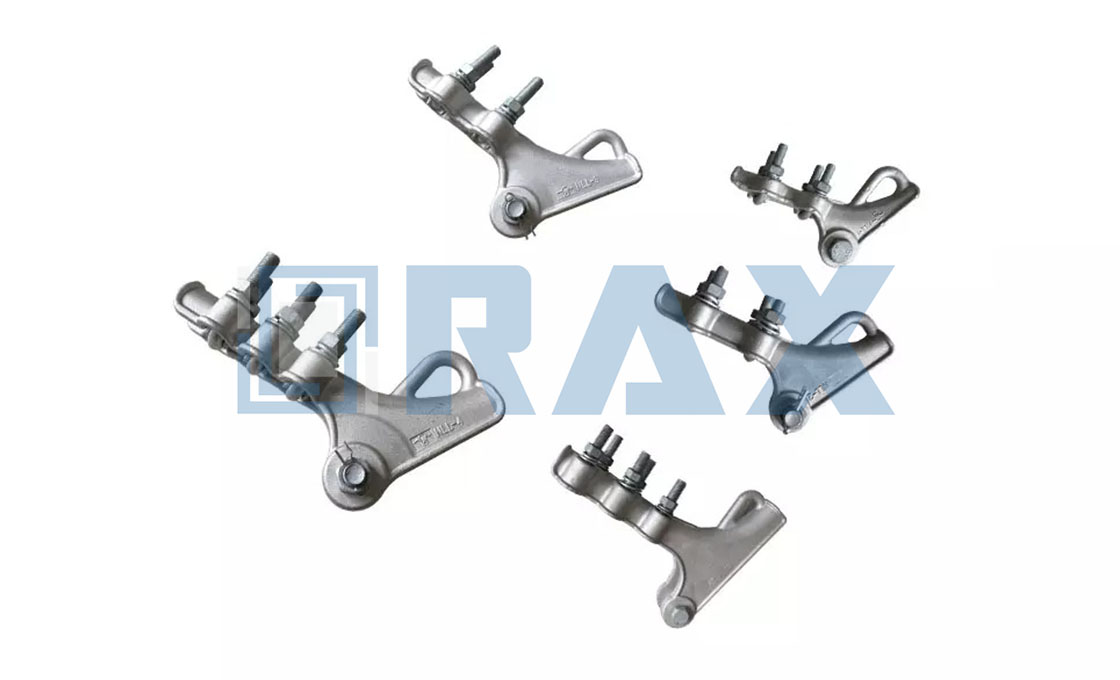
Bodies and keepers are high-strength aluminum alloy; bolts, washers, and hardware that touch steel structures are hot-dip galvanized to keep the corrosion pair honest. Where a termination must also damp vibration, the formed wire family of preformed grips is the companion choice rather than a substitute.
Wedge families follow the same discipline with jacket bands instead. A band marked 10 to 14 mm is honest about its range, and cable outside the band either slips or gets squeezed. Neither failure announces itself at installation.
Installation Points That Protect the Cable
Most field problems trace back to four habits. Clean the cable surface before gripping, because jacket dust and oxidation steal friction. Verify the diameter band, since the clamp is honest only inside it. Seat wedges in the direction of pull, so tension drives them tighter instead of backing them out. And close bolted clamps in the sequence and to the torque the datasheet calls for.
In our experience, skipped re-torque is the quiet failure. Bolts bed into conductor strands during the first months of load and thermal cycling. A clamp that left the truck correct can run loose a year later if nobody returns with a wrench.
Never reuse polymer wedges after removal. The serrations deform on the first installation, and a second one never reaches the same grip.
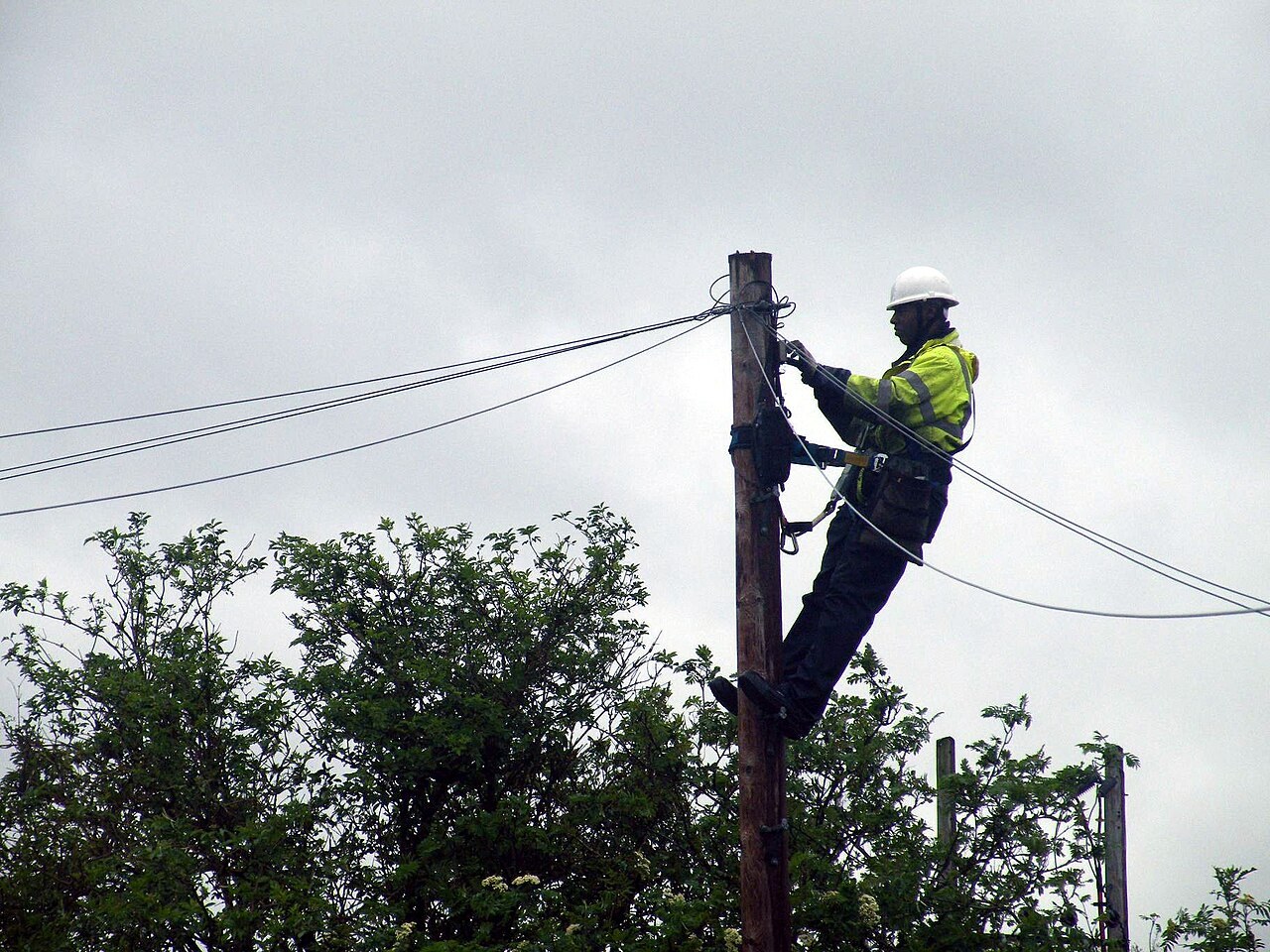
One more habit earns its keep on bundled cable. Support the bundle weight while the clamp takes tension, so the wedge seat forms under controlled load rather than under a falling span.
Inspection Habits That Extend Service Life
Anchor positions reward short, regular attention. From the ground, look for wedge slip lines at the clamp mouth, jacket shine where the cable has been moving, and hardware that has lost its zinc. Bolted clamps deserve a torque wrench at the interval the maintenance cycle defines; wedge clamps need eyes on bail wear and housing cracks.
Until a clamp slips, the hardware is invisible, which is precisely why the inspection route should name every anchor position instead of trusting memory. Hot-dip galvanizing does the long-term work on steel parts, aluminum bodies tolerate most atmospheres, and coastal or industrial air simply shortens every interval on the schedule.
Procurement Notes for Utility and Telecom Buyers
Specification documents settle most anchor tension clamp applications before they happen. Call out the cable diameter and rated breaking strength, the clamp family and band, the standard for fitting tests, and the galvanizing standard for steel parts. Testing against IEC 61284, the international requirements-and-tests standard for overhead line fittings, gives both sides one yardstick; galvanized components typically reference ASTM A153 or ISO 1461.
Ask suppliers for load test reports rather than catalog claims, and for dimensional drawings that match the band you are buying. RaxPower, a pole line hardware manufacturer founded in 2003 in Hebei, China, produces its NLL series by hot forging and supplies buyers in more than 70 countries. Custom-engineered clamps are available against project drawings, with samples and inspection reports on request.
One last habit: standardize band markings across crews. Mixed bands in one truck are how a 22 mm conductor meets a clamp cut for 13 mm. No inspection program catches that faster than one printed band table in every vehicle.
Frequently Asked Questions About Anchor Tension Clamps
What cable sizes does an anchor tension clamp cover?
Bolted NLL families span conductor diameters from 5 to 32.6 mm across their size bands, while wedge families are banded by jacket diameter. Select by measured cable diameter, never by span length alone.
Can one clamp hold both ADSS and ABC cable?
No. Grip geometry differs: wedge clamps cushion delicate dielectric jackets, while bolted clamps press metal conductors. Substituting one for the other invites slip or jacket crushing.
Do wedge type anchor clamps need special tools?
No. The wedges seat by hand, and line tension locks them. Bolted clamps need standard wrenches plus the datasheet torque sequence.
Which standards cover these fittings?
IEC 61284 defines requirements and tests for overhead line fittings. Hot-dip galvanized steel parts reference ASTM A153 or ISO 1461.
How often should installed clamps be inspected?
Follow the utility’s maintenance cycle, with annual ground-level checks as a common baseline. Watch for wedge slip, jacket movement, and lost zinc, and re-torque bolted clamps after the first load season.