
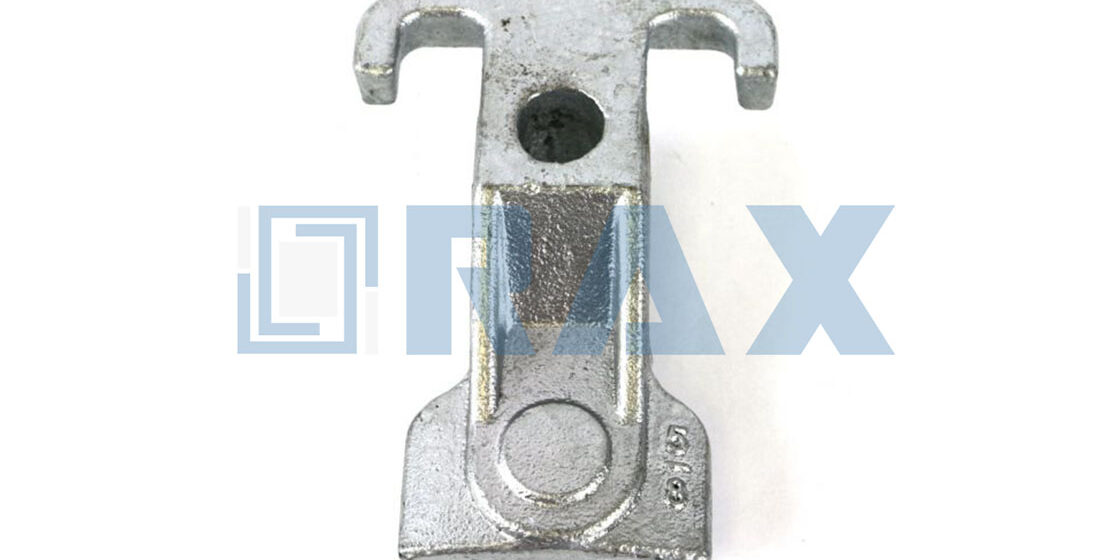
A down guy is a tension member, and every pound of that tension concentrates at one casting on the pole face. The guy hook receives the strand loop, holds it inside a curved groove, and passes the full load into a machine bolt loaded in shear. Remove that single connection and the guy leaves the load path, letting an unbalanced pole lean into its span.
Manufacturer catalogs list the fitting by part number, hole size, and strength rating, but rarely explain how the parts work together. Procurement teams then translate those tables into an order under time pressure, with field rework as the penalty for a wrong call. Load path, type differences, and the selection numbers below are what close that gap.
What a Guy Hook Does Under Load
The fitting has one mechanical job: hold the end of a guy strand against a pole so the strand cannot creep or slip. In wrapped strand applications, the crew wraps the strand into a closed loop around the casting. The loop then hangs in a groove whose rounded profile matches the strand curvature, so tension presses the wire against a smooth seat instead of a sharp edge.
That groove geometry is not cosmetic. A tight bend over a square edge work-hardens the outer wires of the strand and can crack the galvanized coating, which invites corrosion at exactly the point of highest tension. RaxPower's cast guy hook pages specify smooth, rounded wire grooves for this reason, and the same language repeats across Hubbell and MacLean catalog descriptions.
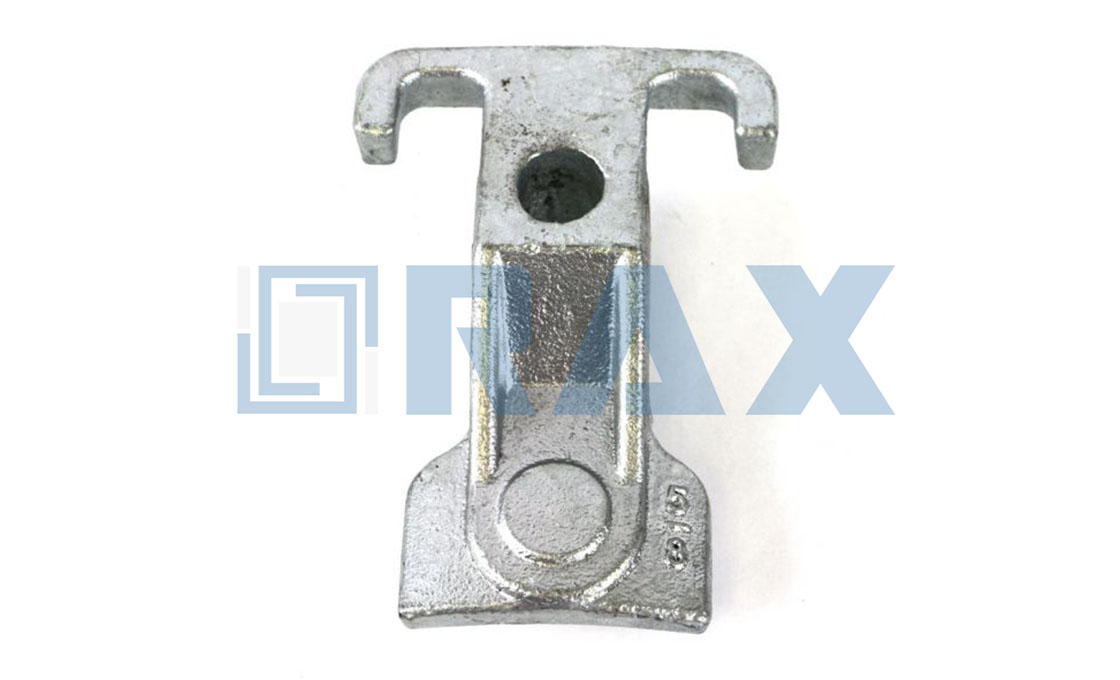
Under load, the connection works in two regimes. With the strand wrapped, the hook acts as a grooved anchor that resists downward creep along the pole face. Where the assembly deadends on the hook instead, it carries the full strand tension. Catalog ratings at a 45 degree pull angle range from 10,000 to 25,000 pounds, depending on casting type and size.
Where the Guy Hook Sits in the Assembly
A down guy runs from a pole top or arm, down through a strain insulator, to an anchor rod set in the soil. The hook is the upper terminus of that run, the point where wire becomes structure. Tracing the load from the strand to the pole shows exactly which component carries which stress.
- Guy strand tension enters the fitting as a wrapped loop seated in the rounded groove.
- The groove carries the loop without kinking the strand or pinching its zinc coating.
- The hook body bears against the shank of a machine bolt passing through the pole.
- A square washer and nut on the far side clamp the casting and spread the bearing load.
- The pole face takes the resulting compression and bending, which the guy balances against conductor pull.
Below the hook, the load continues through turnbuckles or strandvises, through the guy strand itself, and into the anchoring hardware in the ground. The handoff to that buried hardware is covered in the site's triple eye anchor rod installation guide. The full guy attachment family sits along this same run, each fitting handling one interface of the path.
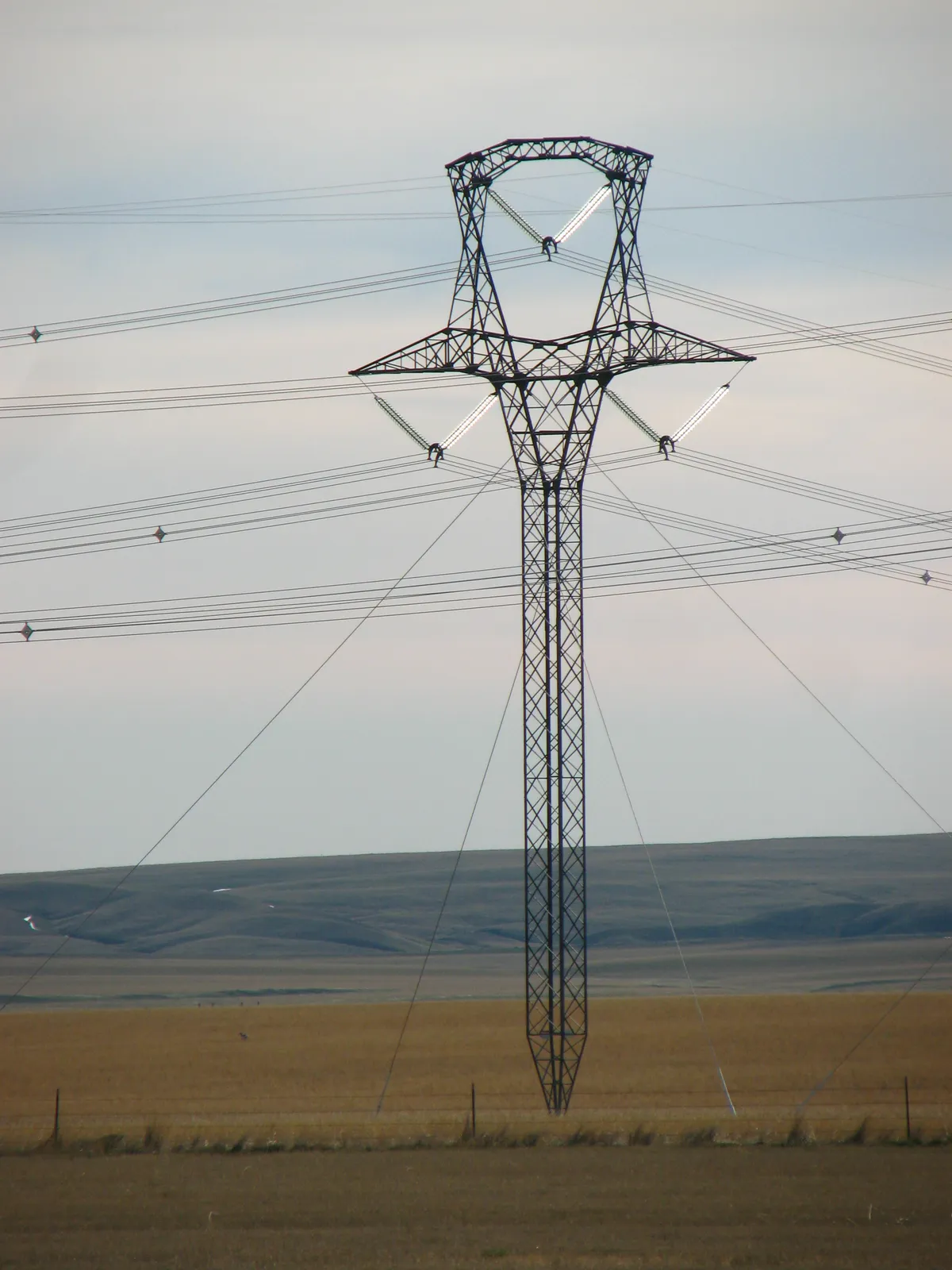
How the Three Casting Types Differ
Three casting families cover nearly every distribution guying callout. Naming varies by supplier, since MacLean, Hubbell CHANCE, and Allied Bolt each use their own catalog numbers for the same functional classes. The table below maps the functional types to how they attach and where crews deploy them.
| Hook type | Attachment style | Typical use |
|---|---|---|
| J pattern hook | Single 11/16 inch hole; thru-bolt or lag screw | Wrapped strand control; stop creep on wood poles and stay rod sets |
| Combination hook and eye | Multiple 11/16 and 13/16 inch holes; spurs or spurless back | Deadending guy wire or fiberglass guy strain insulators on wood, steel, or concrete |
| Storm style strap hook | 1/4 inch steel strap; single 5/8 inch thru-bolt | One-bolt storm attachments where clearance or pole condition limits castings |
The J-pattern casting is the simplest: one hole, one bend, one job. RaxPower's J pattern unit is rated 10,000 pounds at a 45 degree pull and mounts through that single hole or on a 1/2 inch lag screw. MacLean's J1019 class and the distributor equivalents follow the same pattern and are often installed in tandem on opposite pole faces.
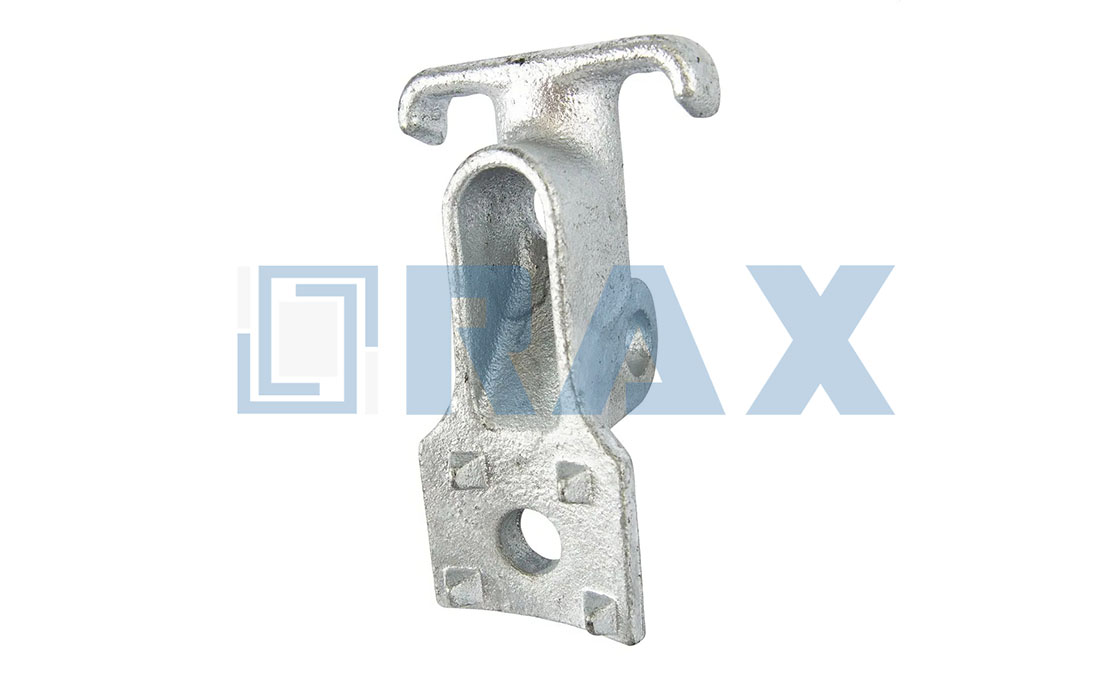
The combination unit merges a strand groove with a clevis eye, so one casting deadends the guy and accepts a strain insulator tongue. RaxPower's combination casting measures 5-3/4 inches long and 3-1/4 inches wide, weighs about 2 pounds, and carries ratings from 13,550 to 21,000 pounds. The storm style strap hook trades the casting for a formed 1/4 inch strap that mounts on a single 5/8 inch thru-bolt.
The Bolt Numbers That Drive Selection
Bolt hole diameter is the first spec to check, because it decides which of your stock bolts can carry the casting. Two sizes dominate: 11/16 inch and 13/16 inch. A hole cast at 13/16 inch accepts a 3/4 inch bolt with room to pivot during installation, while an 11/16 inch hole suits a 5/8 inch bolt. Combination units accept 5/8, 3/4, and 13/16 inch bolts across their hole set.
Strength ratings then sort the castings into a clear ladder. Single-hole J patterns sit near 10,000 pounds at 45 degrees. Standard angled castings step up through 13,550 to 20,050 pounds, combination units reach 21,000 pounds, and heavy-duty styles top out at 25,000 pounds. Choose the rung by the guy's calculated tension, not by habit, and keep the working tension well under the ultimate rating. Let the deadend or strand grip rating set the ceiling for the assembly.
One more hole detail deserves a check before ordering. Combination castings vary their hole sets, with some units pairing an 11/16 inch hole with a 13/16 inch hole and others drilling a single size across the casting. Match the hole callout to the bolt stock your crews already carry, instead of assuming the two sizes always travel together on every catalog number.
Matching the Hook to the Strand
Groove size is the second selection check. RaxPower's castings fit strand diameters from 5/8 to 3/4 inch, and the J pattern's rounded oval accepts stay rod diameters from 1/2 to 1 inch. A groove matched to the strand class holds the loop snugly, so the wire cannot saw back and forth under wind loading.
Mismatch cuts both ways. A groove cast for heavier strand leaves a small loop free to shift and abrade its coating. A groove cast for lighter strand pinches an oversized loop, which bruises the outer wires during wrap-up and can set the failure point before the line is ever energized. Confirm the strand class on the print, then order the casting size to match it.
Iron Choices and Coating Standards
Castings come in three material routes: ductile iron, malleable iron, and formed or forged steel. Ductile iron per ASTM A536 gives high strength with some ductility, which is why RaxPower's highest-rated cast hooks use it. Malleable iron offers dependable strength for mid-range ratings and easier casting of complex shapes. Formed steel strap stock covers the light storm styles.
Coating matters as much as base metal, because the fitting sits outdoors for decades. RaxPower hot-dip galvanizes to ASTM A153 or BS EN ISO 1461, and its plant process is certified to ISO 9001 with hot forging for strength and precise sizing. The zinc layer sacrifices itself at scratches and edge zones, protecting the casting where the strand loop bears.
In production, all three material routes end at the same question: does the casting match its drawing. RaxPower produces by casting, forging, or fabrication, and its combination casting page notes that sand casting supports OEM orders built to customer drawings. For distributors supplying utilities with legacy pole faces, that drawing-level control decides whether replacement hardware bolts on cleanly or needs field rework.
Installation Interface at the Pole
Every manufacturer consulted for this article carries the same installation warning, so it is the one rule to brief every crew on. Seat the casting under the head of the machine bolt, never on the threaded end. Threads loaded in tension and bending can fracture below the bolt's minimum rated strength, and the failure offers no visible warning beforehand.
The full interface on a wood pole runs: bolt through a drilled hole, square washer on the back face, then nut and washer drawn up against the casting. Square washers of roughly 2-1/4 by 2-1/4 inches with an 11/16 inch hole are standard stock. Some utility drawings indent the washer slightly into the pole face so it cannot rotate. Combination units add spurs or backside cleats that bite into wood poles, while spurless backs suit steel and concrete surfaces.
Two handling details protect the assembly for its service life. Torque the nut enough to clamp the casting without crushing the strand loop behind it, and confirm the loop seats fully in the groove before final tensioning. A hook hung loose on an over-torqued bolt can shift after the crew leaves the site.
Pairing Hooks with Guy Strain Insulators
Guys on distribution structures usually need insulation in the run, either to limit corrosion currents or to meet clearance rules. Two pairing routes exist. An in-line insulator, such as the ball pattern visible on many older systems, breaks the strand midway down the guy. Alternatively, the termination itself can be insulating: a fiberglass guy strain insulator deadends into the hook's clevis eye.
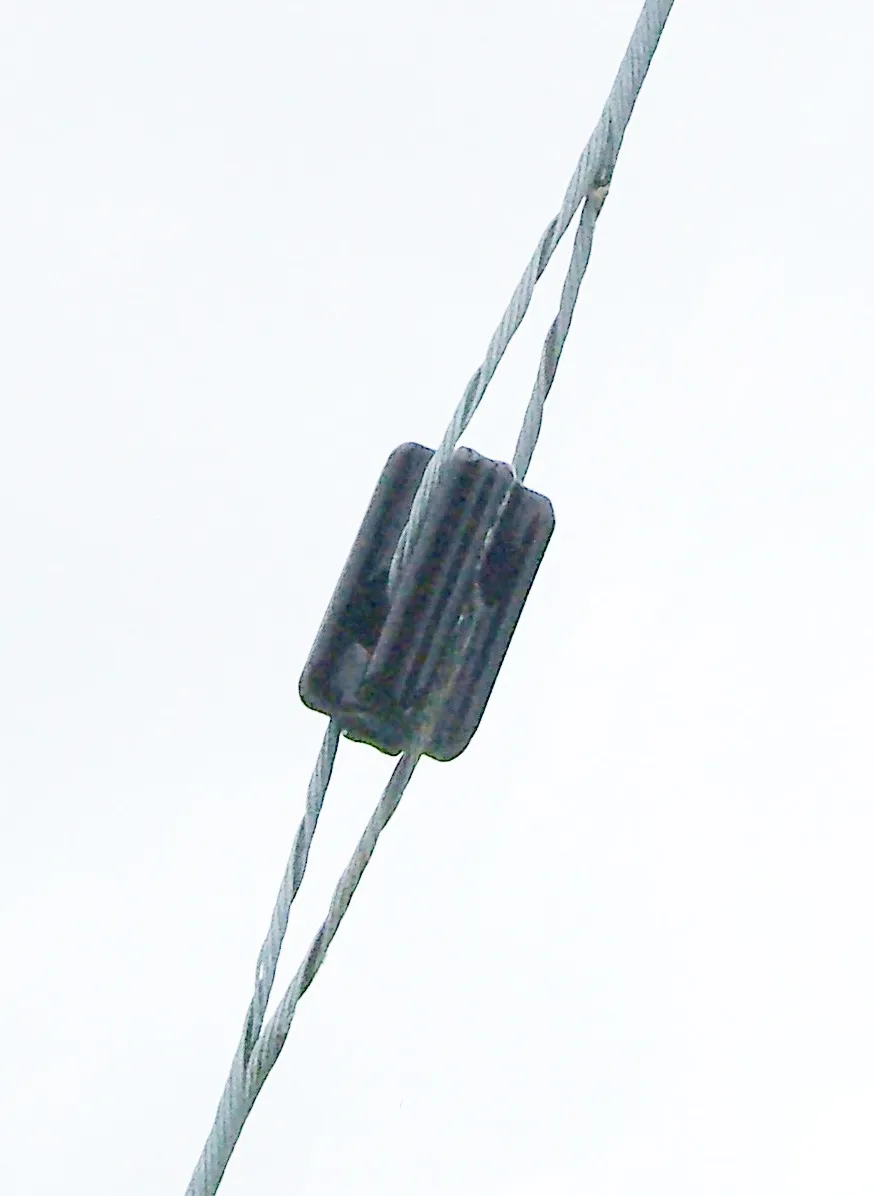
The clevis route is where combination castings earn their premium. RaxPower's combination unit has an 11/16 inch clevis opening sized for fiberglass guy strain insulator tongues, and its catalog explicitly covers deadending guy wire or fiberglass strain insulators. Follow the deadend manufacturer's attachment requirements for orientation, since the insulator must stay in compression under the guy's working tension.
Compared with a Pole Eye Plate
Pole eye plates solve the same attachment problem from the opposite direction. A flat plate bolts to the pole and offers a forged eye for a thimble or shackle, rather than a groove for a wrapped loop. On new construction with formed fittings, an eye plate plus deadend grip gives a clean, inspectable termination. Where crews wrap strand in the field, the grooved casting wraps faster and needs no extra hardware.
Structure material often settles the choice. Eye plates and spurless combination castings both suit steel and concrete poles, while spur-backed castings grip wood best. Sidewalk and span guy fixtures extend the same plate logic to guy-down hardware at ground level. When a drawing shows both options, price the hardware set as a whole, since the plate route usually adds a thimble and shackle that the groove route does not need.
Selection Summary in Four Lines
Match the bolt hole, 11/16 or 13/16 inch, to the machine bolts your crews already stock.
Set the groove to the strand class, 5/8 through 3/4 inch, so the loop cannot creep or abrade.
Pick the rung on the strength ladder, 10,000 to 25,000 pounds at 45 degrees, from the calculated guy tension.
Then mount it under the bolt head, on a square washer, with the insulator pairing the line design calls for.
Frequently Asked Questions
What bolt size does a guy hook use?
Typical cast units mount on a 5/8 inch or 3/4 inch machine bolt with a square washer. RaxPower combination castings accept 5/8, 3/4, and 13/16 inch bolts, while J-hook styles also take a 1/2 inch lag screw.
Why must the casting sit under the bolt head?
The seat under the bolt head puts the connection in shear, where the bolt is strongest. Threads exposed to guy tension see bending and tensile stress that can break the bolt below its rated strength.
How does the J pattern differ from a combination unit?
The J pattern is a single 11/16 inch hole casting for wrapped strand control. A combination unit adds a clevis eye that terminates guy wire or fiberglass guy strain insulators, with higher strength ratings.
Can the casting hold a fiberglass guy strain insulator?
Yes, combination castings are built for that. Their 11/16 inch clevis opening accepts fiberglass guy strain insulator tongues, within the deadend manufacturer's attachment requirements.
What material and coating do these castings use?
Cast ductile iron or malleable iron, hot-dip galvanized to ASTM A153 or ISO 1461. Cast hooks in this range carry ultimate ratings up to 25,000 pounds; the working tension stays well below that.