
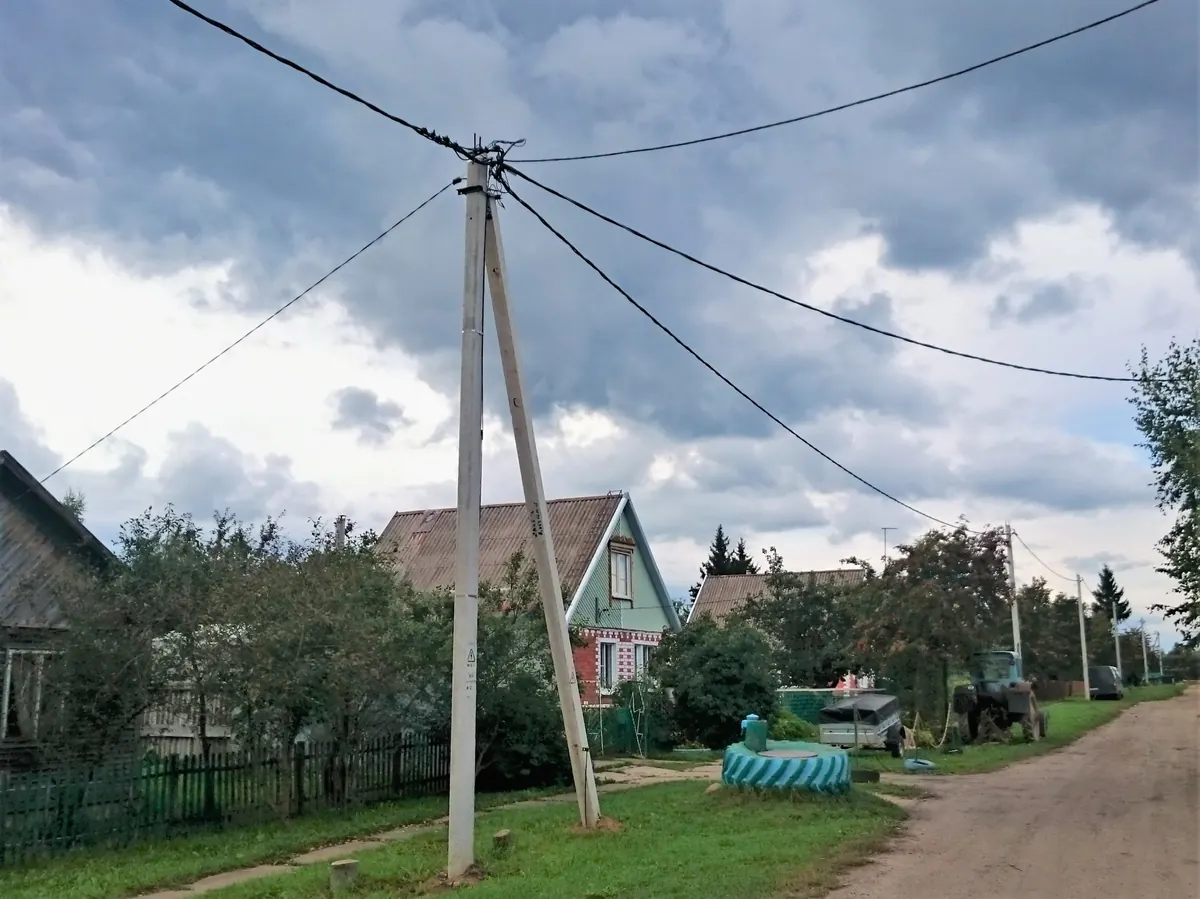
Picture a low-voltage line crossing a crowded street in Marseille, Bogota, or Riyadh: three or four insulated cores twisted in a spiral around a central messenger, swinging between concrete poles. Every attachment point on that line depends on an ABC clamp, and every one of those ABC clamps was sized by an engineer months before the first storm tested it. Choosing those clamps well is what this guide is about.
Since 2003, RaxPower has manufactured pole line hardware at a hot-forging works in Hebei, China, supported today by a 170+ production team serving utilities, line contractors, and distributors. The selection framework below reflects what that engineering desk verifies before recommending ABC clamps for a project: cable, structure, load, material, and standard, in that order.
Start From the Cable, Not the Clamp
ABC stands for aerial bundled cable: a low-voltage overhead system in which insulated aluminum phase cores twist around an aluminum-alloy messenger that carries the complete mechanical load. Most networks run 0.6/1 kV designs in two-core or four-core arrangements, and many add a dedicated insulated street-lighting conductor. The phases are identified by rib counts molded into the insulation.
That messenger changes everything about clamp selection. Because the cable’s weight and tension travel through a single core, anchor hardware grips the messenger rather than the phases. Suspension hardware cradles the whole bundle, and service hardware taps individual insulated cores. In our experience, projects that pull the cable data sheet first end up with a clamp list that practically writes itself.
Two numbers matter most: the bundle’s outside diameter and the messenger’s cross-section. A 4×25 mm2 bundle typically measures 24-27 mm across, while a 4×95 mm2 bundle runs 32-38 mm. Cable designs also vary by region, following NF C 33-209 in France, BS 7870-5 in the UK, or AS/NZS 3560.1 in Australasia. In the Americas, the same product ships as duplex, triplex, or quadruplex service drop. For broader design context on preassembled aerial cables, this TD World overview of overhead cable design principles is worth ten minutes.
Why does this discipline matter at project scale? A ten-kilometer feeder can pass well over a hundred structures, and one wrong cavity size multiplies across every suspension point on the route. Projects that verify diameters early change part numbers on paper. Projects that verify late change them on poles, with a bucket truck and a fault report already in hand.
Match the Clamp Family to the Structure
A line is a chain of structures, and each structure performs one mechanical job. Tangent poles carry weight, angle poles redirect the route, terminal poles absorb full tension, facades carry the line along walls, and service positions tap loads or lamps. Match the clamp family to that job before opening any catalog.
| Clamp family | Typical structure | Load carried | Key sizing input |
|---|---|---|---|
| Anchor (wedge) tension clamp | Terminal, corner, and angle poles | Full line tension through the messenger | Messenger cross-section plus rated daN |
| Suspension clamp | Tangent poles, straight runs | Vertical weight of the supported span | Bundle OD plus span times mass per meter |
| Bracket or hook | Pole tops, walls, facades | Attachment and deviation loads | Pole material, bolt or strap fixing, daN class |
| Service and lighting clamp | Service drops, street-light taps | Service cable tension, tap loads | Core count and service cable OD |
The table reads in the order loads grow. Anchor positions see the highest forces, suspension positions see the most units, and brackets and service clamps decide how neatly the line meets buildings and lamps. Procurement teams usually bundle these families together, and the tension and suspension fitting range groups them in one place for exactly that reason.
Counting positions from the pole schedule turns this table into quantities. A typical route needs anchor clamps at every terminal and angle, suspension clamps at every intermediate support, brackets wherever clamps meet poles or walls, and service clamps at each tap. That count becomes the bill of materials, and it tells the supplier which load classes and cavity sizes to prepare.
Anchor and Tension Clamps: Grip the Messenger
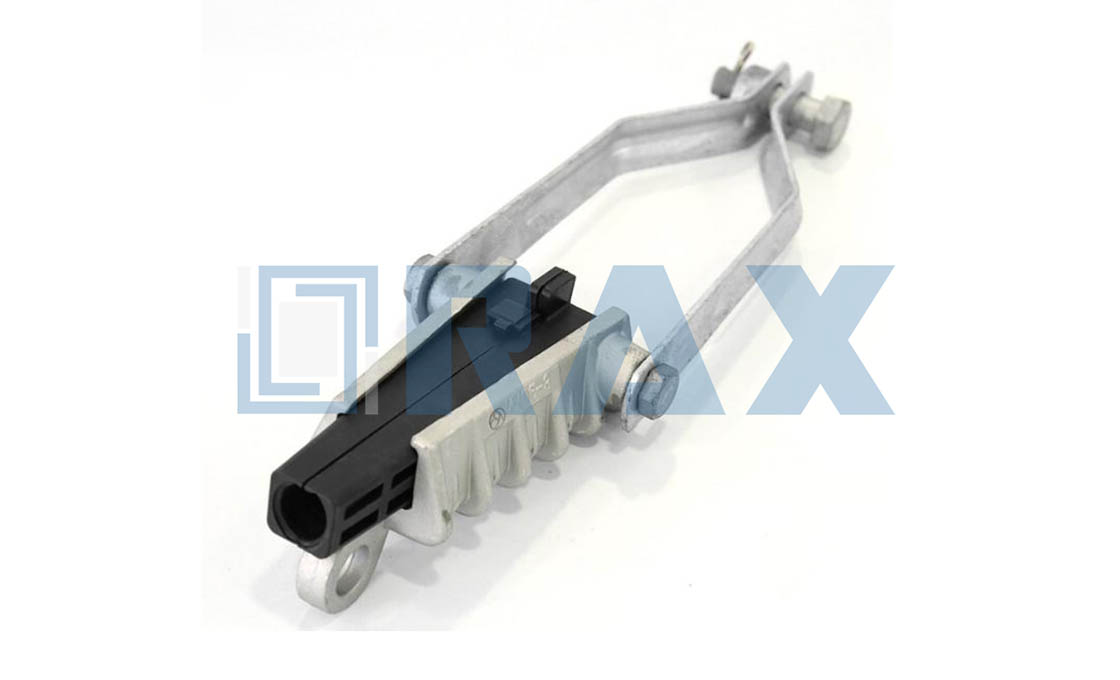
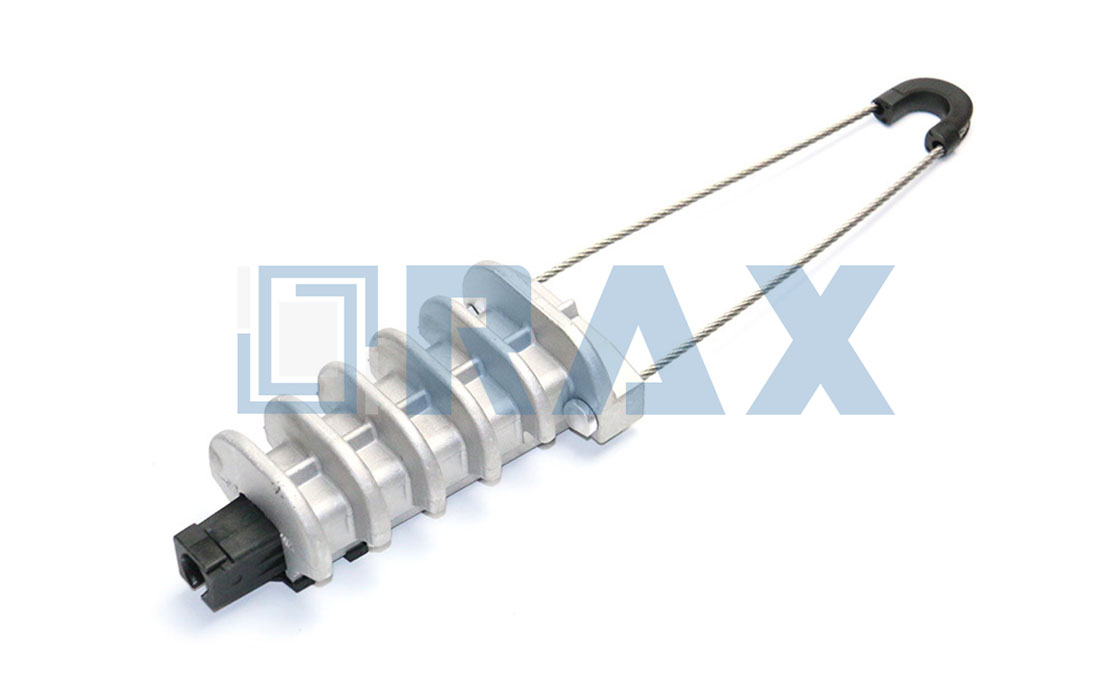
Wedge-type anchor clamps hold the messenger between a shaped body and a wedge that tightens as tension rises: the harder the cable pulls, the deeper the wedge bites. Many designs include springs that hold the clamp open while the conductor seats, which is why a two-person crew can tension and terminate a span in minutes.
Ratings are written in daN, and they scale with the messenger rather than the bundle. One European manufacturer rates its PA1500 clamp at 1500 daN (about 15 kN) for 50-54.6-70 mm2 messengers. The PA2000 carries 2000 daN in the same range, and the PA2200 reaches 2200 daN for 95-120 mm2 cores. Select the messenger class first, then confirm the rated load clears your calculated tension with margin for wind and ice.
Fit the wedge cavity the way you fit a work boot: a loose fit slips under load, and a forced fit damages the insulation. If your project needs to compare specific deadend designs model by model, the companion piece on ABC deadend clamp comparison covers that ground. Current wedge-type products are listed on the anchoring clamp page.
Suspension Clamps for Straight Runs and Angles
Suspension clamps carry weight, not tension. The load on each support comes from the span itself. Multiply the supported span length by the cable’s mass per meter from the data sheet, then add allowances for wind, ice, and safety factors. Longer spans and heavier bundles therefore push you up the suspension range even when the conductor size stays the same.
The cavity must match the measured bundle OD, not the nominal cross-section. Because the phases stay insulated all the way to the support, ABC clamps grip the outside of the bundle instead of the conductor metal. Two 4×95 mm2 cables from different factories can differ by several millimeters, and a cavity sized for one can float loosely on the other. A hanging bundle that moves inside its clamp will fret the insulation at the contact points within a few seasons.
Angles decide the variant. Line deviations beyond roughly 30 degrees call for bracketed or angle-capable designs, and some models are rated up to 90 degrees. Insert quality matters too: buying guides rank EPDM ahead of silicone and PVC because the insert absorbs vibration and stops abrasion where the bundle rests.
Brackets, Hooks, and Facade Mounting Options
Clamps bolt to something, and that something is usually a bracket. Pole-mounted support brackets in classes such as CA1500 and CA2000 carry 1500 and 2000 daN respectively and fix to timber, concrete, or steel poles with bolts or steel strapping. The bracket class must match the anchor clamp it carries, otherwise the weakest link moves from the clamp to its mounting.
The fixing method is a field decision as much as an engineering one. Bolts suit new poles where holes can be drilled before the crew arrives, while strapping wins on energized reconstructions because it needs no drilling. Facade runs use wall brackets to route the bundle along buildings at a tidy standoff. Check the substrate before specifying: brick and concrete accept expansion anchors, while lightweight panels may need spreader plates behind the fixing.
Facade mounting earns its keep in dense cities. Urban networks in Europe and the Middle East lean on wall brackets because poles are scarce on narrow streets. A well-routed facade run can replace three structures with thirty fixings.
Street-Lighting and Service Connection Clamps
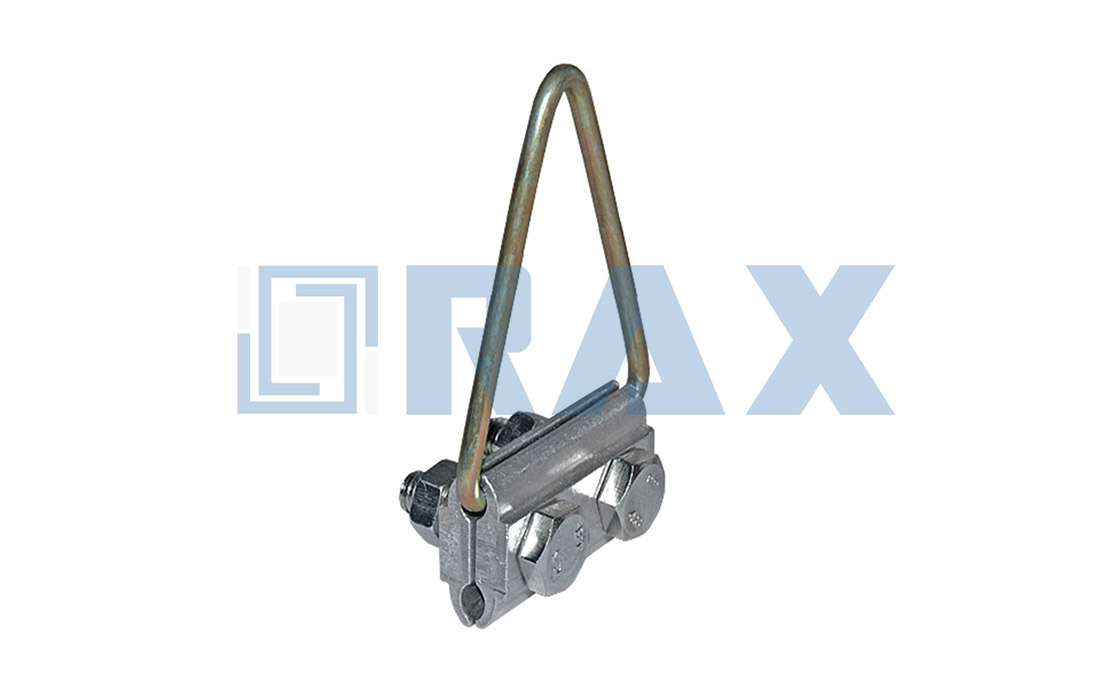
Street lighting is where ABC part lists quietly multiply. Many bundles carry a dedicated insulated lighting conductor, and every lamp needs a tap that grips insulated cores without stripping them. Bolted service clamps exist for exactly this duty: designs such as the PA-215 anchor or suspend two-conductor service lines, while heavier bolted clamps secure larger service drops.
Size these clamps by core count and service cable diameter, and prefer insulated bodies where taps sit close to energized hardware. A clean lighting schedule, with one clamp type per tap class, keeps night crews moving instead of hunting hardware at the pole.
Materials Built for UV, Rain, and Load Cycles
ABC clamps live in a three-material system, and each material does one job. Bodies in the major European ranges are weather-resistant aluminum alloy, chosen for weight and corrosion behavior. Wedges, bolts, and moving links are fiberglass-reinforced or UV-stabilized plastics, and suspension designs add hot-dip galvanized steel for load-bearing pins and hooks. Aluminum carries load without staining the conductor, plastics insulate and damp vibration, and galvanized steel takes bolt forces.
Networks are engineered around 40-50 year component life cycles, so material substitutions are false economies. A cheaper polymer that embrittles after a few summers of UV exposure turns a maintenance-free fitting into a repeat fault call. When a supplier quotes an unfamiliar material, ask for the weathering data behind it.
Standards and Test Reports Worth Requesting
Two references dominate ABC clamp procurement across Europe and much of its export belt. The EN 50483 series covers fittings for tensioning, supporting, and connecting aerial bundled cables rated 0.6/1 (1.2) kV. Separate parts cover general requirements, tension and suspension clamps, connectors, and electrical ageing. NF C 33-041, the French standard for anchoring devices on bundle-assembled-core lines, is frequently cited alongside it.
Together these standards define the test program a qualified clamp survives: tensile and slip tests, endurance or fatigue cycling, and dielectric tests performed with the fitting immersed in water. When comparing suppliers, ask for type-test reports against the exact standard your utility cites, and match the report’s cable size to your own.
What Mis-Selection Costs on Site
By the time a mis-sized wedge announces itself, the installation crew is long gone. The documented failure modes stay consistent across manufacturers. A cavity too large lets the cable slip under tension, while a cavity too small gouges the jacket. A side-loaded clamp wears unevenly until the bundle sags or drops, and until the slip is caught, the pole keeps transferring load into hardware that was never rated for it.
None of these failures look dramatic on commissioning day. Mis-selected ABC clamps fail quietly, surfacing years later as sag drift, chafed insulation, and repeat fault calls. That slow burn is why the checklist below is the cheapest insurance in the whole project file.
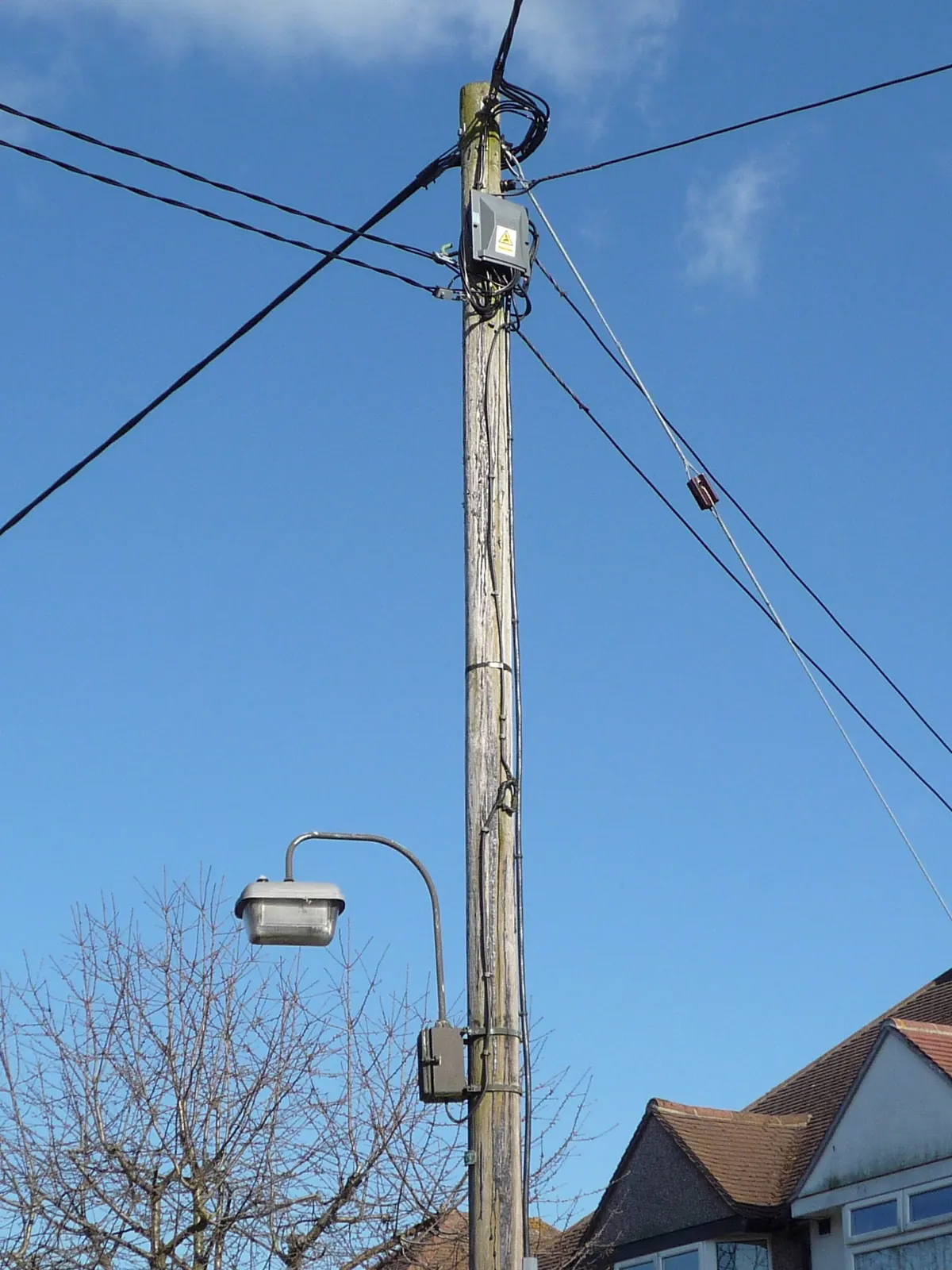
Worked Selection Checklist for a Real Project
Run this sequence once per project and repeat it whenever the cable design or pole schedule changes. Each step feeds the next, and the output is a purchase-ready bill of materials rather than a folder of catalog pages.
- Record the cable design: core count, phase and messenger cross-sections, and the measured bundle outside diameter.
- Map every structure on the route: tangent poles, angles with their deviation degrees, terminals, facade brackets, and service or lighting taps.
- Compute the loads: supported span times cable mass per meter for suspension points, and the tension class for each anchor position.
- Assign a clamp family to each structure using the decision table above.
- Size cavities to the measured messenger or bundle diameter, never to a nominal cross-section alone.
- Confirm materials for the environment: aluminum alloy bodies, reinforced plastic wedges, and galvanized steel fixings.
- Request EN 50483 or NF C 33-041 type-test reports for the exact part numbers quoted.
- Log part number, structure ID, and fixing method for every position so future crews can audit the line.
Final Word: Choose Once, Inspect Rarely
Choosing ABC clamps is not about memorizing catalogs; it is about reading the line first. Cable, structure, load, material, standard — in that order — and the clamp list resolves itself. RaxPower manufactures these components with ISO 9001-certified quality systems and hot-forged discipline, because a clamp that holds quietly for decades is the cheapest hardware on the pole.
Frequently Asked Questions
How do I size ABC clamps for my cable?
Measure the bundle’s outside diameter and the messenger’s cross-section, then match them to the clamp’s cavity range and rated load in daN. Anchor clamps follow the messenger; suspension clamps follow the bundle diameter.
Can one clamp type serve an entire ABC line?
No. Terminal and angle positions need wedge-type anchor clamps for tension, tangent poles need suspension clamps for weight, and facades need brackets. Most projects order at least three families.
What standards apply to ABC clamps?
The EN 50483 series covers low-voltage ABC fittings rated 0.6/1 (1.2) kV, and NF C 33-041 defines tests for anchoring devices. Ask suppliers for type-test reports against either standard.
What happens if the wedge size is wrong?
A cavity that is too large lets the messenger slip under tension, and one that is too small damages the insulation. Side loading wears the clamp unevenly. All three are documented field failure modes.
Do ABC systems need special street-lighting clamps?
Yes. Lighting taps use bolted service clamps sized by core count and service cable diameter, gripping insulated conductors without stripping them. Many bundles carry a dedicated lighting conductor.