
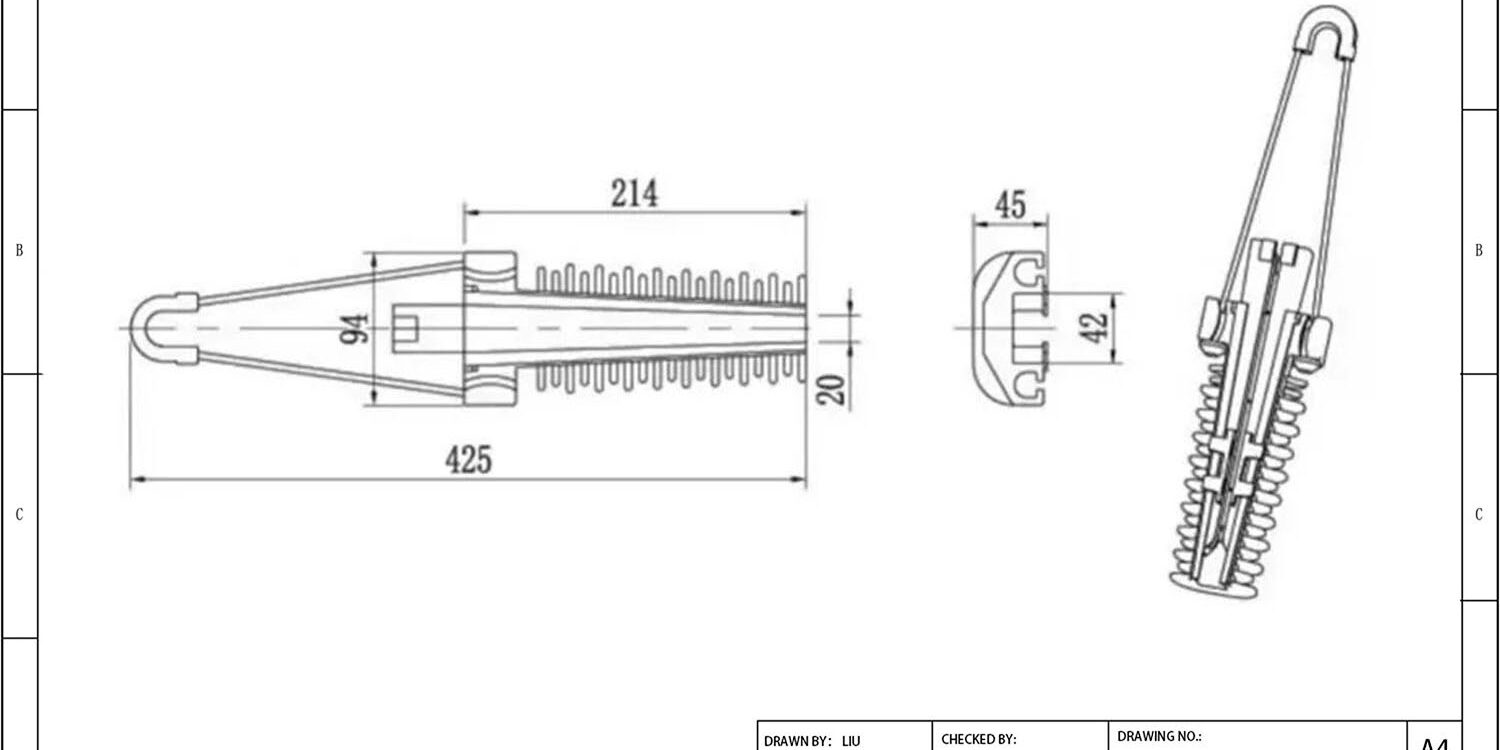
On almost every aerial ADSS route, one small fitting absorbs the entire longitudinal pull of the cable: the anchoring clamp. It is the wedge type tension clamp that grips the jacket at dead-end poles, corner poles, and building entrances, then hands the load to a bracket or cross-arm. Choose it wrong and the cable creeps, slips, or takes a permanent dent where the wedge sits.
Since 2003, the factory behind RaxPower has forged and machined overhead line hardware, and these clamps are among the smallest parts it ships with the largest failure cost. This page defines the clamp, explains the wedge mechanism, and lays out the numbers: size bands, load ratings, angles, and the standards behind them.
What an Anchoring Clamp Does on an ADSS Route
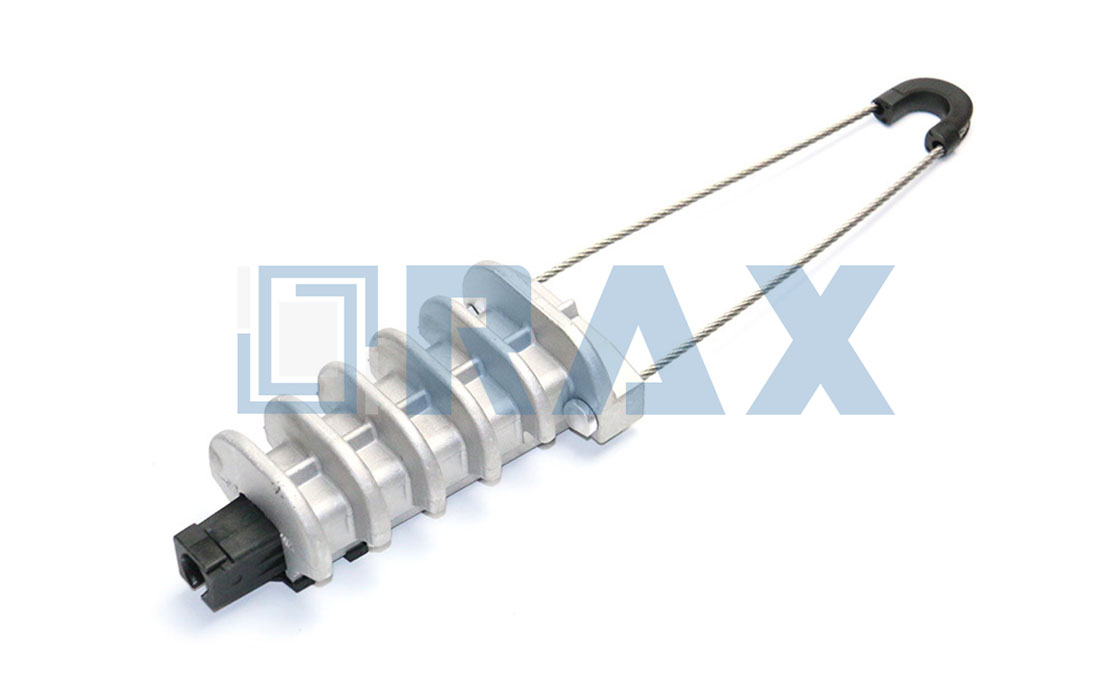
An anchoring clamp is the fitting that terminates an ADSS cable mechanically. It grips the cable’s outer jacket in a tapered wedge housing and hangs from a pole bracket or cross-arm through a steel bail. From that anchor point it carries the full longitudinal tension of the span at every place the route stops or turns. Installers also call it a wedge type tension clamp or a dead-end clamp, and catalogs file it under tension hardware rather than suspension hardware.
Three parts do the work. The wedge pair closes around the jacket and is the only surface that touches the cable. The housing sets the taper angle and takes the pull. The bail wire, looped from hot-dip galvanized steel, connects the assembly to the bracket, the eye bolt, or the cross-arm.
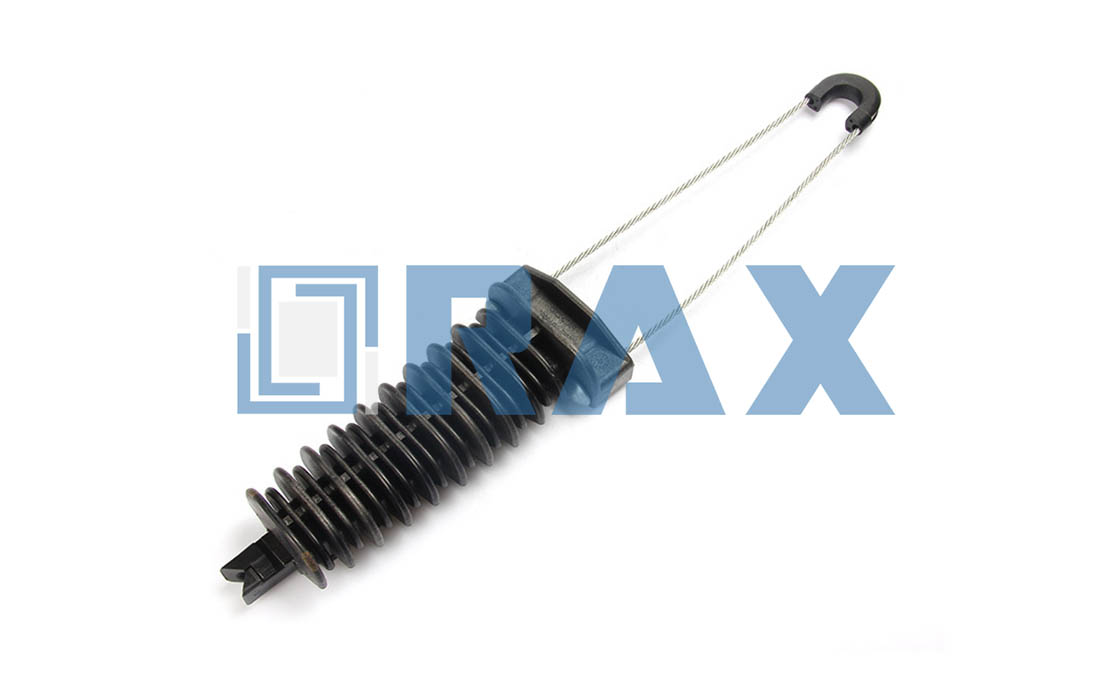
Everything about that layout follows from one property of the cable: ADSS is all-dielectric, so there is no metallic strength member to grab. The real tensile work is done by aramid yarn locked inside the jacket, and the clamp can only hold what the jacket lets it hold. Picture the jacket as the only handle the cable offers; squeeze it unevenly and the fibers inside take the punishment.
That constraint explains the design. A metal messenger cable tolerates aggressive steel grips, but an ADSS jacket needs a grip that holds without cutting. The wedge faces carry fine serrations molded into the UV-resistant engineering plastic. Sized to the measured jacket diameter, they key into the surface and spread load instead of concentrating it.
Longer spans take preformed rod tension sets, where parallel rods wrap the cable and spread the same pull over a greater length. On the distribution and FTTH routes this family serves, a wedge clamp hangs in seconds, by hand, without a torque wrench.
How the Wedge Turns Cable Tension Into Grip
Bolted dead-ends exist for metal cables. On ADSS they invite two problems: a torque-dependent point load on the jacket, and a grip that can loosen as the jacket creeps under sustained tension. The wedge answers both by trading bolt force for geometry.
The holding principle is self-tightening. A wedge sits loose in the tapered housing until the cable is inserted and pulled. From that moment, tension drags the wedge deeper into the taper. The deeper it sits, the harder it clamps. Grip scales with load: a heavier span pulls a tighter seat, with no bolts to torque and no tools beyond your hands.
It behaves the way you expect a doorstop to behave: the harder the door pushes, the harder the wedge resists. The same feedback loop is what makes the clamp forgiving in service. Load swings from wind and temperature simply re-seat the wedge instead of loosening it.
Installation follows the same logic. The cable is laid into the open wedge and slid to its marked position, then the bail is hooked to the bracket, and stringing tension locks the joint. The full sequence, including the tension checks that keep the wedge biting, is covered step by step in the step-by-step installation guide.
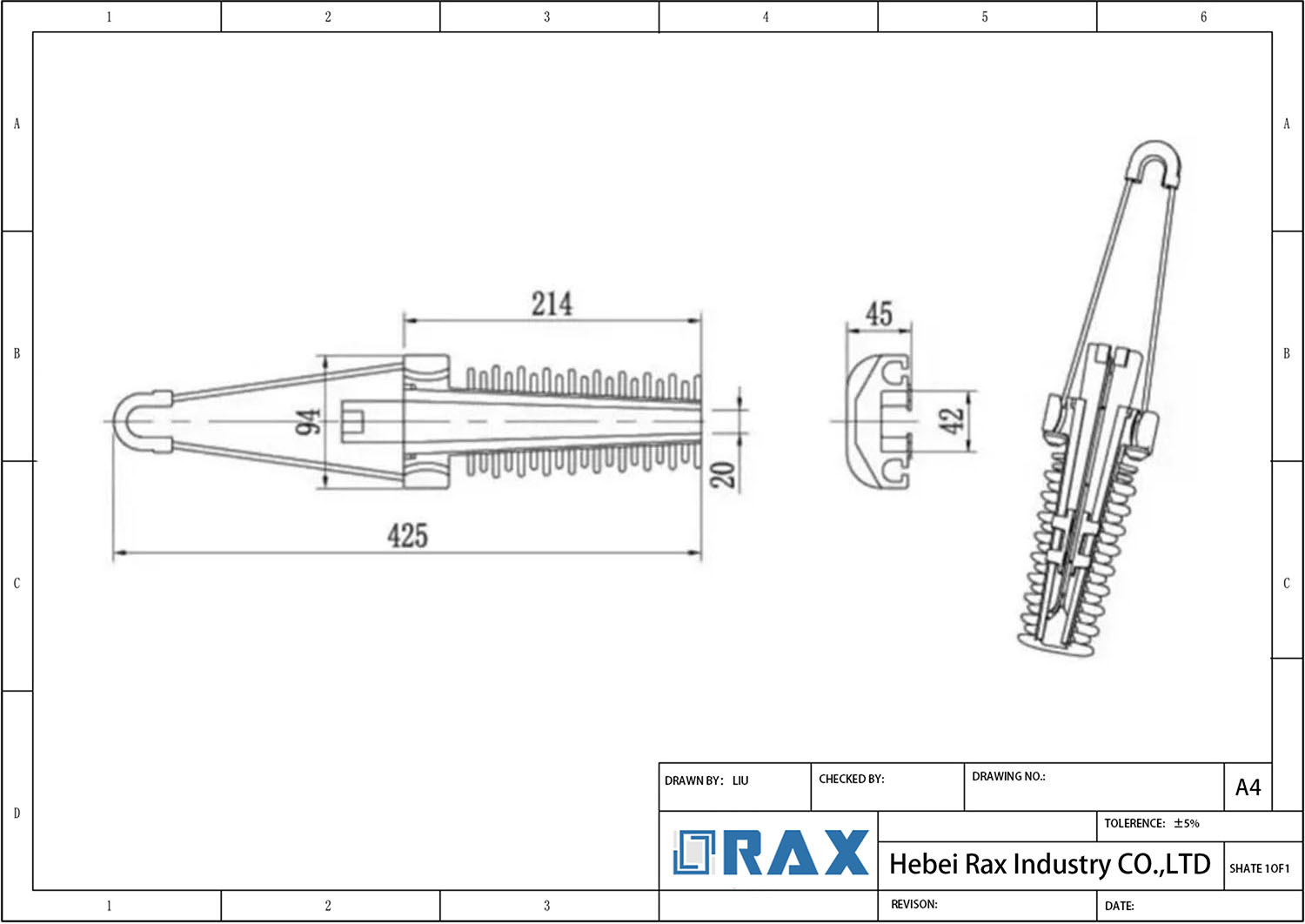
The drawing shows the geometry of one production variant: a 425 mm body with a 214 mm tapered grip section and the bail loop above it. Length is the point. A long taper spreads the holding force along the jacket instead of pinching one cross-section, which is why grip length, not weight, is the figure to compare between designs.
Where Anchoring Clamps Belong vs Suspension Clamps
ADSS hardware splits by structure type, and the split is exact. At tangent poles, where the cable passes straight through, a suspension set carries only the vertical weight of the span and lets the cable continue. At dead-ends and corners, an anchoring clamp takes the full horizontal tension of both spans and hands it to the pole.
When the route turns forty degrees at a corner pole, both spans pull on that structure in different directions. The clamp at the apex holds the cable still while the pole geometry absorbs the resultant. Suspension hardware in that position would let the cable slide and chew its jacket at the housing edge.
Industry practice draws the same line: ADSS is anchored with dead-end tension fittings at strain positions and supported by suspension clamps on tangent runs. The test for a purchaser is simple. If the cable would stop, turn more than a few degrees, or drop into a closure, the attachment is an anchoring point. On the straight runs between those points, the suspension sets for ADSS do the supporting.
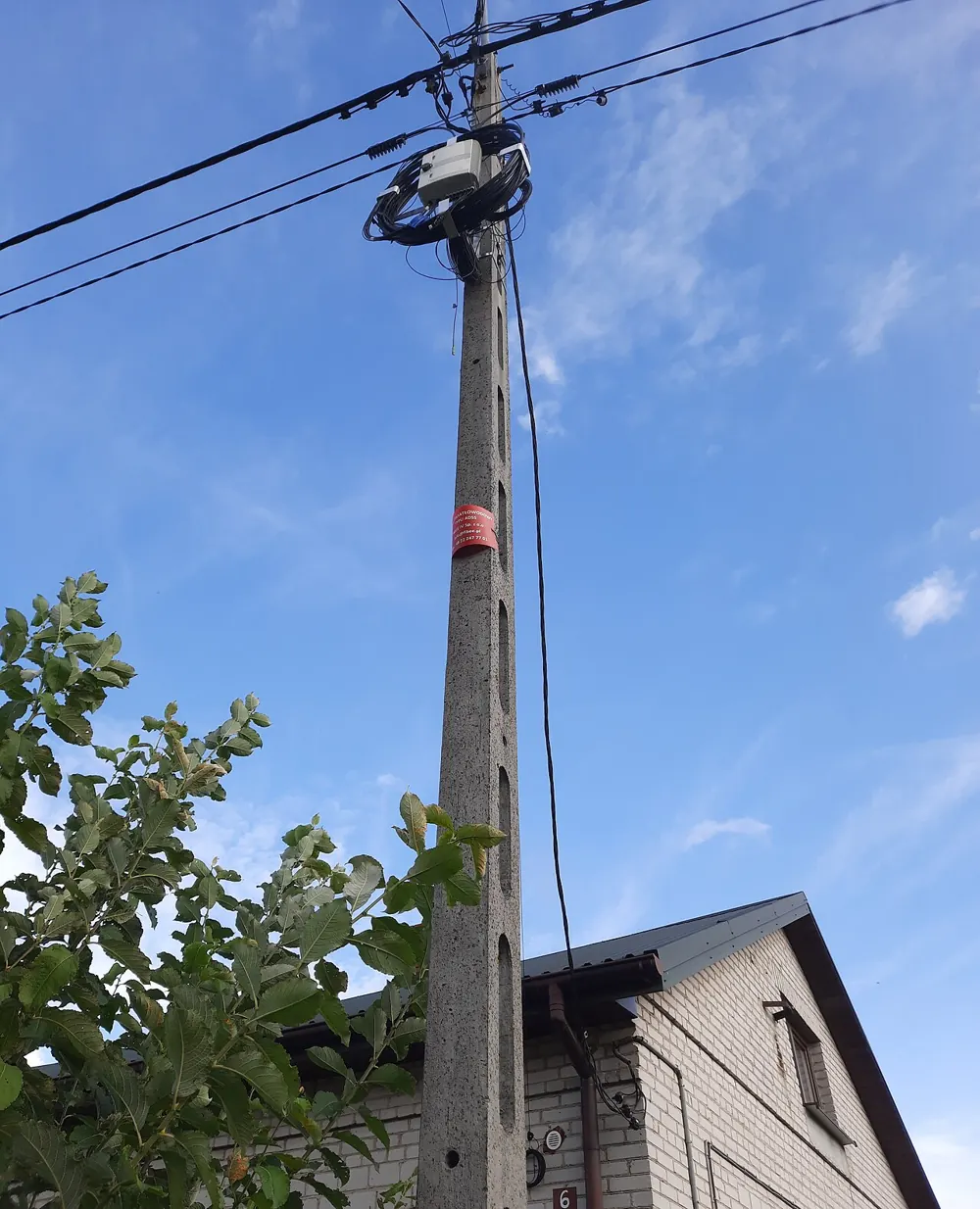
The polymer body adds one quiet benefit on shared structures: the clamp introduces no metallic contact into the cable’s path. On a route sharing poles with medium-voltage conductors, that is one less bonding question to answer. Jacket class still matters for the cable itself, with PE jackets generally limited to lines up to roughly 35 kV and anti-tracking jackets above that.
The pull also needs a place to land. Every bail ends in a bracket, an eye bolt, or a cross-arm interface, and that interface decides how safely the structure carries the load. The companion guide to the pole bracket covers that interface in detail.
The Size Ladder From 6 to 20 mm
Clamp selection starts with one measurement: the cable’s actual outside diameter, taken with calipers at several points along the drum. ADSS jackets vary by maker and by fiber count, so two cables with the same nominal design can differ by a millimeter or more. The jacket, not the datasheet headline, is what the wedge has to grip.
This product family spans 6 mm to 20 mm in six overlapping bands: 6-10, 8-12, 10-14, 12-16, 14-18, and 16-20 mm. A measured 10 mm cable falls into both the 8-12 and 10-14 bands. The band that centers the measurement keeps the full taper working, because a cable at the extreme edge of a band leaves the wedge little travel left to self-tighten. A drum measuring 12.5 mm, for instance, reads one clear answer: the 12-16 band, comfortably inside rather than at the edge.
Competitor catalogs follow the same pattern. The PA-701 class of clamp, for example, is quoted for a single 8-12 mm band. A purchaser who orders by fiber count or cable name instead of measured diameter usually receives a clamp that never matches the drum that arrives. Measure first, then buy the band.
Five Inputs That Fix the Clamp Selection
Beyond diameter, five inputs settle a specification before anyone requests a quote. Diameter sets the band, tension sets the margin, and the remaining three are checks a crew makes from the site and the spec sheet. Each maps to a number, which makes this purchase unusually easy to verify. In our experience, the load margin line repays the most attention, so start there.
| Input to confirm | What it decides | Working figures for this clamp family |
|---|---|---|
| Measured cable OD | Clamp size band | Six bands spanning 6-20 mm |
| Route tension at the anchor pole | Load margin | Breaking load 500-600 daN (5-6 kN) |
| Line angle at the structure | Anchoring vs suspension, bracket choice | Dead-ends and turns up to 90 degrees |
| Service temperature | Polymer wedge suitability | -60 to +60 °C |
| Purchase specification | Compliance file | NFC 33-041, EN 50483 |
The load line deserves the note. The rated breaking load of 500 to 600 daN applies across the standard sizes. Working route tension should sit far below it, because that margin is what survives ice, wind, and installation shock. Where a span calculation is not at hand, the anchoring clamp product range lists each size band with its rating so the check can be made before ordering.
Matching clamps to a cable drum?
Send the measured OD, span lengths, and pole layout, and the clamp bands and brackets come back as a listed set.
Failure Modes: Slippage, Jacket Crush, Wedge Reuse
Slippage is the failure that shows up first. If the wedge cannot seat, the cable creeps through the clamp until the sag ruins the span. The seat fails in two classic ways: a cable diameter below the band, or take-up tension too low to start the bite. Installers who hold stringing tension until the wedge locks avoid both.
Jacket crush develops more slowly. Debris in the wedge path, a band chosen too small, or a bolted metal clamp substituted in an emergency all concentrate load on one patch of jacket. By the time the jacket shows a visible dent, the fibers beneath it have already absorbed the stress, and attenuation often follows.
Reusing a wedge is the quietest risk. The plastic teeth take a set against the first cable’s jacket, so a wedge pulled from one drum may never re-grip a second with full force. Treat wedges and bails as single-installation consumables and the risk disappears.
None of these failures announce themselves at the factory. They are selection and installation outcomes, which is why the five-input check before ordering matters more than any post-failure inspection. Inspection itself stays visual and cheap: look where the cable exits the wedge, along the bail wire, and at the bracket eye. Treat anything unusual as a re-set order rather than a watch-and-wait item.
Frequently Asked Questions About ADSS Anchoring Clamps
What is an anchoring clamp for ADSS cable?
It is a wedge type tension clamp that grips an ADSS cable’s jacket and anchors it at dead-end poles, corner poles, and route turns. It holds the span’s full tension while protecting the fibers inside the jacket.
How does the wedge hold without bolts?
Cable tension pulls the wedge deeper into its tapered housing, and the deeper it seats, the harder it grips. The clamp is self-tightening: grip rises with load, so wind and temperature swings re-seat it instead of loosening it.
When is one needed instead of a suspension clamp?
At dead-ends, corners, and any structure where the cable stops or turns. Suspension clamps only support vertical weight where the cable passes straight through; anchoring clamps carry the full span tension, including turns up to 90 degrees.
What size clamp fits a 10 mm ADSS cable?
A measured 10 mm jacket falls in the 8-12 mm and 10-14 mm bands. Center the measurement in its band so the wedge keeps travel to self-tighten, and always size from caliper readings rather than the cable’s name.
How much tension can this clamp family handle?
Standard sizes are rated to a breaking load of 500-600 daN (5-6 kN). Route tension should sit well below that, with margin for ice, wind, and installation shock; spans beyond the rating need a heavier tension set.
Can a wedge be reused on a second cable?
Not recommended. The plastic teeth take a set against the first jacket, so a used wedge may not re-grip with full force. Spares are cheaper than a re-suspension.
The Clamp Decision, Compressed to One Checklist
This clamp is a small purchase with a long service shadow. The decision compresses to five lines. Measure the jacket and pick its band. Check route tension against the 500-600 daN rating. Confirm the structure is a real anchoring point with turns up to 90 degrees.
Add the temperature check for the polymer wedge and the NFC 33-041 and EN 50483 file for the purchase spec, and the order writes itself. None of the five lines needs a meeting; each is on the datasheet and the drum. A clamp chosen this way stays boring for its whole service life, which is exactly what a dead-end should be.