
Soil variability remains the most underestimated variable in guy anchor depth calculations, often leading engineers to treat the ground as a static constant rather than the primary determinant of structural integrity. Our 21 years of export experience have shown that a standard 7-foot embedment works reliably in Class 5 soil, but that same depth fails catastrophically in loose fill or saturated clay. We design helical and expanding anchors that withstand ultimate loads up to 6,500 lbs, yet even our hot-forged components cannot overcome poor soil classification. The difference between a compliant installation and a grid failure event often comes down to matching the anchor type to the specific soil bearing capacity.
This article moves beyond generic charts to address the specific depth-to-soil-bearing-capacity relationships that procurement directors and engineers must navigate. We break down how seasonal moisture changes impact holding power in clay versus sand, compare ANSI C2 requirements against IEC standards for embedment, and provide the formulas needed to calculate the exact depth required for your specific site conditions.
You will gain a clear methodology for selecting anchor depth and type based on real soil data, ensuring your installations meet zero-safety incident KPIs and pass rigorous compliance audits. By aligning your design choices with the actual physical properties of the ground, you eliminate the guesswork that leads to costly retrofits and liability exposure.

Soil Classification Impact on Anchor Depth
Soil composition directly dictates holding power. Misjudging clay, sand, or loose fill risks catastrophic structural failure during installation or operation.
Clay vs Sand Bearing Capacity
Engineers often mistake soil density for uniform strength, but cohesive clay and granular sand behave radically differently under lateral guy wire loads. Clay relies on adhesion and cohesion, meaning its holding capacity is heavily dependent on moisture content and plasticity. In contrast, sand relies primarily on friction and interlocking particle density.
When installing helical anchors in stiff clay, the shaft’s frictional resistance provides substantial uplift capacity. However, if that clay becomes saturated, the bearing capacity can drop precipitously, potentially leading to anchor pull-out. Conversely, loose sand offers minimal initial resistance. Our engineering data shows that achieving a 2:1 safety factor in loose sand often requires significantly deeper embedment or larger helix diameters compared to dense, medium-clay soils.
Rock Anchor Alternatives
Encountering bedrock is a common challenge in utility pole line installations, but it does not require abandoning screw anchor systems. While some contractors assume direct rotation into rock is impossible, specialized installation techniques allow for secure anchoring in fractured rock or shallow soil-over-bedrock conditions.
For solid, unyielding bedrock, the industry standard alternative is mechanical expansion or grouted socket anchors. These systems involve drilling a precise hole, inserting the anchor rod, and securing it with high-strength non-shrink grout. This method transfers the load through bond stress rather than friction. It is critical to distinguish between these two scenarios: helical anchors work best in soil profiles, while rock sockets are mandatory for deep bedrock engagement.
Loose Fill Risks
Construction sites frequently contain “loose fill”—uncompacted debris, topsoil, or backfill material that lacks structural integrity. Installing guy anchors in this zone is a critical error that leads to immediate settlement and pole instability. Unlike natural soil, loose fill has unpredictable bearing capacity that can vary by hundreds of pounds within a single foot of depth.
Mitigating the risks associated with loose fill requires driving anchors below unstable layers until competent native soil is reached, a process where premature termination is a common cause of failure. In our 21 years of export experience, we have seen numerous failures where anchors were stopped prematurely in compacted fill. If native soil is inaccessible, structural solutions like concrete ballasts or drilled piers extending through the fill are required. We strictly advise against relying on standard helix capacity charts for fill zones without geotechnical verification.
Standard Embedment Depths by Soil Type
Embedment depth is dictated by soil shear strength and the required safety factor, not uniform fixed measurements.
Minimum Depth for Clay
Determining the correct embedment depth in clay relies heavily on the soil’s undrained shear strength and its plasticity index. In cohesive soils, anchor holding capacity is derived primarily from the adhesion between the anchor body and the soil matrix. Consequently, the installation depth must correspond precisely to the expected shear resistance of the specific clay layer, which can fluctuate significantly between stiff, dry clay and soft, saturated deposits.
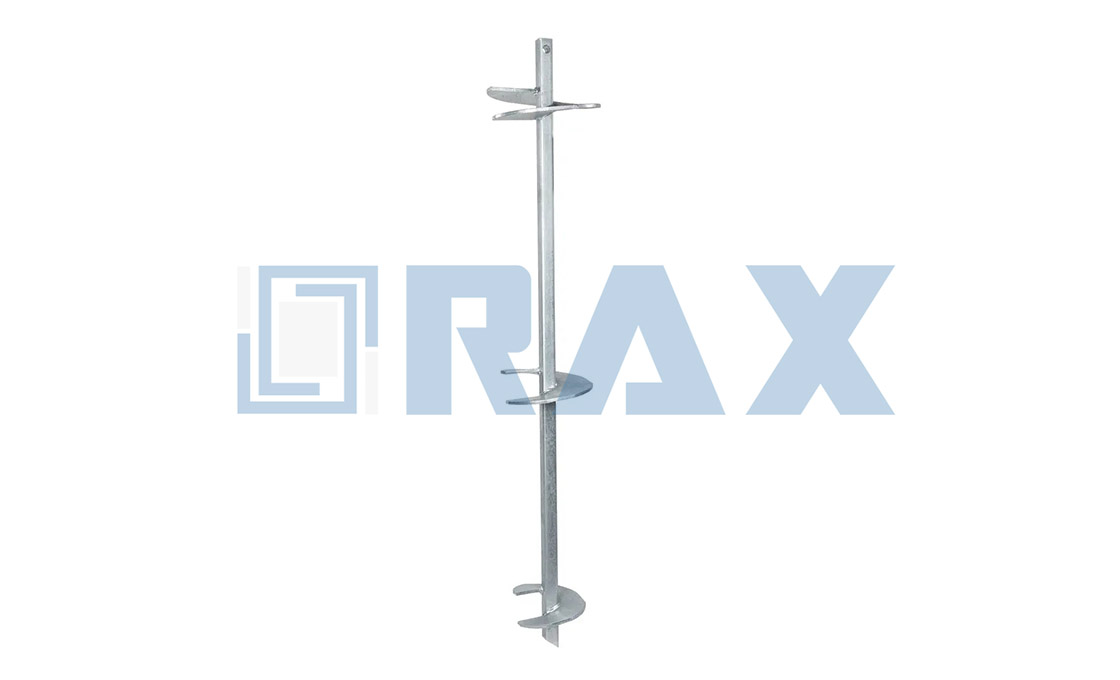
Engineers typically utilize the Standard Penetration Test (SPT) blow counts to categorize the clay’s density and correlate it to a safe pull-out rating. For standard utility applications, we design our helical and expanding anchors to engage firm clay layers that provide consistent resistance, ensuring the system meets the necessary 2:1 safety factor against the guy wire’s maximum working tension.
Minimum Depth for Sandy Soil
Sandy soils behave fundamentally differently from clay, relying on friction and the passive bearing capacity of the anchor’s helices or plates. Because sand lacks cohesion, the anchor must be driven deep enough to reach dense strata that can withstand the lateral thrust of the guy wire. The embedment depth is directly proportional to the relative density of the sand, which is often assessed using SPT N-values.
In loose sand formations, achieving adequate holding power often requires significantly deeper installation or the utilization of larger diameter helical plates to maximize surface area engagement. We account for these variables by offering hot-forged rods with varying shaft diameters, allowing our engineering teams to specify the optimal rod and anchor combination that maintains structural integrity even in lower-density sandy profiles.
Rock Socketing Requirements
When soil profiles transition into solid bedrock or extremely dense gravel, traditional screw-in embedment depths become irrelevant. In these high-resistance terrains, the anchor must be socketed directly into the rock mass to transfer the guy wire load into the geological foundation. This process requires drilling a precise borehole that accommodates the anchor rod, followed by grouting to secure the connection and prevent longitudinal movement.
Rock socketing demands strict adherence to the rock’s unconfined compressive strength (UCS) to determine the required socket length and diameter. Our technical team supports these specialized installations by providing custom-manufactured anchor rods capable of handling the immense tensile loads associated with rock-socketed systems, ensuring the hardware itself never becomes the weak link in the guying structure.
Anchor Type Selection Based on Depth
Calculating Holding Capacity vs Depth
Load Testing Verification
