
Corona discharge rarely announces itself with an event. It announces itself with symptoms: a faint violet halo at a fitting, a hiss that strengthens after dark, static on a nearby radio. Picture the line-end fitting an hour after sunset, glowing faintly and humming to itself in the dark. Those symptoms are the visible end of a chain that starts much earlier, at the level of electric stress on a metal surface.
The fastest way to understand what a corona ring actually does is to walk that chain stage by stage: onset stress, Trichel pulses, glow and streamers, and finally arc. RaxPower supplies aluminum-alloy corona and grading rings for overhead line hardware, and this chain is the physics those rings are bought to interrupt. One link decides everything downstream.
Corona Discharge Is a Chain, Not an Event
Engineers define corona as a leakage of electric current into the air next to high-voltage conductors. It is sometimes visible as a dim blue glow beside sharp points on hardware. The air at one spot has broken down and turned conductive, while the rest of the gap still insulates.
That definition hides a progression. Between healthy hardware and a flashed-over string lie four distinct stages, each with its own physics and its own signature. Treat the glow the way you would treat smoke: evidence of a fire upstream, not the fire itself.
It also helps to say what corona discharge is not. It is not a fault, and no breaker sees it. It is a continuous leak of charge from the conductor into the air, persisting for as long as the local stress persists. A leak that small never trips anything, yet it quietly consumes power, emits interference, and ages the surfaces it lives on.
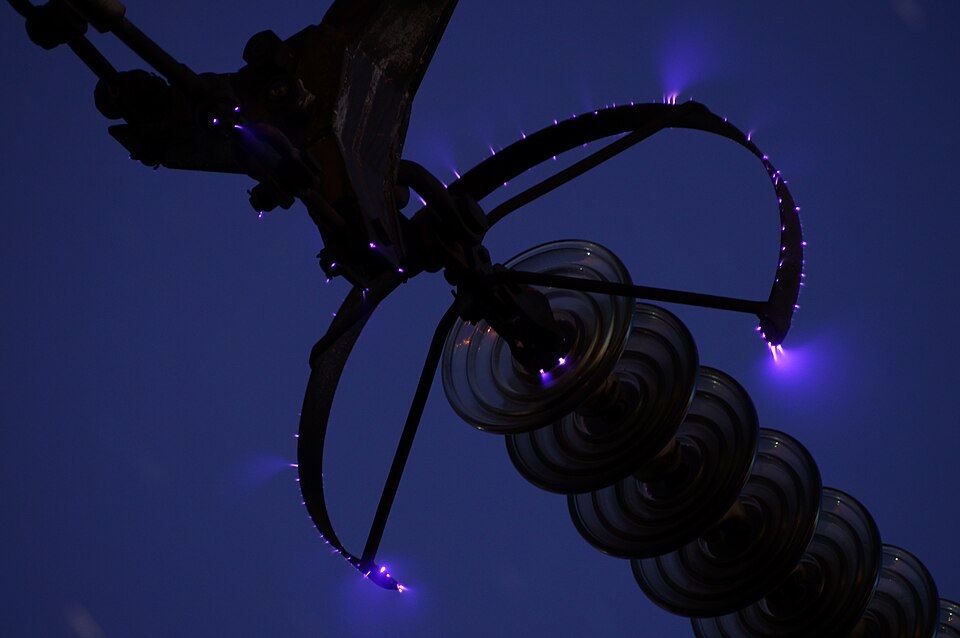
Naming the stages matters for a practical reason. A corona ring acts at exactly one of them. Everything you can see, hear, or measure later belongs to the stages it is meant to prevent.
Stage 1: Surface Stress Crosses the Onset Gradient
Every chain starts with geometry. The field at a conductor surface is strongest where curvature is sharpest, which is why corona claims points, corners, and edges first. A bolt end, a clamp lip, or a stranded conductor all carry the same voltage with very different local stress.
In air at sea-level pressure, the disruptive gradient sits near 30 kV per centimeter. Below that ceiling, the stray electrons from cosmic rays and natural radioactivity drift and recombine without drama. Above it, each free electron accelerates hard enough to knock more electrons loose, and the avalanche feeds itself.
When the gradient at one collar of a fitting crosses that line, the air there stops being an insulator. Nothing visible may happen yet at a distance. The chain, however, has started, and the threshold is not fixed: it falls as air pressure falls, which is why altitude tightens every margin.
On a real string, stage-one candidates are everywhere the hardware turns sharp. Clamp lips, bolt ends, and the attachment points where conductors meet insulator fittings all qualify, and that is exactly where corona rings get installed. Contamination and weather decide which candidate fires first, which is why two identical phases can behave differently on the same tower.
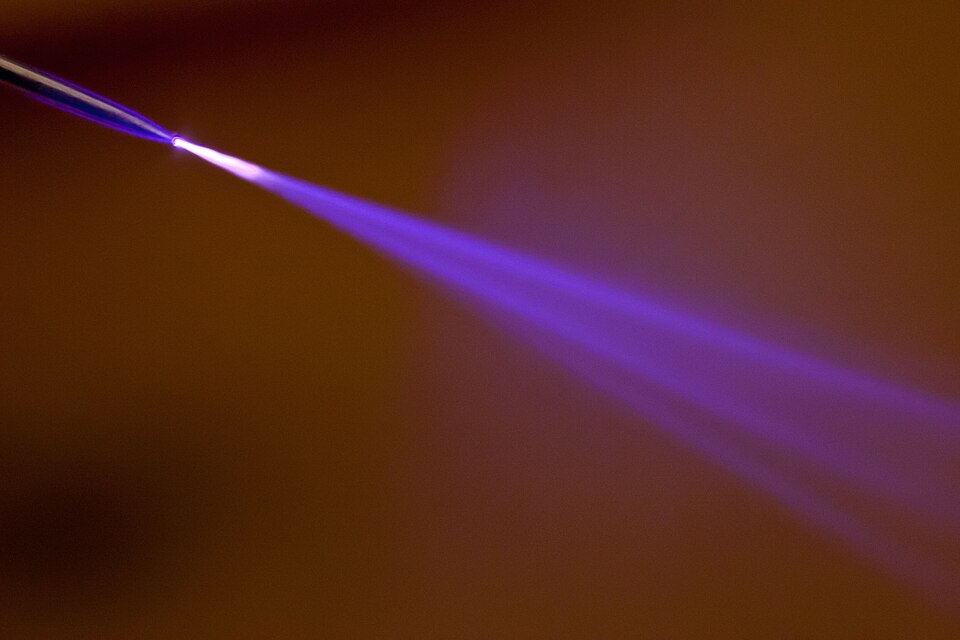
Stage 2: Trichel Pulses Announce Negative Corona
Give stage one a sharp cathode and a little more voltage, and the discharge organizes itself into pulses. Negative corona is famous for this self-pulsing regime, first described by Trichel in 1938 and still named after him. Each pulse is a burst of avalanches, quenched by its own space charge, then repeated.
The numbers are well documented in the research literature. Applied voltages typically sit between minus 5 and minus 50 kV. Repetition runs from a few kilohertz to a few hundred kilohertz, and average currents land between 5 and 100 microamps. Voltage level, temperature, pressure, and humidity all bend those figures.
For a line crew, stage two is the first stage with an electronic fingerprint. Every current pulse injects a step into the fitting, and that is the raw material of radio interference. A discharge at this stage is still small, but it is no longer hypothetical.
The regularity is what makes the signal usable. Random interference scatters across the spectrum, while Trichel pulses repeat at rates set by the physics of one point. An instrument that hears a disciplined pulse train is hearing a specific surface stressing the air, not the whole line talking at once.
Stage 3: Glow and Streamer Regimes Take Over
Push further and the pulse train gives way to steadier forms. Negative corona can settle into a pulseless glow before streamers take over at higher voltage. Positive corona behaves differently: a uniform blue-white plasma sheath whose secondary avalanches are fed by photoionization, photons from the plasma ionizing the gas ahead.
This is the stage human senses notice first. Much of the emission is ultraviolet, well beyond what the eye reports, and the visible fringe reads as the classic purple halo. Ozone and nitric oxides form in the same zone, which is why nearby hardware and elastomers age faster than the service roster expects.
On an AC line, every fitting lives through both polarities in each cycle. The negative half-cycle favors Trichel pulsing, while the positive half-cycle favors the glow and streamer forms described below. The result is a discharge that changes character twice every cycle, which is part of why corona discharge sounds rough rather than smooth.
Streamers also belong here: luminous, branching filaments of ionized air that strike out from the electrode again and again. They are the discharge testing how far the gap will let it go. As long as they cannot bridge it, the hardware still holds.
Stage 4: When Streamers Grow Into an Arc
A streamer that reaches the opposite-polarity conductor changes the game. It leaves an ionized, conductive path through which large current can flow, releasing enough heat to establish a true electric arc. Lightning works on exactly this logic at atmospheric scale.
Insulator strings fail through the same progression, with a geometric assist. The field along a string is not uniform; it is strongest near the high-potential end. Once the surface there turns conductive, the remaining dry length suddenly carries almost the whole voltage, as if the string had shrunk in one step. The failure then propagates into a flashover arc.
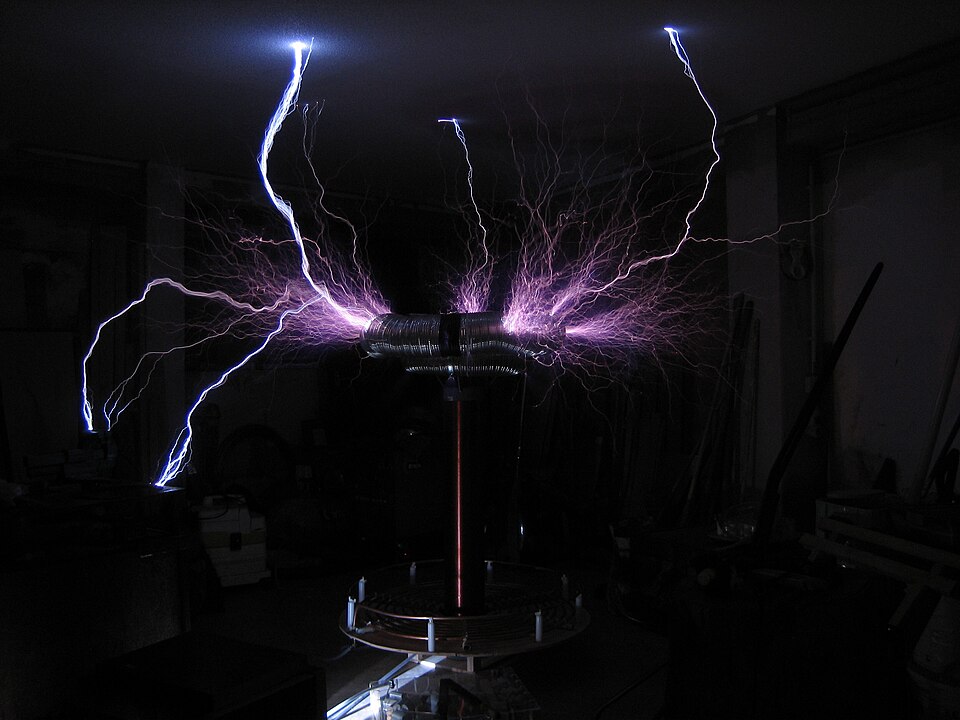
By the time a string reaches this stage, the outcome is electrical, not chemical. No hardware accessory reverses an established arc. The entire value of a corona ring lies in making sure stage four is never reached, by breaking the chain at its first link.
Where the Corona Ring Breaks This Chain
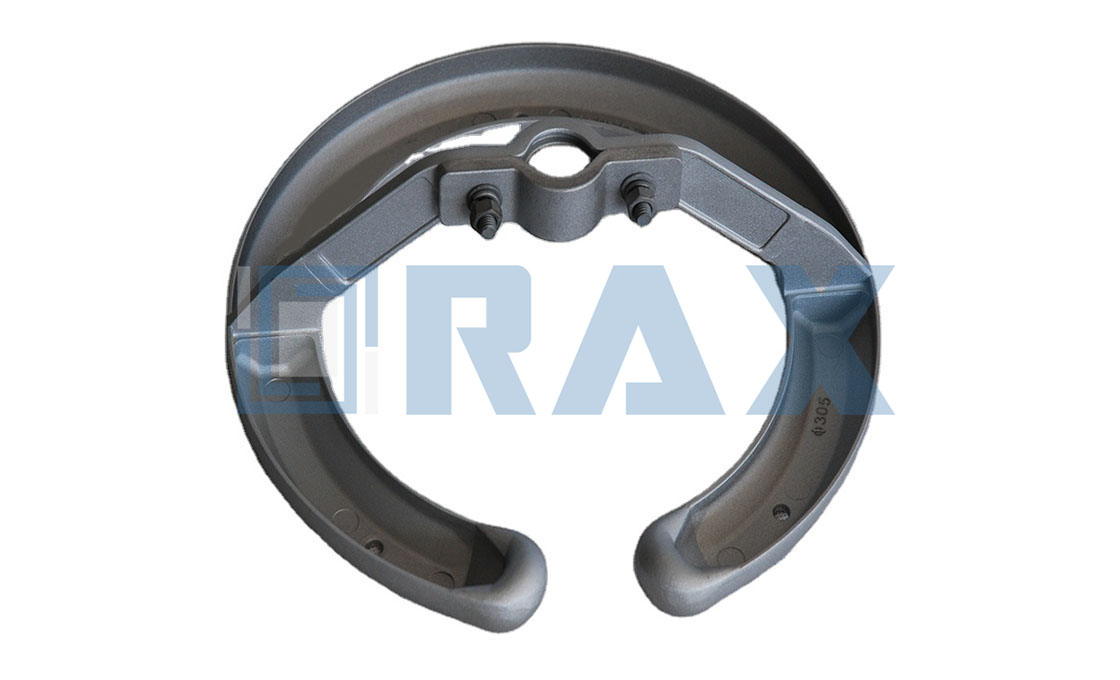
A corona ring is a toroid of conductive metal mounted at the terminal or hardware piece where corona would form. It sits at the same potential as the conductor it surrounds. Because the ring presents a large, smooth radius exactly where the field used to concentrate, the surface gradient at the covered points drops below the disruptive gradient.
That is the whole mechanism, and its placement in the chain is precise. The ring does not fight pulses, extinguish glow, or quench streamers. It holds stage one below its threshold at the points it covers, so stages two, three, and four never begin there.
Geometry decides whether the ring delivers that promise. A ring only helps where it actually encircles the point that would emit, and its value comes from presenting a large, rounded surface instead of a sharp edge. Its radius and its mounting position decide how far the surface gradient falls, which is why ring selection sits next to fitting selection, not after it.
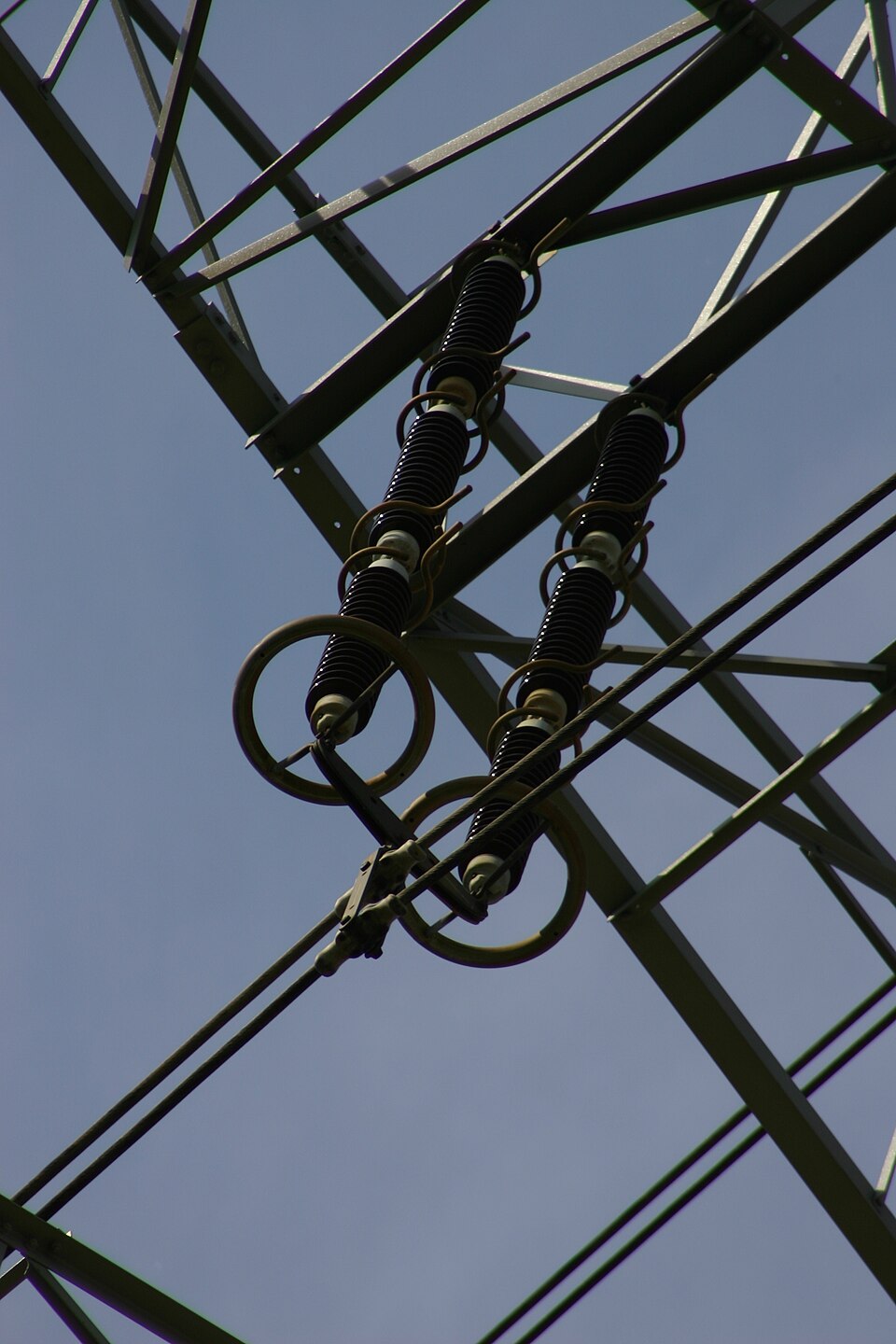
A grading ring extends the same idea along the insulator string. Mounted around the string, it evens out the potential gradient down the column and relieves the line-end concentration that starts the stage-four cascade. Same potential, same physics, applied to the length of the string instead of one fitting.
Reading the Signals: Pulses, UV, Noise, Ozone
Each stage leaves a detectable trace, and the trace tells you how far the chain has progressed. Current pulses in the kilohertz range point to early negative corona. A UV-rich glow, audible hiss, and radio noise mark the middle stages, alongside the ozone smell that gives corona away indoors.
| Chain stage | What the air is doing | What you can detect |
|---|---|---|
| Onset stress | Local gradient passes roughly 30 kV/cm at a sharp point | Nothing yet, by ordinary means |
| First activity | Self-pulsing negative corona near the point | Current pulses from a few kHz to a few hundred kHz |
| Glow and streamers | UV-rich glow, branching filaments, gas chemistry | Visible halo, audible hiss, radio interference, ozone |
| Bridging | A streamer completes a conductive path | Arc and flashover, with heavy current |
Wet weather rewrites this map in real time. Audible noise from transmission lines is generated mainly by corona at defects and water droplets on the surface. A droplet's size and position raise the local field on their own.
The ultraviolet part of the signature deserves its own note. A corona discharge radiates much of its energy in the ultraviolet, which is why a halo that looks faint to the eye is conspicuous to equipment built for that band. The chemistry completes the picture: ozone and nitric oxides confirm that the air really is breaking down, not merely glowing in passing.
In our view, the most useful reading is trend: signals that climb across weeks mean surface stress is rising somewhere upstream of the glow.
What the Chain Means for Ring Selection
The chain framing settles several selection arguments quickly, because a ring protects what it surrounds and nothing else. Three consequences follow for anyone specifying hardware:
- Cover the emitting geometry, not the neighborhood. A ring shields the points it encircles; a discharge starting at an uncovered clamp or bolt stays outside its reach.
- Surface condition is part of the electrical design. A damaged ring edge, a welding burr, or a city of water droplets can each become the new sharpest point, reopening stage one at the very place meant to prevent it.
- Margins must survive the site. The onset threshold falls with air pressure, so a ring that silences a fitting at sea level may only restrain it at altitude. Holding the gradient further below the ceiling is a calculation made before the order, not an adjustment made on the pole.
In our experience, buyers ask for a bigger ring when the real question is which link failed. Sizing answers that with geometry and margins; the chain answers it with physics. Used together, they end the argument before the hardware ships. The corona ring product page on this site carries the aluminum-alloy ring geometries discussed above.
One Link Decides the Whole Chain
Corona discharge is a progression: stress past the onset gradient, Trichel pulses, glow and streamers, then arc. A corona ring earns its place at the front of that progression, where a smooth conductive surface at conductor potential keeps local stress under the ceiling. Everything downstream is a symptom of the link it protects.
That is the standard RaxPower applies when it supplies aluminum-alloy corona and grading rings for overhead line hardware. Specify the ring for the link it can actually break, and the glow, the hiss, and the interference stay where they belong: out of the specification.
Frequently Asked Questions
Can a corona ring extinguish a discharge that has already started?
No. The ring works one link earlier, holding surface stress below the onset gradient so the chain never starts. A discharge already burning at a sharp point, a damaged edge, or a water film is beyond any ring.
Do Trichel pulses always mean hardware is failing?
No. Regular current pulses are the normal first self-sustained stage of negative corona near onset. The trend matters more than the pulses themselves: a repetition rate that keeps climbing points to surface stress rising somewhere.
Why does corona sound louder in rain?
Water droplets and surface defects concentrate the local field, so wet weather multiplies emission points and raises audible noise. The ring's job has not changed; rain simply opens new stage-one sites faster than smooth surfaces close them.
Is corona discharge the same as a flashover arc?
No. Corona is a localized leak that glows, hisses, and ages nearby surfaces. A flashover arc is the end of the chain, a conductive path bridging the insulation and carrying heavy current. A ring suppresses the front of that chain.
Does altitude change where the chain starts?
Yes. The onset threshold falls with air pressure, so at altitude the chain starts at lower surface stress. Rings must then hold the gradient further below it, which is a design calculation rather than a field adjustment.