
Imaginez le dernier poteau avant que la ligne ne quitte la ville. Un petit raccord sur son côté reprend la force de traction de chaque mètre de câble derrière lui. Ce raccord est le collier d'ancrage, et les acheteurs qui le traitent comme une marchandise standard finissent par le retrouver en saison des tempêtes.
RaxPower fabrique du matériel de ligne pour poteaux depuis 2003, et les raccords d'ancrage se trouvent au centre de la famille de tension de ce catalogue. Ce guide recueille ce qu'un concepteur de ligne, un entrepreneur ou un distributeur devrait savoir avant de les spécifier : comment le coin saisit, quels types existent, et quelles lignes de fiche technique décident vraiment des performances.
Ce que fait un collier d'ancrage sur la ligne
Un collier d'ancrage est le raccord de tension qui termine un câble aérien et transmet sa traction longitudinale complète au poteau, au support ou à la tour. Les colliers de suspension fonctionnent différemment : ils ne soutiennent que le poids du câble et le laissent glisser sous les changements de charge. C'est pourquoi les lignes passent par des supports de suspension au milieu d'une travée mais se terminent toujours aux points d'ancrage. Sur les réseaux BT ABC, la même pièce est souvent vendue comme collier de tension à coin ou comme nœud mort ABC, classé pour un service de 1 kV. Quelle que soit l'étiquette, la tâche est identique : maintenir le câble contre la pleine tension de ligne sans l'écraser.
Pour un regard plus approfondi sur la géométrie de saisie, consultez l'explication complémentaire sur comment ces colliers saisissent avant de plonger dans l'image complète ci-dessous.
Regardez où le matériel est positionné et son rôle devient évident. Chaque travée se termine deux fois, une fois à chaque structure qui arrête le câble. À ces points, un petit coulage transfère des kilonewtons de traction longitudinale dans le sommet du poteau ou le support. Choisir le mauvais raccord et le câble dérive, la flèche change et le dégagement entre phases diminue avec elle.
Pour les acheteurs, la simplicité du matériel est un piège. Tout atelier de mécanique peut copier le contour d'un boîtier à coin. Beaucoup moins peuvent tenir la tolérance de conicité et la composition polymère qui font qu'une saisie survit à une décennie de cycles de charge. La différence apparaît dans les rapports d'essais de type, pas dans les photos de produit.
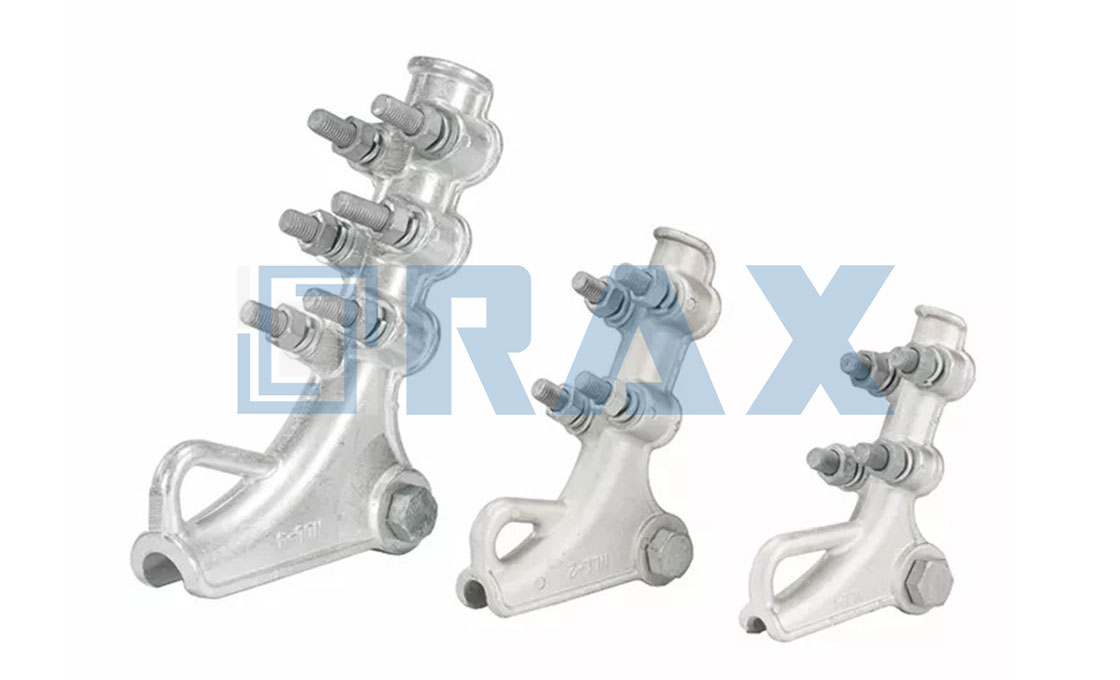
Comment un collier d'ancrage à coin saisit le câble
À l'intérieur d'un collier à coin, deux coins polymères rainurés sont assis dans un boîtier alu conique. Le câble entre entre eux, et la tension de ligne tire la paire de coins plus profondément dans le cône. Tirez plus fort et la saisie se serre davantage, ce qui explique pourquoi les installateurs n'ont pas besoin de clé dynamométrique pour cette famille. Comme un camion garé sur une pente, le câble ne cesse jamais de tirer, donc le collier ne cesse jamais de répondre.
Les surfaces des coins portent de fines nervures qui s'incrustent dans l'isolation du câble sans toucher les conducteurs. Une anse en acier sort du boîtier et transmet la charge au support sur le poteau. Parce que les coins flottent, un seul boîtier couvre une fenêtre de diamètres étroite plutôt qu'une seule taille.
L'absence d'outil importe plus qu'il n'y paraît. Les équipes terminent des faisceaux en hauteur, par tous temps, souvent avec des gants. Un boîtier à coin ne nécessite aucun tissage de boucle, aucun couple de boulon et aucune mesure sur poteau. Des mentions indépendantes du type PA-1500 décrivent les coins comme auto-réglassants et sans outil, ce qui explique pourquoi cette famille s'est répandue si rapidement sur les réseaux BT ABC.
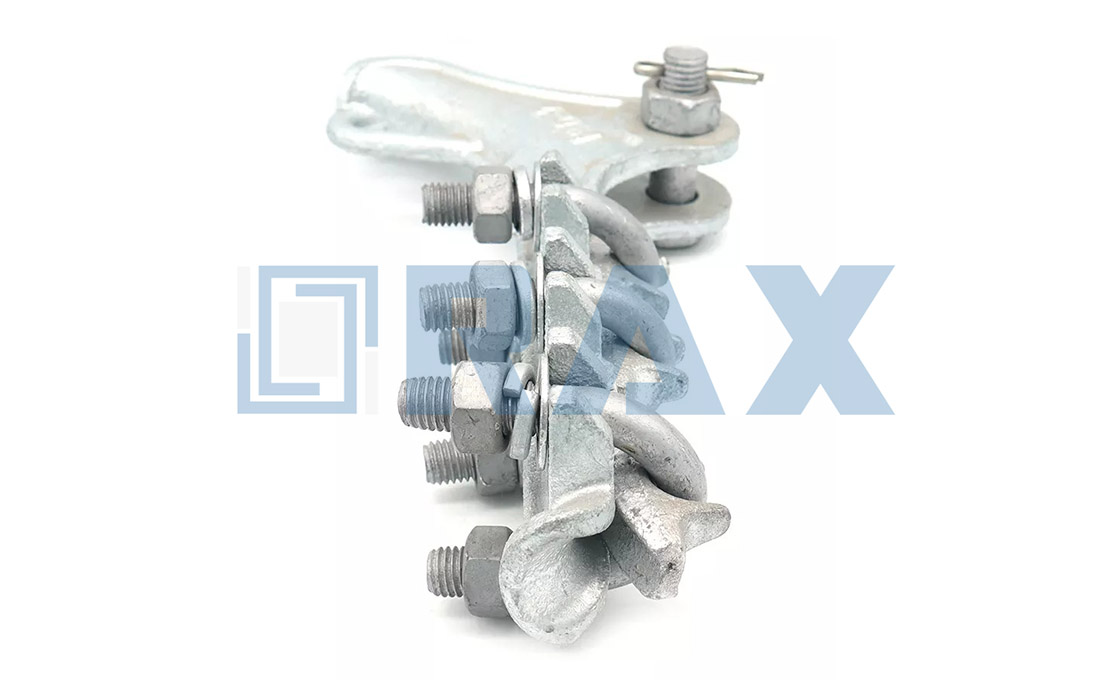
Options de colliers d'ancrage à boulons et préformés
Les colliers à coin dominent les terminaisons BT ABC, mais ils ne sont pas le seul matériel d'ancrage. Les colliers de contrainte boulonnés de style NLL ferment un corps en alliage d'aluminium autour des conducteurs nus ACSR ou tout-aluminium, avec des étriers en acier galvanisé fournissant la pression. Les serre-câbles à tiges préformées s'enroulent en hélice et répartissent la charge, ce qui convient aux câbles fibre et aux ancrages de câble de contreventement.
Le matériel boulonné a sa propre logique. Un creux fermé par des étriers en U saisit par pression, donc l'installateur contrôle directement la morsure. Cela en fait le choix par défaut sur les réseaux à conducteur nu, où les épissures et les connexions d'équipement nécessitent une connexion reproductible et revisable.
| Famille | Mode de serrage | Meilleur ajustement | À surveiller |
|---|---|---|---|
| Coin (style PA) | Coins polymères auto-resserrants | Nœuds morts BT ABC et travées de desserte | La fenêtre de diamètre doit correspondre au faisceau |
| Collier de contrainte boulonné (style NLL) | Étriers galvanisés en U ferment un corps aluminium | ACSR nu aux poteaux et équipements | Couple par fiche technique, marquer l'écrou |
| Serre-câble à tiges préformé | Tiges hélicoïdales répartissent la charge | Nœuds morts fibre et contreventement | La longueur de tige doit correspondre à la taille du câble |
| Nœud mort fibre amorti | Elastomer pads inside a wedge housing | Short ADSS spans | Pad condition at every patrol |
A cushioned fiber dead-end deserves special mention. Elastomer inserts reduce compression and bending stress on the cable, protecting the fibers inside a jacket that must never be crushed.
Four-core bundles bring one sizing detail. Some four-core service clamps take the whole bundle in a single body, while heavier feeders put each core on its own anchoring point. Match the bracket to that arrangement before ordering hardware.
Où ces colliers gagnent leur poste
Walk any overhead distribution route and the anchoring points announce themselves. Dead-end poles at the end of a line take the full span pull on every phase. Angle poles take a resultant force whenever the route bends, so each direction change needs its own anchor clamp. Service entrances use smaller wedge units where the bundle drops toward a building.
Fiber routes add their own cases. Short ADSS spans between poles take cushioned wedge dead-ends, and catalog listings typically cover 8 to 12 mm cable over distances up to about 100 meters. Medium voltage bare conductor lines keep bolted strain clamps on terminations and equipment jumps.
Voltage class changes the hardware, not the principle. A 1 kV service bundle anchors in polymer-bodied wedges, medium voltage bare lines lean on metal strain clamps, and fiber routes need the cushioned middle ground. Vocabulary shifts between countries, so check the cable construction first and the catalog language second.
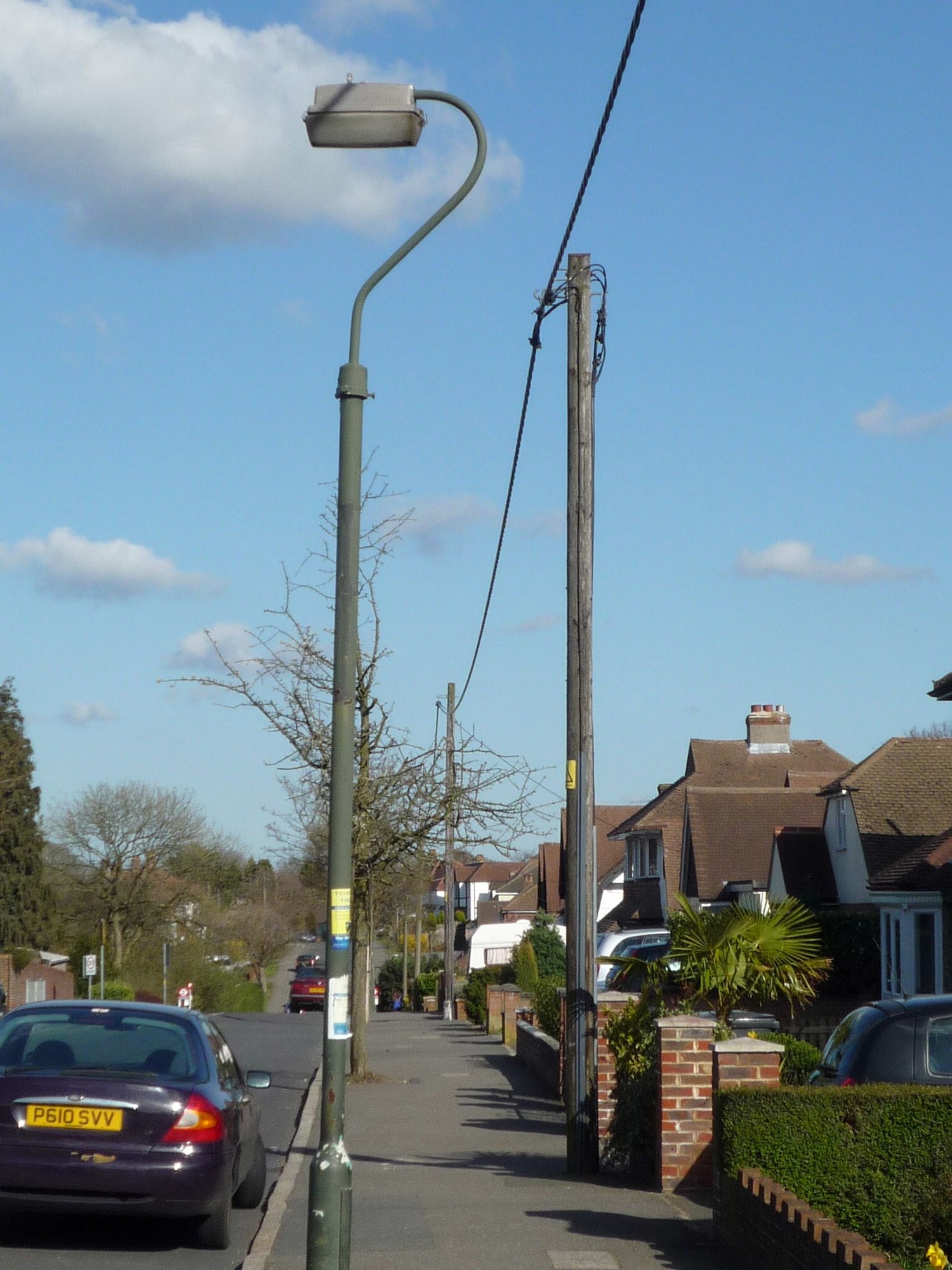
Matériaux et protection contre la corrosion expliqués
Aluminum alloy shells dominate the wedge family because they are light, dimensionally stable, and galvanically compatible with the aluminum conductors they hold. Polymer wedges and covers use UV-stabilized, fiberglass-reinforced compounds that keep their grip after years in the sun. Steel parts tell a different story: bolts, bails, and brackets rely on hot-dip galvanizing to ISO 1461 for corrosion protection.
Forging matters as much as coating. Hot-forged blanks keep the metal’s grain flow intact, which is why forged hardware resists cracking under cyclic line tension better than machined bar stock. When you compare quotes, ask what the load path is made of and how the zinc was applied.
None of these materials excuse a bad finish. Zinc coverage on steel parts should be continuous, because a single pinhole becomes the corrosion path for the whole fitting. Ask whether coating mass is tested against ISO 1461 and whether the certificates travel with the batch.
Spécifications et charges que les acheteurs doivent vérifier
Three datasheet lines decide most purchases. First, confirm the cable diameter window, because a wedge built for a 12 to 14 mm bundle will not hold an 8 mm drop wire. Second, read the minimum breaking load, not just the model number. Third, check the insulation class if the line runs covered cable.
Model names mislead more than any other trap. One manufacturer’s PA-1500, for example, is listed for 50 to 70 mm² single-core 1 kV cable with a 15 kN minimum breaking load. Other catalogs stretch similar model numbers across different sizes and loads from 6 to 20 kN. The number on the housing is not a specification until the datasheet confirms it.
Insulation class deserves its own minute. Covered cable needs clamps whose polymer parts keep the covering intact at the grip point, while bare conductor lines can spend their budget on the metal. Mixing these up shows up later as tracking marks on the jacket.
Breaking load is not working load, either. Designs keep a safety factor between the cable’s everyday tension and the clamp’s rated maximum, and each utility defines that margin in its own standards. Quote the expected span tension when you ask for a recommendation; that number makes the datasheet meaningful.
Typical listing: wedge clamp for 50–70 mm², 1 kV, MBL 15 kN, aluminum alloy shell, UV-stabilized polymer wedges, self-adjusting, no tool required.
| Standard | Scope |
|---|---|
| NF C 33-041 | Tension fittings for LV ABC accessories |
| NF C 33-042 | Service connection anchoring clamps |
| EN 50483 series | Harmonized European test methods for LV ABC accessories |
European buyers will also see NF C 33-041 and its harmonized EN 50483 equivalents on quotation sheets. Ask suppliers which clauses their type tests cover, and expect a test report with each shipment batch. A supplier that cannot produce the report is selling a model number, not verified performance.
Approvisionner des colliers pour votre réseau
A short supply chain helps here. When the same factory that forges the blank also runs the plating line and assembles the finished clamp, deviations get caught before shipment instead of after installation. In our experience, buyers who audit these process steps once cut their incoming inspection work for years.
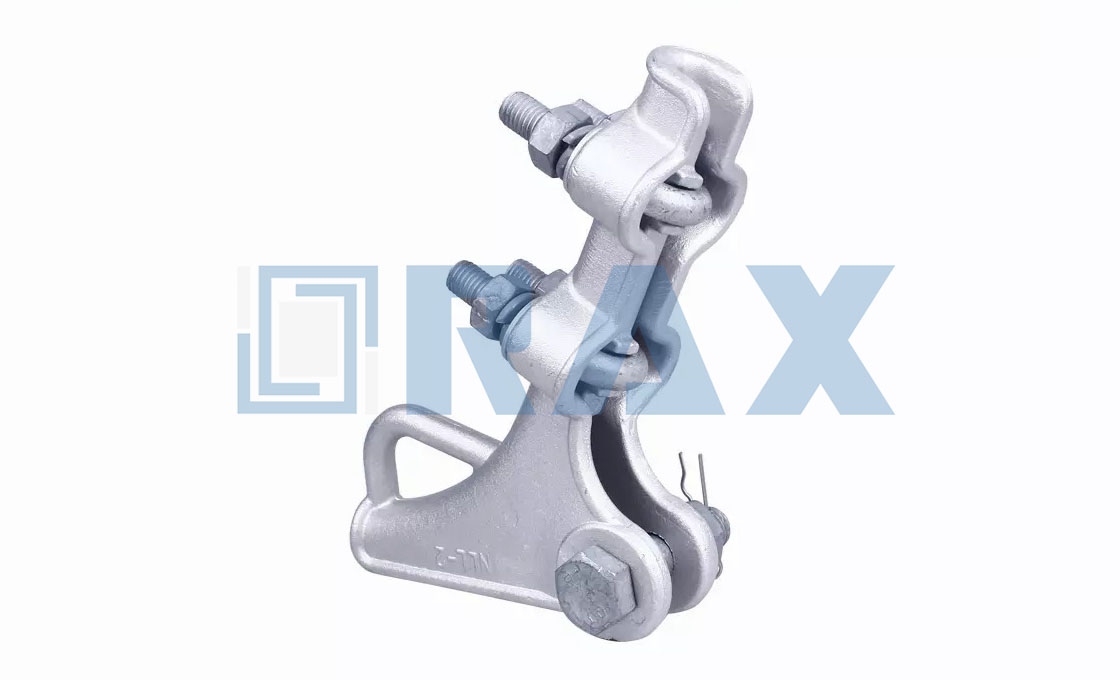
Volume programs and OEM drawings run through the same channel, from tension and suspension fittings to matched brackets for each pole type.
Contrôles d'installation qui préviennent les défaillances d'ancrage
This is not an installation manual, but four checks belong in every crew’s routine. Verify the cable diameter against the clamp window before the bucket leaves the yard. Torque bolted strain clamps to the datasheet value and mark the nut with paint so any movement shows at the next patrol. Treat any clamp that shows slip marks as retired hardware. The wedge has already given up its bite.
Sequence matters on the pull, too. The winch stays attached until every dead-end is made off, because a released bundle stores enough energy to move on its own. On the crew side, rigging discipline does more for anchor reliability than any catalog choice.
- Match the clamp window to the measured cable diameter, insulation included.
- Respect the datasheet torque on every bolted clamp.
- Keep the bail free to articulate; a side-loaded bail works loose.
- Replace, never re-tighten, hardware that shows slip or corrosion trails.
Signes d'alerte d'inspection et de remplacement
Patrols should look hard at anchors after the first big temperature swing of the year and after every serious storm. Cracked polymer housings, white powdery oxidation at aluminum contact points, and fresh slip marks on the cable all deserve a work order. Galvanized steel parts showing rust streaks have lost zinc in spots and need tracking.
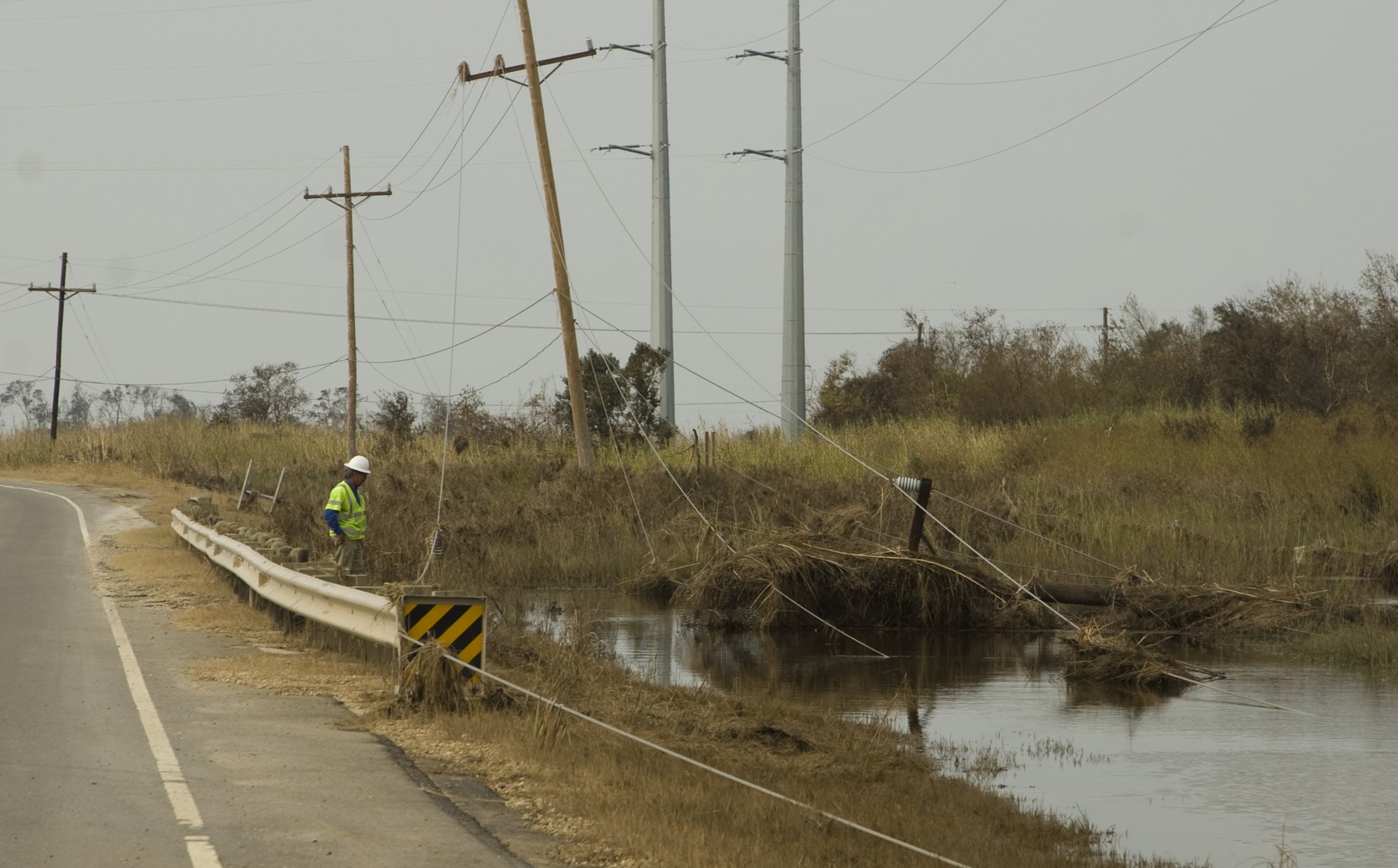
Storm damage rarely announces itself politely. By the time a span is sagging, the clamp that let go has usually been telling patrols something for two seasons. Photo records of each anchor point make those early warnings visible before they become outages.
Cold climates add one more check. Freeze-thaw cycles move brackets and poles slightly all winter, and hardware that was tight in autumn can read loose by spring patrol. Recording torque readings per structure turns that drift into data instead of guesswork.
Questions courantes des monteurs de lignes
Que fait un collier d'ancrage sur une ligne aérienne ?
It is the fitting that ends a run: the cable stops there and the span’s full longitudinal load transfers into the structure. Anchors therefore appear at dead-ends, angle poles, and terminations rather than mid-span.
Où doit s'arrêter l'équipement de suspension et où doit commencer l'équipement de tension ?
Let the load decide. Mid-span poles only hold weight, so suspension clamps suit them; wherever direction changes or the run ends, longitudinal pull takes over and tension hardware takes the point.
Quelle taille de collier d'ancrage convient à mon câble ?
Measure the cable’s overall diameter with insulation and take the clamp whose window brackets that number. When a bundle sits between two windows, choose the larger body only if its MBL still clears the span’s expected tension.
Les câbles ADSS utilisent-ils le même matériel ?
No. A fiber jacket cannot tolerate the point pressure a power clamp applies. ADSS routes specify dead-ends with elastomer cushioning, because bruised jackets bend the glass inside and degrade transmission.
Quels standards couvrent ces raccords de tension ?
In Europe, NF C 33-041 covers tension fittings for LV ABC and NF C 33-042 covers service anchoring, with the EN 50483 series providing harmonized test methods. Ask for the type test report by clause.
Quick answer: an anchor clamp is the tension fitting that terminates overhead cable and carries full line tension at dead-ends, corners, and terminations. Wedge types self-tighten on LV ABC, bolted strain clamps hold bare conductors, and cushioned dead-ends protect ADSS fiber. Verify the cable diameter window and the datasheet MBL before ordering.
Points clés pour les monteurs de lignes
Anchor clamp selection is not exotic engineering; it is the discipline of matching a window to a cable and a load to a datasheet. Buyers who verify diameter, minimum breaking load, and standards coverage before ordering rarely meet these fittings again outside routine patrols. RaxPower has forged and galvanized pole line hardware since 2003, and we put the same rule on our own drawings: no claim without a test behind it.
- Match the clamp window to the measured cable diameter.
- Read the MBL on the datasheet, never the housing.
- Anchor every dead-end, angle pole, and termination.
- Keep cushioned hardware on fiber, metal jaws on power.
- Demand type test reports with the shipment.