
A pole band clamp looks like the simplest fitting on the pole: a curved strap, a couple of tornillos, done. That simplicity hides the decisions that decide whether it holds for twenty years or slips in the first storm. Diameter fit, band style, load rating, coating, and installation torque all change how the same piece of galvanized steel behaves on a live pole.
Pole band inquiries that reach the RaxPower order desk almost always state a pole diameter. Very few state the load the band must carry, the coating environment, or the attachment it serves. Those three gaps are where selection failures start, and this guide closes each one in turn.
What a Pole Band Clamp Replaces
The traditional way to hang hardware on a pole is to drill it. Drilling takes crew time on site, weakens the pole at the hole, and locks the layout in place. A band wraps around the structure instead and clamps to itself, so the pole keeps its full section and the attachment can move later.
The product definition on the catalog's pole band page makes the scope explicit. It describes "hardware accessories for guying and deadending applications on steel, wood, or concrete poles without requiring pre-drilled perno holes". An independent supplier page adds the practical benefit: the band "wraps around the pole and clamps securely", which "helps mount hardware without drilling".
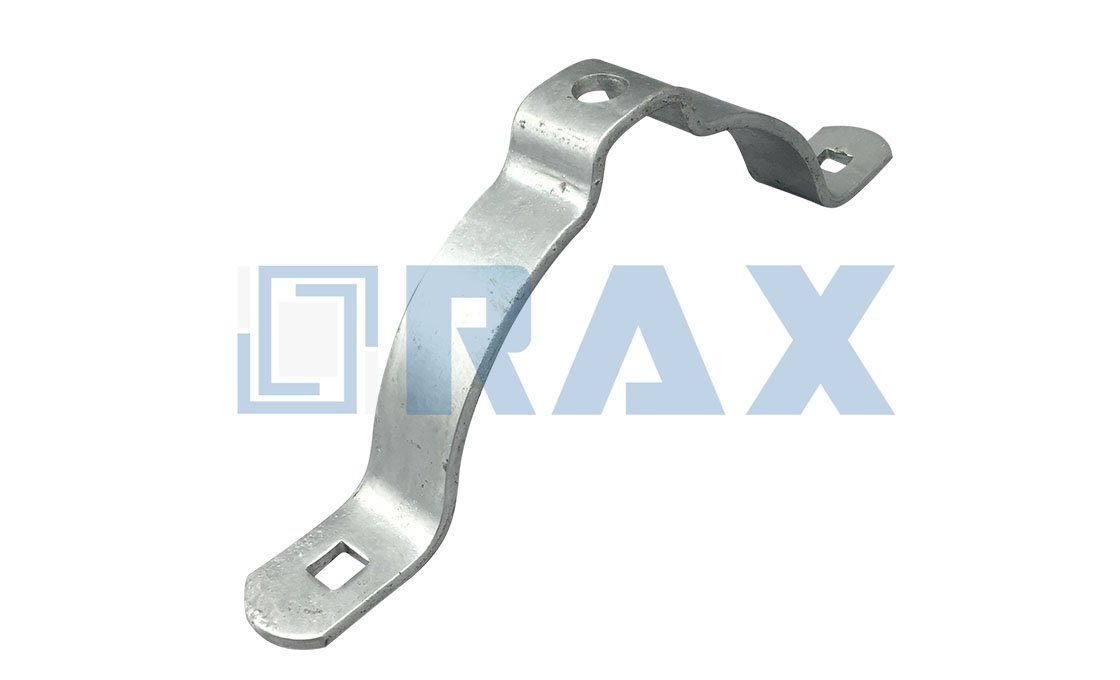
Once wrapped, the band gives you a place to hang things: secondary racks, insulator brackets, guy hooks, street light arms, and equipment plates. Each of those attachments pulls in a different direction and with a different force. That is why a pole band clamp is chosen by duty first and diameter second.
Measure the Pole Before You Pick
Every sizing mistake starts as a measuring mistake. One buying guide for the product puts the measurement first: "First, measure or confirm the diameter or circumference of the pole." A tape wrapped around the pole gives the circumference. Dividing by pi gives the diameter the catalogs use. Until you measure the pole at the attachment height, every catalog number is a guess.
Conventional fixed bands are cut for diameter ranges, not for a universal fit. The Allied Bolt poleline catalog lists its single offset series in adjacent steps, each covering one inch of pole diameter:
| Part number | Pole diameter range | Carton quantity |
|---|---|---|
| 1111 | 6 to 6-3/4 in | 10 |
| 1116 | 7 to 7-3/4 in | 10 |
| 1112 | 8 to 8-3/4 in | 10 |
Band length is the mirror of diameter. Pelco's traffic hardware catalog pairs its hinged clamp bands accordingly: a 29-inch band supports pole diameters up to 7.3 inches, and a 42-inch band up to 11.5 inches. Longer bands are not interchangeable with shorter ones; the fit is a maximum, not a suggestion.
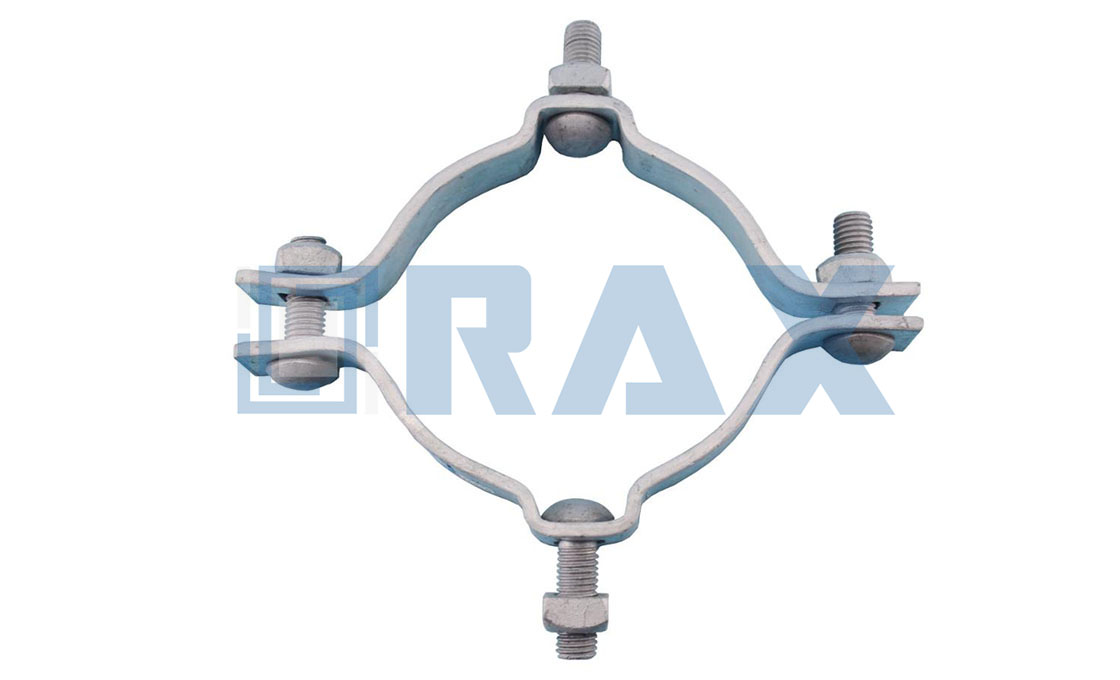
Adjustable link-type designs relax the arithmetic. The catalog's pole band series accommodates pole diameters "from a minimum of 8 inches to virtually unlimited maximum diameters", because added links extend the wrap. Fixed or adjustable, the rule holds: the band must close fully and seat square, or nothing else in its specification matters.
Match the Band to the Duty
Bands serve three duty classes, and the load separates them. Guying and deadending put the full guy tension into the strap, which is why serious catalogs rate bands in the tens of thousands of pounds. The series carries two tensile ratings, 15,000 pounds and 30,000 pounds, with the higher class intended for heavy-duty transmission construction.
At the lighter end, bands carry bracketry rather than tension. Hubbell's Chance catalog describes the classic secondary application as a "pole band for attaching secondary racks, double mounting, 6 to 6-5/8 inch pole diameter". Telecom brackets, cable clamps, and street light hardware sit in the same class. Picture the difference in the field: a dead-end band holds a wire that never stops pulling, while a rack band holds a spool that mostly holds its own weight.
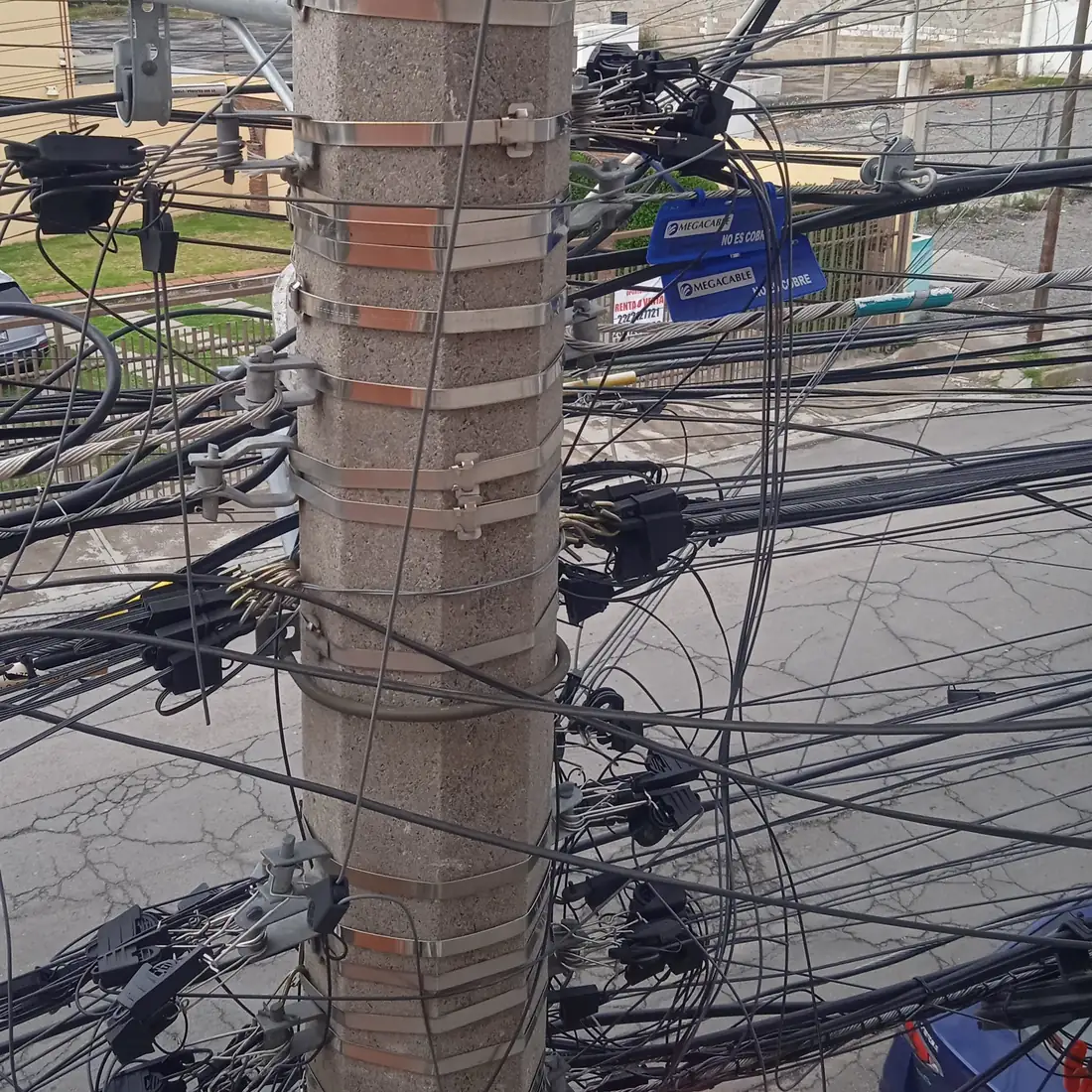
Overspecifying wastes money; underspecifying removes your margin for the unexpected. A band that serves a bracket today may inherit a guy tomorrow when the line changes. Specifying the same pole band clamp for both duty classes on one structure costs little at purchase and removes that failure path entirely. For installation sequencing on bracket work, the guía de montaje de soporte para poste con abrazadera de anclaje covers the mating hardware side.
Single Offset or Double Offset Design
Offset describes where the attachment point sits relative to the band body. A single offset version "provides an attachment point on one side of the pole", in the wording of one manufacturer's buying guide. A double offset version "provides attachment points on both sides", which serves two-direction connections from one wrap.
The choice follows the framing plan. A straight run with one rack or one guy needs a single offset and nothing more. Double mounting, cross-direction loads, and junction points justify the double offset because two hardware points stay aligned without a second band.

Corner poles are the extreme case, and link systems answer it modularly. The series pairs the band with PEL eye link terminations, with configurations "supporting up to four links for 90-degree corner poles". Four links means four load directions on one collar, each at an angle the crew would otherwise have to improvise. Choosing the offset count is cheaper than inventing that rig in the field.
Adjustable Bands Widen the Fit Range
Fixed bands ask you to know the diameter exactly. Adjustable link-type bands ask only that you know it approximately, then close the gap with hardware. The assembly includes one CLP clip permitting a 4-inch take-up adjustment for fine-tuning the fit, and additional clips, full links, and half links extend the diameter range on order.
That adjustability converts directly into stock discipline. One part number covers a mixed fleet of wood, concrete, and steel poles instead of one number per inch of diameter. An independent adjustable band covers pole sizes from 8 to 14 inches on the same principle, which is why utilities with aging, tapered poles favor the style. The take-up range also absorbs the diameter change where a tapered pole is strapped higher or lower than planned.
The trade-off is honest and small. A link assembly has more joints, so it has more items to torque and more surfaces to galvanize. In our experience, buyers who standardize on adjustable bands rarely go back, because the fitting errors that used to mean a second truck roll now mean turning a clip.
Coating and Corrosion Choices to Specify
A band lives where water runs: strapped tight against a pole face, in the splash and debris zone. Coating is therefore a structural specification, not a finish preference. These bands use ductile iron links that are hot dip galvanized. The steel bolts and hinge pins receive the same galvanized treatment, so no link in the chain rusts first.
Name the standard in the purchase order. One adjustable band datasheet lists its coating as "Galvanized, ASTM A-153", the standard for hot-dip galvanized hardware. The same sheet states a tensile strength of at least 560 N/mm² and a service life of 20 to 30 years in most outdoor conditions. Those three lines are what a band specification should look like on paper.
Environment moves the requirement. Buyers serving coastal, humid, or industrially polluted markets are advised to "confirm the required coating specification before production", because standard zinc thicknesses age faster in those atmospheres. The trade-off between plain steel and galvanized fasteners is already quantified in the carbon steel versus galvanized fasteners comparison on this site.
Bolt Hardware and Installation Torque
The band is only half the clamp; the bolt set is the other half. Suppliers are explicit that "bolts, nuts and washers must match the band design and installation requirement". The holes, the offset, and the pole material all set what the fastener must do. A through-bolt machine screw suits a wooden pole; lag-style hardware suits shallow mounts; square necks keep bolts from spinning in square holes.
Installation failures have a short, well-documented list. A pole-mount equipment guide attributes cabinet slippage to "insufficient band clamp torque or wrong band size for the pole diameter". The same guide directs crews to "torque each band to the manufacturer's specification (typically 40 to 50 N·m on the buckle bolt)". It adds cleaning debris and ice off the pole face before reinstallation, and a rubber friction pad between band and pole on slick surfaces.
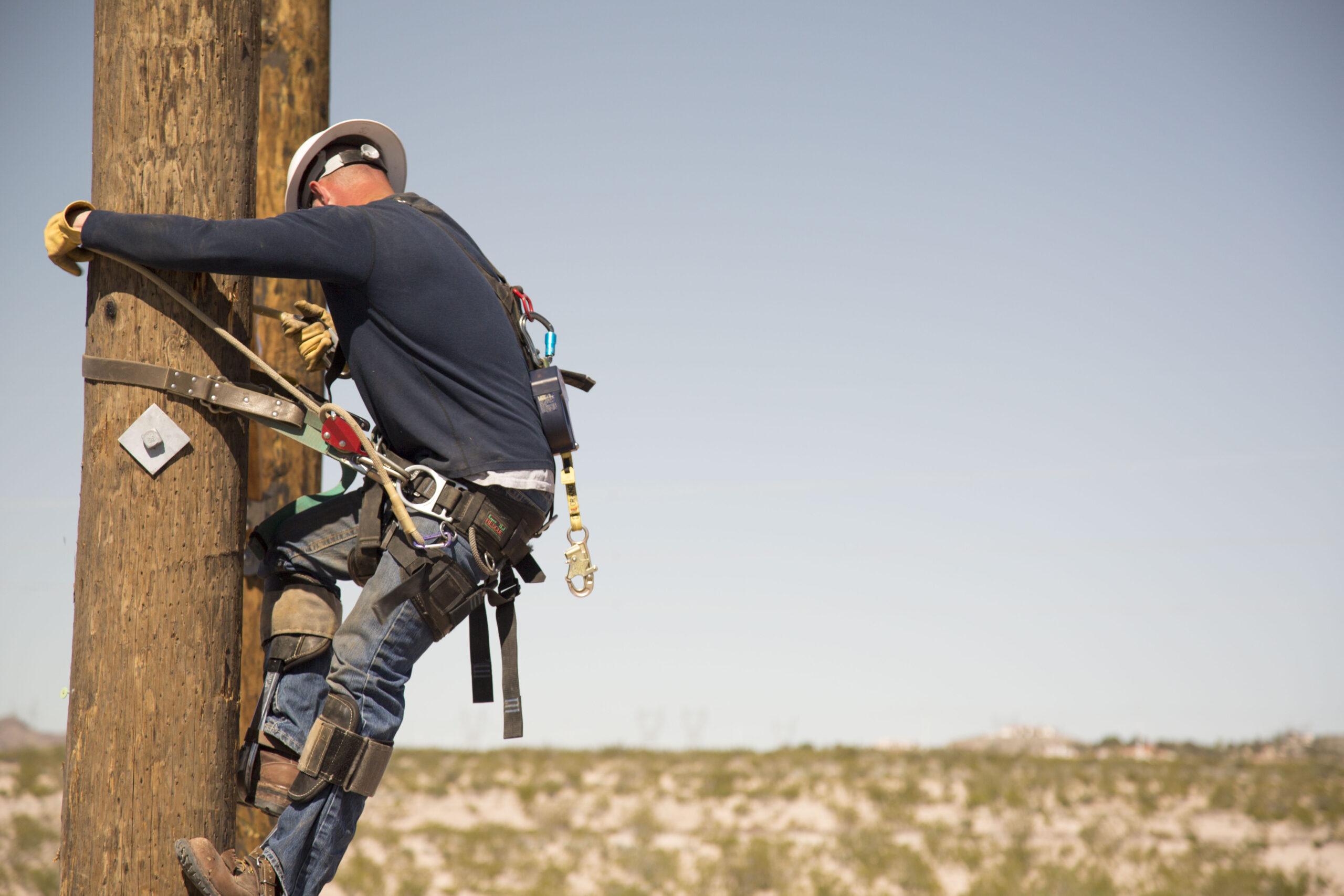
Torque is also the cheapest warranty you can buy. The way you torque the band decides the way it grips a year later, because a properly drawn strap digs in and self-locks under vibration. The same equipment guide adds a sequence rule for two-band mounts: "top band first, then bottom, then re-check top". That order draws the cabinet evenly against the pole instead of twisting its frame. Specify a torque wrench on the truck, a stated value on the drawing, and a re-check on the first maintenance visit, and the slip failures mostly stop.
How to Screen a Pole Band Supplier
Screening starts with how the supplier handles your drawing. One export buyer's guide is blunt about inputs: "you should provide exact dimensions rather than only sending a product photo." A supplier who quotes from photographs is guessing. A supplier who answers with an indexed dimension list is manufacturing. Ask for the data sheet before the price.
Then ask what the supplier can prove. Material certificates for the ductile iron and steel, gauge reports on formed straps, and load test records on assembled bands are the normal evidence pack for this product family. A factory that runs multi-stage load testing on finished bands can usually produce those records the same week. Custom and OEM work follows the same logic described in the custom pole line bolt OEM manufacturing guide.
Finally, make the supplier repeat the application back to you. The same guide advises buyers to "tell your supplier what the pole band will support". Its example declarations cover guy hardware, telecom brackets, cable clamps, ADSS and OPGW fittings, and secondary racks. A supplier who asks about pole material, diameter, and attachment load before quoting is a supplier you can audit later.
Packing and marking finish the screening. The catalog data sheet behind this guide states standard pack quantities of 5 clips and 25 links. That number tells you how the goods arrive at your warehouse, and how easily a partial order can be split. Ask the same question of every bidder. A supplier who cannot state pack quantity, marking, and lead time in writing is quoting from a brochure rather than a production plan.
Specification Details That Decide the Fit
A complete pole band clamp specification fits in six lines, and every line prevents a specific failure. The first line is the pole: material, diameter or circumference at the attachment height, and whether the section is round or square. The second is the attachment: what the band carries, in which direction, with the working load in pounds.
The third line is the rating: a 15,000-pound band and a 30,000-pound band look identical in a photograph and behave differently in a storm, so write the number. The fourth is the coating standard with thickness for the service environment. The fifth is the hardware set: bolt diameter, length, and style matched to the band holes. The sixth is packing and marking, so a crew ten years from now can identify a 30,000-pound strap from a 15,000-pound one on the pole.
Send those six lines and the quotation comes back as an engineering document instead of a price list. Send a photograph and the quote comes back in an hour, wrong in ways you will discover with the band already on the pole.
A Ten-Point Checklist for Buyers
Everything above compresses into ten lines to answer before the purchase order goes out:
- Pole material, and diameter or circumference measured at the attachment height.
- Duty class: guying, deadending, secondary rack, or equipment bracket.
- Working load and the band tensile rating that covers it with margin.
- Offset count: single, double, or link-type for multi-direction attachments.
- Adjustable take-up range, if pole diameters vary across the fleet.
- Coating standard and thickness matched to the service environment.
- Bolt, nut, and washer set matched to the band holes and pole material.
- Installation torque value stated on the drawing, typically 40 to 50 N·m at the buckle.
- Supplier evidence: material certificates, gauge reports, and load test records.
- Packing and permanent marking that identifies the rating class on the pole.
A specification that answers these ten lines survives the handoff from desk to truck. One that skips them survives only until the first heavy load or the first re-torque.
The Buyer Who Measures Twice
The RaxPower order desk applies the same sequence to every pole band clamp inquiry that this guide applies to the product. Measure, declare the duty, rate the load, specify the coating, and torque on install. None of those steps is expensive, and together they remove nearly every field failure the product family is capable of producing.
The economics reward the same behavior. A band specified correctly costs the same as one specified casually, and it never bills you for a second truck roll, a slipped cabinet, or a guy that let go. The tape measure, the load figure, and the torque wrench are the entire quality program.
That is the quiet argument for treating this smallest of fittings as an engineered selection. The pole carries everything else you hang on it, and it starts with one strap that has to close, seat, and hold. Choose it the way a crew would have to install it, and the rest of the hardware inherits the discipline.
Preguntas frecuentes
¿Qué hace una abrazadera de banda para poste?
Se envuelve alrededor de un poste y proporciona un punto de anclaje para tensores, remate, soportes secundarios y hardware de equipos, sin necesidad de taladrar agujeros para pernos en postes de madera, hormigón o acero.
¿Cómo determino el tamaño de una banda para mi poste?
Measure the circumference at the attachment height and divide by pi. Fixed bands cover narrow diameter ranges; adjustable designs add a 4-inch take-up to cover mixed fleets.
When should I choose a double offset band?
When one structure carries attachments in two directions, such as double-mounted secondary racks or corner configurations, where link-type bands support up to four attachment points.
What load ratings do pole bands have?
Common tensile ratings are 15,000 pounds and 30,000 pounds, with the higher class for heavy-duty transmission work. Match the rating to the working load with margin.
Why does a pole band slip after installation?
Usually insufficient torque or a band sized for the wrong pole diameter. Re-torque to specification, typically 40 to 50 N·m at the buckle, and add a friction pad on slick surfaces.