
Every lamppost hides one joint that decides whether the light stays aimed for twenty winters or drifts after the first storm season. The light pole bracket is that joint. It is the arm that reaches from the pole to the luminaire, carries its weight, and takes the wind. Iowa's SUDAS street lighting manual defines the part plainly. A bracket or mast arm, it says, is "an attachment to a lighting standard or other structure used for the support of a luminaire."
Inquiry logs at a pole line hardware factory see the confusion firsthand: drawings labeled "pole bracket" arrive showing crossarms, while others show lamp arms with no tenon size given. The two parts share a pole and little else. This guide fixes the vocabulary first, then walks through the loads, the materials, and the installation steps a crew actually performs.
What a Light Pole Bracket Does on a Pole
The part does three jobs at once. It holds the luminaire at a chosen height above the roadway. It sets the horizontal reach that positions the light over the lane. It also transfers the fixture's dead load and wind drag back into the pole shaft. Remove the bracket and the best LED lamp in the catalog has nowhere to sit.
The SUDAS definition covers both the short decorative arm on a downtown post and the long mast arm over a highway lane. One word therefore describes hardware that differs by an order of magnitude in strength. The SUDAS Chapter 11 definitions treat "bracket" and "mast arm" as one attachment class, and buyers should do the same when comparing quotations.

What the bracket never does is touch the electrical system. It is structure, not circuit: the photoeye, the driver, and the lamp head handle current, while the arm only answers gravity and wind. In our experience, quoting goes fastest when a buyer sends three things together: the luminaire data sheet, the pole type, and the target mounting height. Those three facts fix the arm before any drawing is opened.
Bracket or Cross Arm: Where the Jobs Split
The confusion in inquiry inboxes comes from one shared feature: both parts perno to a pole and reach outward. An electrical cross arm is the primary structural component that holds conductors away from the pole, which puts it in the business of insulators, phase spacing, and clearances. A lighting bracket puts a lamp over the lane instead, and carries none of the circuit's responsibilities.
That split drives different hole patterns, different arm lengths, and different failure modes. Cross arm hardware follows conductor tension and utility framing standards, covered in detail in a cross arm brace installation guide and in the gama de travesaños eléctricos. Lighting hardware follows luminaire weight, EPA, and mounting height instead.
On combined distribution poles, both parts can share the same shaft, stacked at different heights. The order matters: lighting brackets sit below or above the communication space according to the owning utility's framing standard, and the crew inherits whatever the pole top already carries. Checking what is already on the pole is step one of any retrofit.
Slip Fitters and Tenons at the Luminaire End
The luminaire end of the bracket follows a de facto size standard built around pipe diameters. A typical LED roadway luminaire spec calls for a "die cast aluminum housing with universal two-bolt slip fitter". The mount takes "1-1/4" to 2" (1-5/8" to 2-3/8" O.D.) diameter mast arm". That single sentence fixes the arm outside diameters the bracket maker must cover.
Two mating styles dominate. A slip-fitter arm accepts the luminaire's tubular tenon directly, with two or four setscrews clamping the joint and a leveling screw setting the tilt. A tenon adapter does the reverse: the arm ends in a short tenon, and the luminaire's slip fitter clamps over it. Both close the same gap, and the choice usually follows the luminaire already in the utility's storeroom.
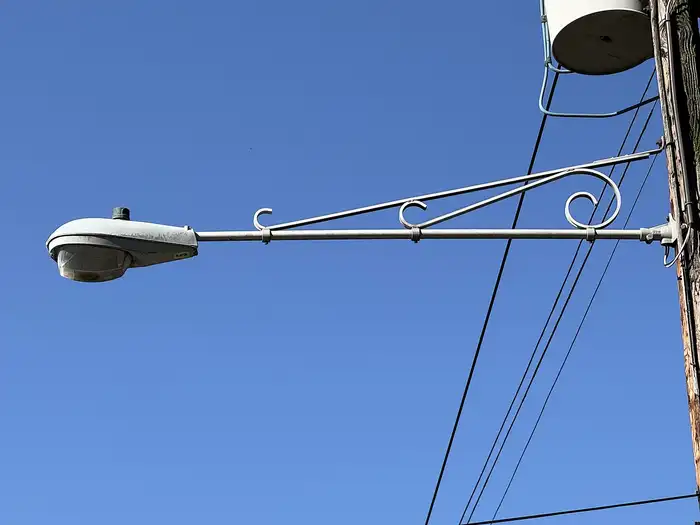
Mounting hardware is also graded for shake, not just strength. Luminaire makers certify slip fitter provisions against vibration classes such as "3G vibration per ANSI C136.31" for normal, bridge, and overpass applications. An arm that survives static load but resonates in a crosswind will crack a housing long before it bends a bolt.
Wind Loads: EPA Sets the Arm Budget
Wind, not weight, sizes most lighting brackets. The key figure is effective projected area, EPA for short. In the lighting trade, the EPA is "a two-dimensional projection of a three-dimensional object". It matters because it "helps to indicate the wind resistance of the particular luminaire (and thus the forces it will impose on the pole)".
The rating game works in one direction. The rule is to "ensure that the luminaire has an EPA less than or equal to the rating of the pole it will be fixed to". The same arithmetic extends down the arm. A longer bracket multiplies the torque applied at the pole attachment. A luminaire that fits a 2-foot arm comfortably can overload a 6-foot arm in the same wind zone.
In practice, the bracket budget gets checked three ways before an order is released. The fixture EPA must sit inside the pole rating. The arm length must match the roadway overhang the lighting plan calls for. The worst-case combination must still respect the pole's torque limit at the design wind speed. Skipping the middle check is how oversized arms end up on undersized poles.
The Arm Is a Structure, Not a Shelf
Cantilevered lighting supports live a dynamic life. Steady wind sheds vortices off the arm, gusts arrive in pulses, and every cycle loads the welds at the pole connection. This behavior is not folklore: it is written into the design standards. NCHRP research conducted for AASHTO studied wind-induced fatigue on structural supports and "a set of fatigue loads was recommended" for the specification covering signs, luminaires, and traffic signals.
El NCHRP report behind the AASHTO supports specification treats galloping and vortex shedding as first-class load cases, alongside natural wind gusts. For a buyer, the practical takeaway is simpler than the math. Welded tube-to-plate connections on a bracket are fatigue-sensitive details. Finish quality at those welds predicts service life better than the catalog's static load number.
It is the way you would judge a truck hitch: anyone can quote capacity, but the joint that survives ten thousand bumps is the one engineered for repetition. Ask a bracket supplier for the fatigue or vibration class of the luminaire connection, not only the yield strength of the tube.
Picture the arm on a coastal four-lane, fixture bolted at the three-meter mark, wind straight off the water. Nothing moves when you look up, yet the joint counts a gust cycle every few seconds, all night, for decades. That quiet arithmetic, not the nameplate weight, is what the specification exists to discipline.
Steel, Hot-Dip Galvanizing and the Shipping Drawing
Most steel light pole brackets leave the plant as carbon steel, hot-dip galvanized after fabrication. Coating thickness is the quiet difference between a bracket that outlives the pole and one that bleeds rust down the shaft. A genuine ISO 1461 hot-dip galvanized coating must achieve a mean thickness of at least 85 microns to protect the steel. Inferior production often leaves cut edges and internal hole surfaces thin.
Every bracket order should carry a dimensioned drawing, and the drawing does more than show shape. It fixes the arm reach, the rise at the luminaire end, the pipe diameter at the slip fitter, the plate hole pattern at the pole, and the finish. The drawing below shows a 1,828.8 mm reach with a 42 mm pipe end, specified as ASTM A123-equivalent steel with a hot-dip galvanized finish.
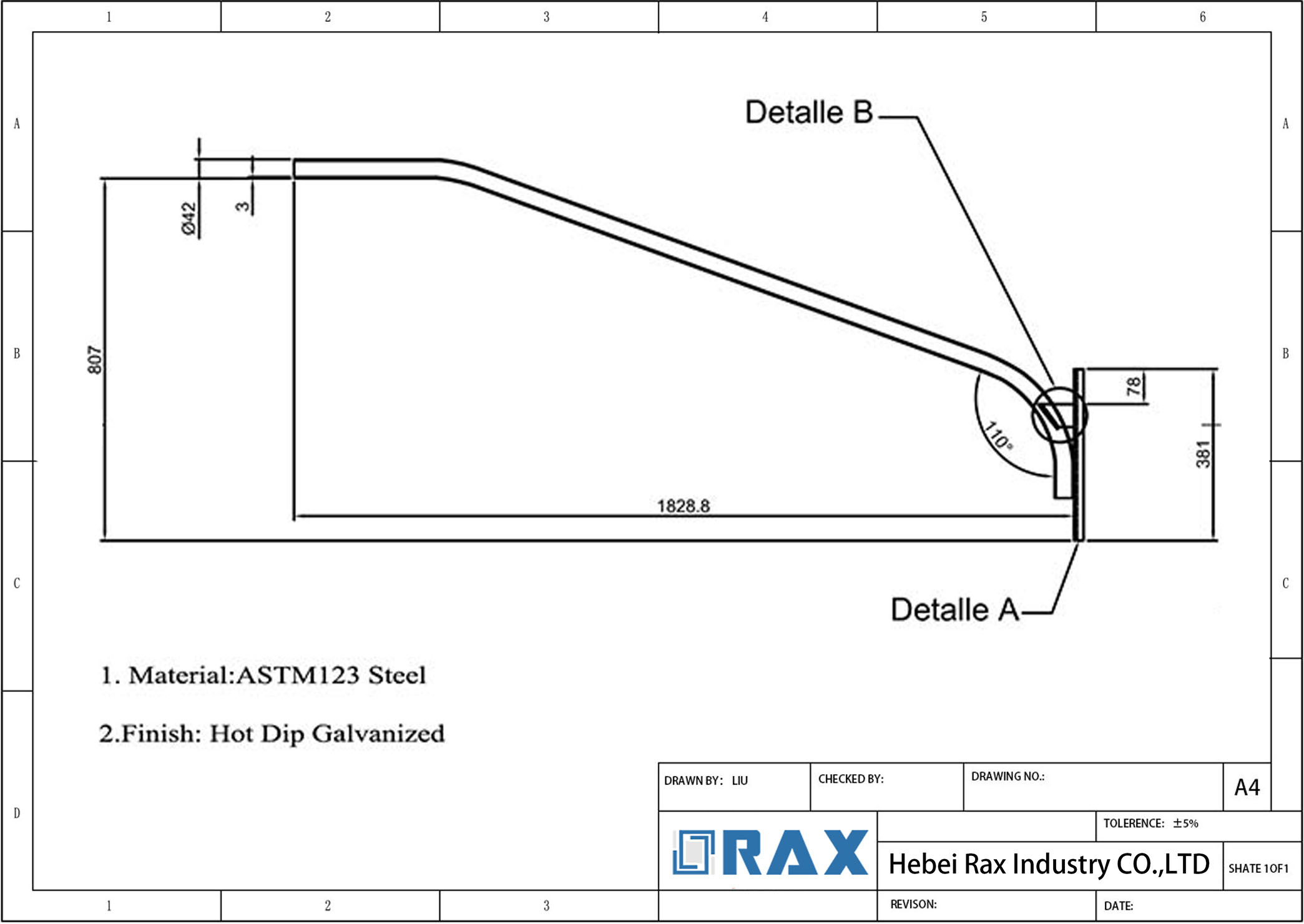
Tolerance lines on that drawing deserve attention during inspection. A bracket bent a few degrees out of plane looks fine in the box and wrong on the pole, with the luminaire aimed at the curb instead of the lane. Checking the drawing against the part before the bucket truck arrives costs nothing.
Mounting Height and Overhang Conventions
Bracket placement follows lighting geometry, not guesswork. The SUDAS manual brackets the range. Street luminaires mount anywhere from 15 feet to more than 100 feet above the street. Conventional municipal street lighting "utilizes mounting heights of 25 to 50 feet." Local streets typically run 25 to 30 feet, and collector and major streets run 30 to 40 feet.
The horizontal position gets its own term. Overhang is "the transverse horizontal dimension of the position of the luminaire relative to the edge of the roadway or back of curb," counted positive toward the street center. The bracket's reach, plus where it bolts on the pole, produces that number; the lighting designer sets the target and the installer delivers it.
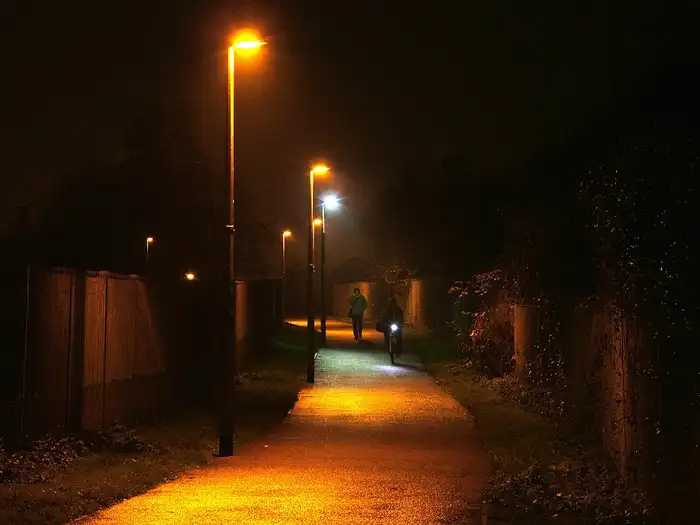
Uniformity ties the two dimensions together. Higher mounting with a longer reach covers more lane per pole, while lower mounts concentrate light and raise glare risk. A retrofit that changes bracket height or reach also changes the pole spacing inherited from the old design. The lighting plan, not habit, should approve the new position.
Spacing conventions also decide how many brackets a program buys per kilometer. A 30-foot mounting with a modest reach repeats every 30 to 40 meters on a collector road. Each repeat means one bracket, one banding or bolting kit, and one luminaire connection to seal. Multiply that by a district-wide relamping program and the difference between a 1-meter and a 2-meter reach becomes a purchasing decision, not a drawing detail.
Installing a Light Pole Bracket Step by Step
Installation splits into two families by attachment method. Band-mounted brackets clamp to the pole with steel banding and a back plate, which suits composite and concrete poles where drilling is restricted. The same banding logic is covered in the guía de montaje de soporte para poste con abrazadera de anclaje. Bolt-mounted brackets pass a through bolt into wood poles, giving a fixed joint for heavier arms.
The working sequence stays similar either way. Set the bracket height and orientation against the lighting plan before any fastener is pulled tight. Seat the pole-side attachment square, then torque the banding or bolt to the hardware's specified value rather than to feel. Present the luminaire, engage the slip fitter or tenon fully, clamp the setscrews in their pattern, and level the fixture with the leveling screw until the lens reads flat.
Two details separate a professional make-up from a marginal one. First, the drip loop and connector orientation on the lamp cable keep water out of the slip fitter cavity. Second, the setscrew engagement depth: a tenon seated shallow can pass a pull test and still walk out under months of vibration. Handover should record both.
Checks Before the Bucket Leaves the Pole
A finished bracket installation shows its quality in four checks. The luminaire sits level, the overhang matches the plan dimension, every fastener carries its marked torque value, and the cable leaves the housing with its drip loop intact. Photographing the torque marks and the level reading closes the record.
The same checks drive the purchasing decision in reverse. A bracket specified with the right reach, the right slip fitter range, a stated vibration class, and a certified galvanized coating gives the crew nothing to improvise. For buyers building a lighting hardware package, the adjacent parts matter too. The guide to what an anchoring clamp pole bracket is and how it works shows the banding side of the same pole.
Light Pole Bracket Questions Answered
¿Qué hace un soporte para poste de luz?
Se fija al poste y sostiene la luminaria, manteniéndola a la altura y el voladizo elegidos mientras resiste la carga muerta, la resistencia al viento y la vibración que genera la luminaria.
¿A qué tamaños de brazo se adapta un conector deslizante para farola?
La mayoría de las luminarias viales utilizan un conector de inserción de dos o cuatro pernos que sujeta brazos de 1-5/8 a 2-3/8 pulgadas de diámetro exterior, con tornillos de fijación para el ajuste y un tornillo de nivelación para la inclinación.
How high are street light brackets mounted?
Conventional municipal street lighting runs between 25 and 50 feet; local streets typically use 25 to 30 feet, while collector and major streets use 30 to 40 feet.
How do you size a bracket for wind?
Check the luminaire EPA against the pole and arm rating, keep the EPA at or below the pole rating, and confirm the assembly meets the vibration class the site requires.
Can a light pole bracket replace a cross arm?
No. A light pole bracket carries a luminaire, while a cross arm holds conductors and insulators clear of the pole, so the hardware, hole patterns, and load paths differ.