
Stellen Sie sich den letzten Mast auf einer neuen Versorgungsleitung vor. Der Leiter läuft unter voller Zugkraft ein, und der Mannschaft bleibt nur noch eine Aufgabe: die Strecke sauber an der Konstruktion beenden. Die Zugspannung des Kabels muss genau dort enden, nicht in den Mastkopf oder über die Beschläge weiterlaufen.
Eine Ankerspannklampe ist der für diesen Moment entwickelte Totendschlussbeschlag. Sie greift das Kabel, trägt seine volle Betriebszugkraft und leitet die Last in den Mast, Turm oder die Wandhalterung ein. Der Begriff umfasst zwei Baureihen: Polymer-Keilklemmen, die auf Faserrouten dominieren, und geschraubte Klemmen aus Aluminiumlegierung, die Verteilungsleiter halten. RaxPower produziert beide Varianten in seinem Werk in Hebei, wo mehr als 170 Spezialisten in Entwicklung und Schmiede arbeiten.
Kurzdefinition: Eine Ankerspannklampe, auch als Totendschluss- oder Zugspannungsklemme verkauft, beendet eine Freileitung und hält deren volle mechanische Zugkraft an einem Mast, Turm oder einer Wandbefestigung.
Anwendungsbereiche für Ankerspannklammern umfassen ADSS- und Figure-8-Faserrouten, ABC-Bündel-Totendschlüsse, auf Masten oder Wänden verankerte Hausanschlüsse sowie blanker Leiter-Totendschlüsse oder -Winkelstellungen an Verteilungsleitungen.
Zwei Baureihen übernehmen die Arbeit. Polymer-Keilklemmen werden von Hand montiert und spannen sich unter Last selbst nach. Geschraubte Klemmen aus Aluminiumlegierung der NLL-Baureihe dienen Leitern von 5 bis 32,6 mm mit Zugbelastungen bis 100 kN.
Zitierte Normen: IEC 61284 für Anforderungen und Prüfungen an Freileitungsbefestigungen sowie ASTM A153 oder ISO 1461 für feuerverzinkte Stahlteile.
Was eine Ankerspannklampe tatsächlich leistet
Jedes Freileitungskabel bewältigt zwei Lastarten. Aufhängungsbefestigungen tragen das Kabelgewicht in der Mitte einer Spannweite und lassen es bei Wind und Temperatur pendeln. Ein Totendschluss ist anders: Die Kupplung dort muss die volle Betriebszugkraft des Kabels halten und in die Konstruktion ableiten.
Das ist die Aufgabe der Ankerspannklampe. Sie beendet die Strecke, greift das Kabel fest genug, dass nichts nachrutscht, und überlässt dem Mast oder der Halterung die Kraftaufnahme. Richtige Klampe gewählt — die Terminierung bleibt langweilig, auf die bestmögliche Weise. Falsch gewählt — das Kabel kriecht, scheuert am Mantel ab oder gibt die Spannung auf, auf die die Durchhangtabellen basieren.
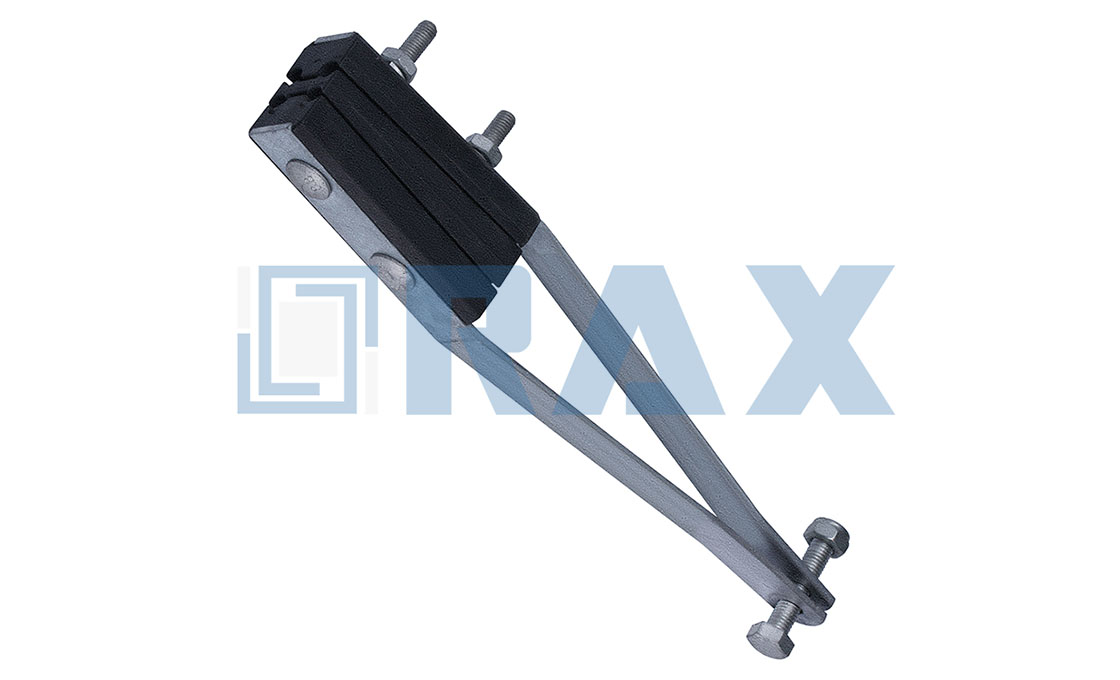
Zwei Konstruktionsbaureihen erledigen diese Arbeit. Polymer-Keilklemmen schließen sich per Hand um leichte, alldielektrische Kabel, wie bei den meisten Keil-Ankerklammern. Geschraubte Klemmen aus gegossener und geschmiedeter Aluminiumlegierung schließen sich um größere Leiter unter Schraubendrehmoment und halten deutlich höhere Lasten.
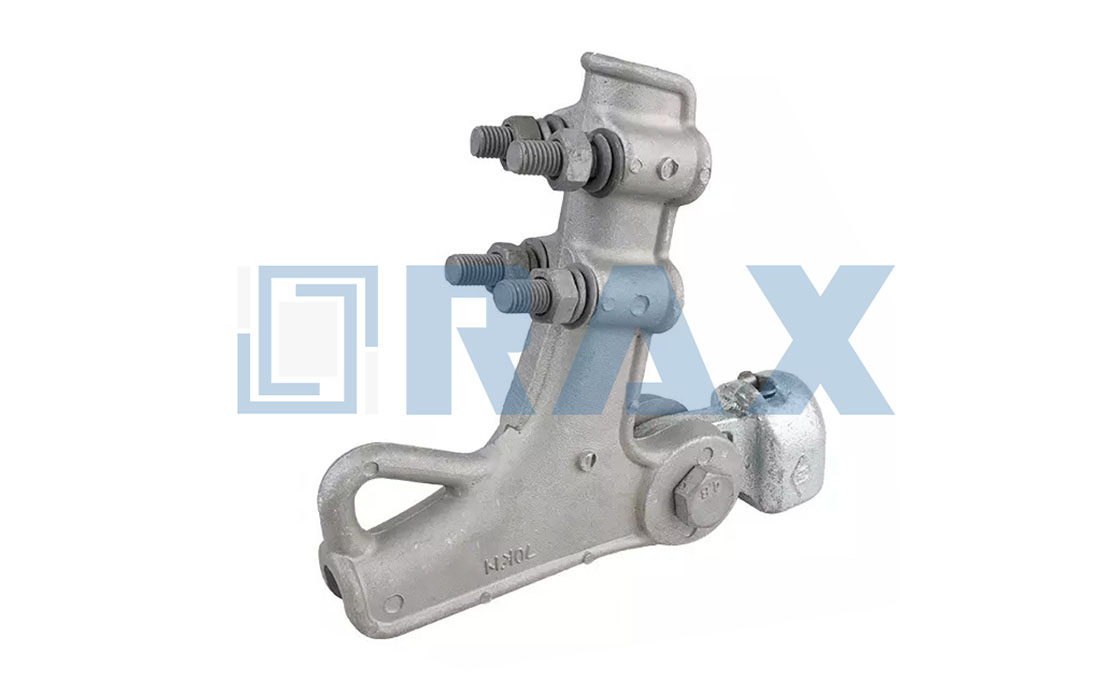
Die Unterscheidung ist beim Spezifizieren wichtig. Eine Keilklemme für einen 12-mm-ADSS-Mantel kann keinen blanken ACSR-Totendschluss halten. Eine für 26 mm Leiter ausgelegte Schraubklemme ist bei einer Faserzuführung eine sperrige Überdimensionierung. Der Rest dieser Seite ordnet zu, welche Baureihe wohin gehört und was jede Einzelne halten muss.
Wie der Halt ohne Quetschung funktioniert
Die Keilfamilie ist ein Paradebeispiel für Einfachheit. Ein konisches Gehäuse, meist glasfaserverstärkt, nimmt das Kabel von vorne auf, und zwei Polymer-Keile mit gezahnten Flächen sitzen dahinter. Zieht man das Kabel unter Zugspannung, wandern die Keile tiefer in den Konus, als würde die Last ihren eigenen Schraubstock anziehen.
Die Haltekraft skaliert daher mit der Leitungsspannung. Bei Schlaffseil sitzen die Keile locker genug, um sie von Hand zu positionieren; bei Nennlast verriegeln sie. Der Klemmdruck verteilt sich um den Mantel herum statt an einem einzelnen Bolzenpunkt zu konzentrieren — genau das benötigen empfindliche alldielektrische Kabel von ihren Beschlägen.
Geschraubte Klemmen gehen den anderen Weg. Ein Aluminiumlegierungsgehäuse trägt eine Brücke oder einen Halter, den zwei oder mehr Bolzen auf den Leiter pressen. Der Halt wird durch Bolzendrehmoment und Kontaktfläche eingestellt und nicht durch den Keilwinkel, und der Lastpfad verläuft durch Metall, das gegen die Bruchkraft des Leiters ausgelegt ist.
Beide Ansätze teilen eine Regel. Die äußere Kabeloberfläche nimmt den Klemmdruck auf, daher entscheiden Klemmgeometrie und nicht rohe Kraft darüber, ob eine Terminierung Wind, Eis und ein Jahrzehnt Temperaturwechsel übersteht.
Ankerspannklammern-Anwendungen in freien Netzen
Fragen Sie, wo sich Ankerspannklammern-Anwendungen konzentrieren, lautet die Antwort überall dort, wo ein Kabel bewusst enden, abbiegen oder gegriffen werden muss. Fünf Szenarien decken den Großteil der Einkaufsbedarfe ab.
| Szenario | Kabel | Klemmenfamilie | Feldhinweis |
|---|---|---|---|
| ADSS-Backbone-Routen | Alldielektrisches Rund-ADSS | Polymer-Keilankerklemme | Kurze Spannweiten, Schleifen am Mast geschlaufen |
| FTTH-Zuführungsstrecken | Figure-8 selbsttragende Zufuhr | Keilklemme mit Tragdrahtnut | Tap-offs from aerial distribution |
| ABC service drops | Two or four core insulated bundle | Service anchor clamp | Anchors at pole or wall bracket |
| Distribution dead-ends | Bare ACSR or AAAC | Bolted NLL series | Full running tension at line ends |
| Angle and substation entrances | Bare conductor | Bolted NLL series | Angle poles up to 90 degrees |
The pattern to notice: fiber and service scenarios are diameter-matched and tension-light, while bare-conductor dead-ends are load-matched and tension-heavy. The same product name covers both, which is why selection discipline matters more than catalog branding.
ADSS- und Figure-8-Faserrouten
All-dielectric self-supporting cable carries no metallic strength member, so its hardware cannot bite with metal teeth and cannot introduce a conductive path. Polymer wedge anchor clamps were designed around that constraint. They pair glass-fiber reinforced housings and polymer wedges with a soft bail that ties to the pole bracket, as catalogued across the Glasfaserkabel-Hardware line.
Manufacturers band these clamps by jacket diameter. Supplier datasheets for ADSS anchor clamps quote routes up to 100 meters, with slack loops stored at the pole for splicing and future taps. Anchor tension clamp applications on fiber routes therefore cluster at pole positions: line ends, mid-route tension points, and loop storage at joint locations.
Figure-8 drop cable adds a messenger to the same logic. The clamp grips jacket and messenger together, so the drop hangs from its own strength member rather than from the fibers. The wedge geometry also keeps the small jacket from ovalizing.
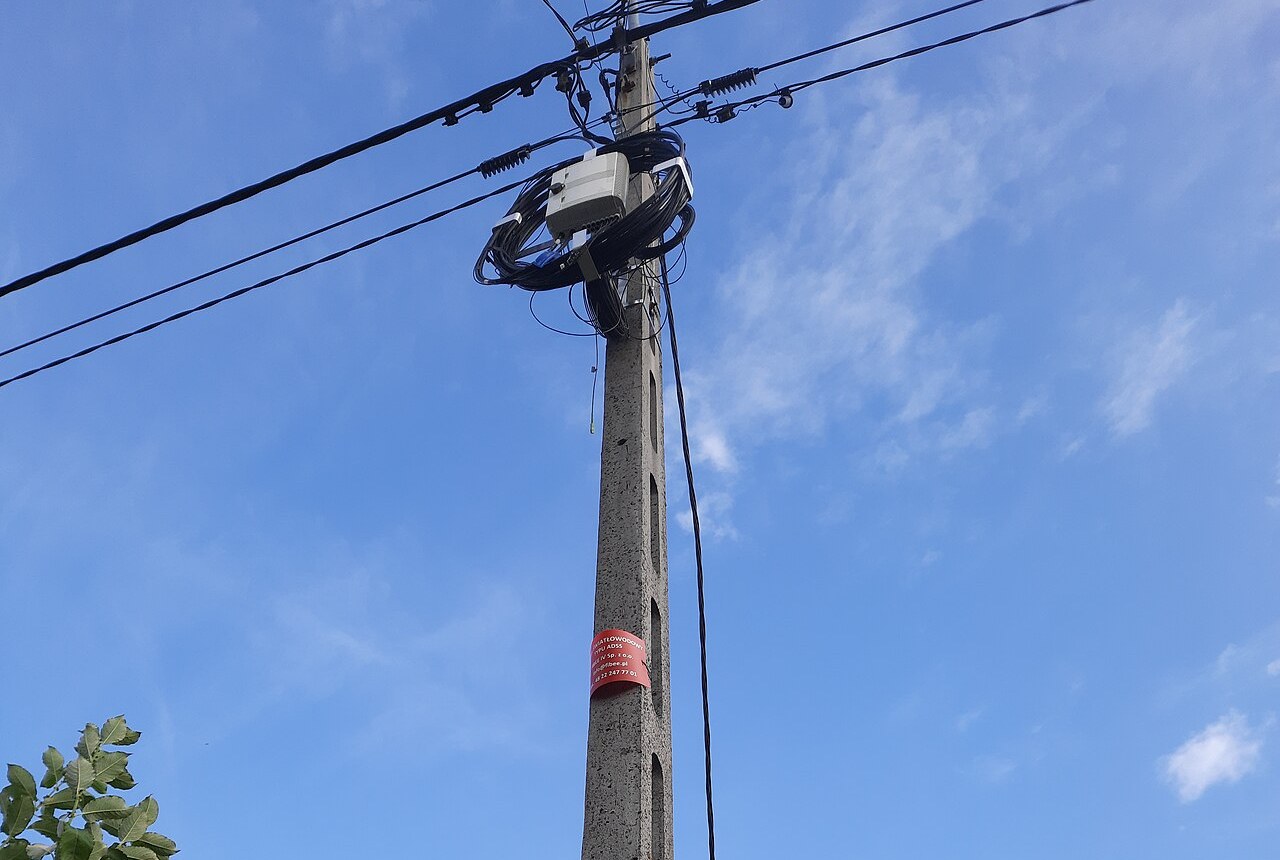
When the route leaves the backbone and turns toward a subscriber, the same clamps follow it. Aerial fiber, in practice, is a chain of anchor points joined by slack.
ABC-Verteilung und Totendschlüsse bei Hausanschlüssen
Aerial bundled cable, and the service drop that leaves it, create the dead-end points most people actually see from the street. A two or four core insulated bundle crosses from the pole to the customer’s wall bracket. Both ends are anchor tension clamp applications: the cable terminates, the tension stops, and everything downstream hangs slack into the meter position.
Wedge-type service clamps dominate this scene because crews install them by hand, on the pole and at the wall, with no press and no pumping equipment. The self-tightening principle is identical at this scale; only the jacket bands shrink to match small bundle diameters.
On the mains side, bundled feeders end at poles the same way bare conductors do, and bolted clamps take over as bundle diameter and line tension climb. The two families hand off to each other along one route without the crew changing philosophy.
Passende Klemmenbaureihe für Leiter und Last wählen
Bolted clamp selection starts from two numbers on the conductor datasheet: overall diameter and rated breaking strength. The clamp’s grip band must contain the diameter, and its rated tension load must meet or exceed the design tension, on the Spannclips family page as in the field. NLL series clamps quote grip of at least 95 percent of the conductor’s breaking force, with loads that climb through the range.
Three bands from that series show the spread.
| Typ | Conductor range (mm) | Tension load (kN) |
|---|---|---|
| NLL-1 | 5 – 15.5 | 68 |
| NLL-3 | 11.4 – 22.6 | 93 |
| NLL-6L | 25.9 – 32.6 | 100 |
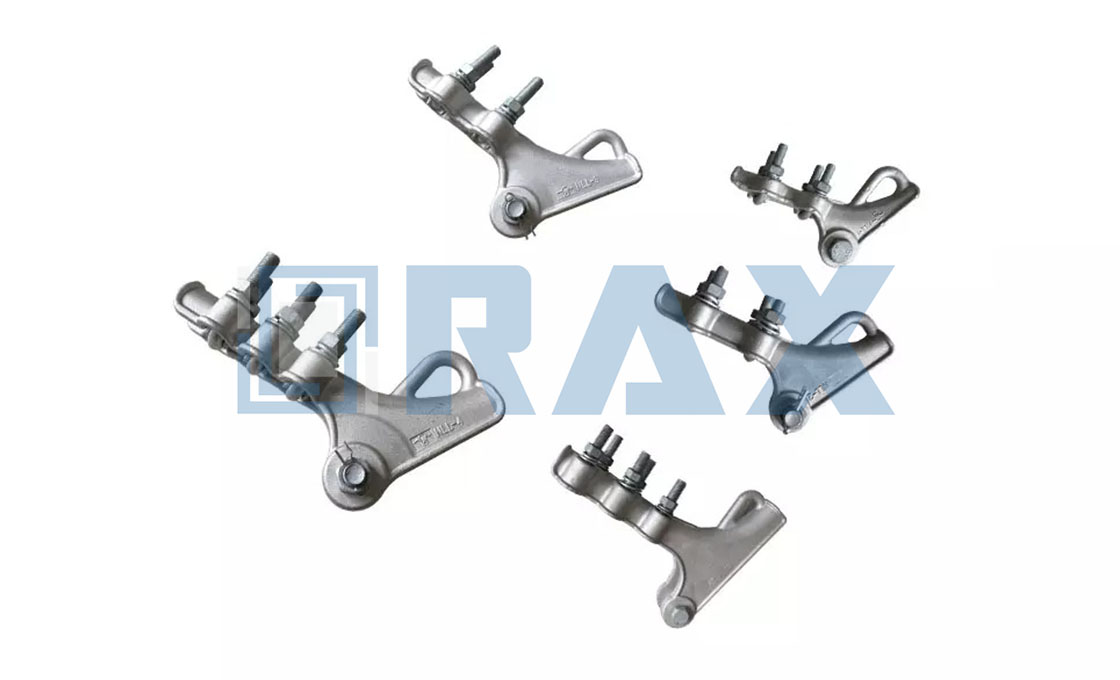
Bodies and keepers are high-strength aluminum alloy; bolts, washers, and hardware that touch steel structures are hot-dip galvanized to keep the corrosion pair honest. Where a termination must also damp vibration, the geformten Draht family of preformed grips is the companion choice rather than a substitute.
Wedge families follow the same discipline with jacket bands instead. A band marked 10 to 14 mm is honest about its range, and cable outside the band either slips or gets squeezed. Neither failure announces itself at installation.
Installationspunkte zum Schutz des Kabels
Most field problems trace back to four habits. Clean the cable surface before gripping, because jacket dust and oxidation steal friction. Verify the diameter band, since the clamp is honest only inside it. Seat wedges in the direction of pull, so tension drives them tighter instead of backing them out. And close bolted clamps in the sequence and to the torque the datasheet calls for.
In our experience, skipped re-torque is the quiet failure. Bolts bed into conductor strands during the first months of load and thermal cycling. A clamp that left the truck correct can run loose a year later if nobody returns with a wrench.
Never reuse polymer wedges after removal. The serrations deform on the first installation, and a second one never reaches the same grip.
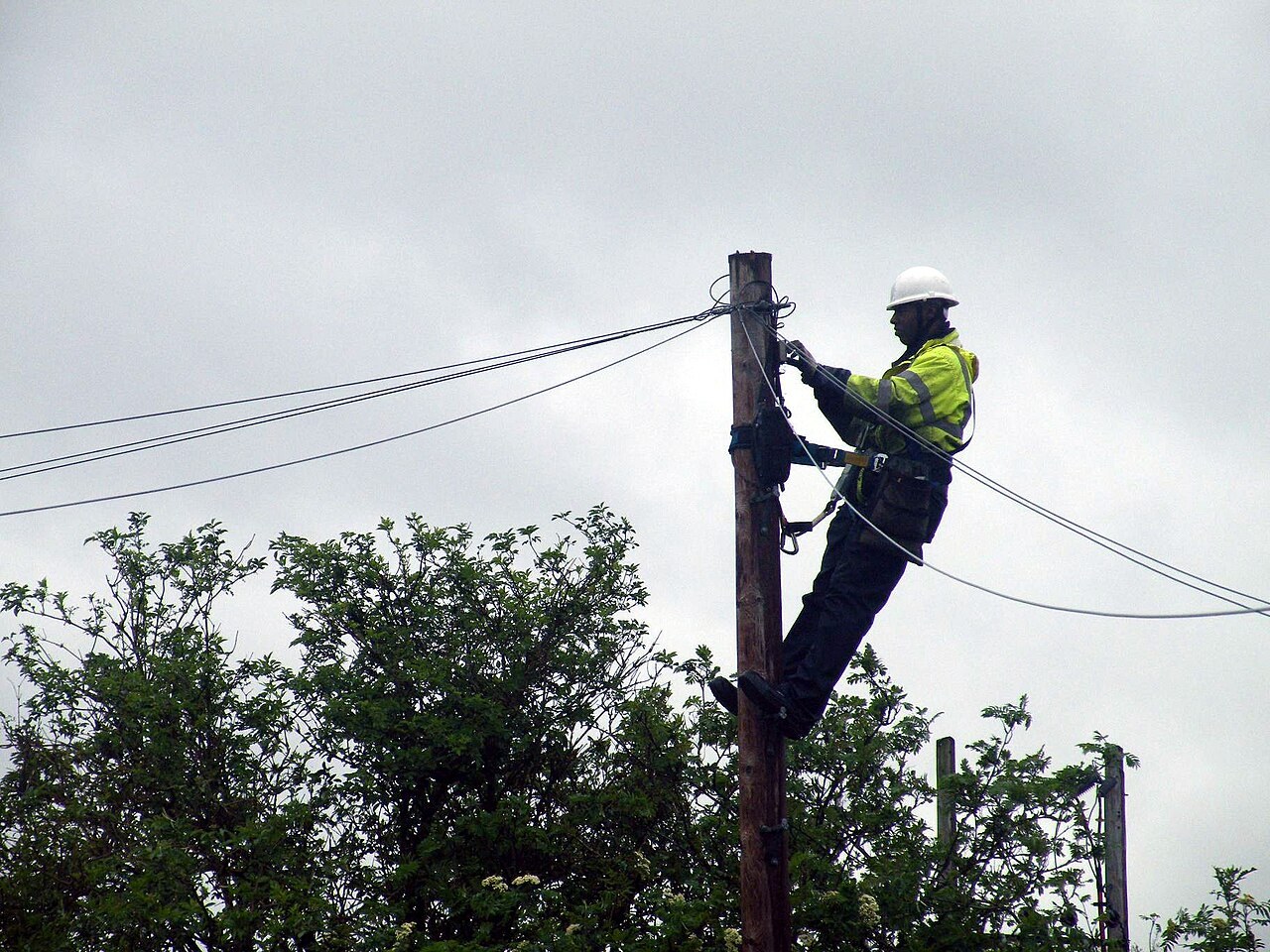
One more habit earns its keep on bundled cable. Support the bundle weight while the clamp takes tension, so the wedge seat forms under controlled load rather than under a falling span.
Inspektionsgewohnheiten zur Lebensdauerverlängerung
Anchor positions reward short, regular attention. From the ground, look for wedge slip lines at the clamp mouth, jacket shine where the cable has been moving, and hardware that has lost its zinc. Bolted clamps deserve a torque wrench at the interval the maintenance cycle defines; wedge clamps need eyes on bail wear and housing cracks.
Until a clamp slips, the hardware is invisible, which is precisely why the inspection route should name every anchor position instead of trusting memory. Hot-dip galvanizing does the long-term work on steel parts, aluminum bodies tolerate most atmospheres, and coastal or industrial air simply shortens every interval on the schedule.
Einkaufshinweise für Versorgungs- und Telekommunikationskunden
Specification documents settle most anchor tension clamp applications before they happen. Call out the cable diameter and rated breaking strength, the clamp family and band, the standard for fitting tests, and the galvanizing standard for steel parts. Testing against IEC 61284, the international requirements-and-tests standard for overhead line fittings, gives both sides one yardstick; galvanized components typically reference ASTM A153 or ISO 1461.
Ask suppliers for load test reports rather than catalog claims, and for dimensional drawings that match the band you are buying. RaxPower, a pole line hardware manufacturer founded in 2003 in Hebei, China, produces its NLL series by hot forging and supplies buyers in more than 70 countries. Custom-engineered clamps are available against project drawings, with samples and inspection reports on request.
One last habit: standardize band markings across crews. Mixed bands in one truck are how a 22 mm conductor meets a clamp cut for 13 mm. No inspection program catches that faster than one printed band table in every vehicle.
Frequently Asked Questions About Anchor Tension Clamps
Welche Kabelgrößen deckt eine Ankerspannklampe ab?
Bolted NLL families span conductor diameters from 5 to 32.6 mm across their size bands, while wedge families are banded by jacket diameter. Select by measured cable diameter, never by span length alone.
Kann eine Klampe sowohl ADSS- als auch ABC-Kabel halten?
No. Grip geometry differs: wedge clamps cushion delicate dielectric jackets, while bolted clamps press metal conductors. Substituting one for the other invites slip or jacket crushing.
Benötigen Keil-Ankerklammern Spezialwerkzeug?
No. The wedges seat by hand, and line tension locks them. Bolted clamps need standard wrenches plus the datasheet torque sequence.
Welche Normen gelten für diese Befestigungen?
IEC 61284 defines requirements and tests for overhead line fittings. Hot-dip galvanized steel parts reference ASTM A153 or ISO 1461.
Wie oft sollten installierte Klammern inspectiert werden?
Follow the utility’s maintenance cycle, with annual ground-level checks as a common baseline. Watch for wedge slip, jacket movement, and lost zinc, and re-torque bolted clamps after the first load season.