
Pigtail eye нные, hang dead-end clamps, suspension clamps, and cable brackets on wood and concrete poles across distribution and telecom networks. The bent loop at the head makes the bolt easy to hang hardware from in tight spots. It also raises a fair question about pigtail eye bolt load capacity: how much pull can the curved head actually take?
At RaxPower, our order desk still fields inquiries that say “pigtail bolt” on one line and “pigtail eye bolt” on the next. Same forged part, same question attached. In our experience, most of those questions are really about limits: what the bolt holds in a straight pull, and where a heavier fitting has to take over. This guide answers both with published load data rather than catalog adjectives.
What a Pigtail Eye Bolt Actually Is
A pigtail eye bolt is a through-bolt with a threaded shank, a bent looped head, and a bearing face where the loop meets the pole. The kit is simple: the forged body, two washers, and two hex nuts. A complete assembly includes the main body, two hex nuts, and two washers, with the loop threaded through a pre-drilled hole.
The current data sheet for this product family lists an M16 thread, a 210 mm overall length, a 40 mm eye diameter, and hot-dip galvanizing per ISO 1461. Aliases abound — pigtail hook, pigtail fastener — but the working parts stay the same. The loop is not a closed, butt-welded ring like a rigging eye. It is a bent round that leaves a curve, and that single difference shapes every load number that follows.
Within the pole line fastener family, this bolt sits on the attachment side of the catalog. It lives next to lag screws and cable suspension bolts, not the big machine bolts that clamp crossarms. It exists because distribution and telecom crews constantly hang things off poles: dead-end shoes, suspension clamps, sign brackets, drop-wire hooks. A curved head accepts that hardware without a shackle, a thimble, or an extra link in between.
Eye orientation is the ordering detail that separates smooth installs from rework. An in-line eye pulls along the shank axis, while a cross-mounted eye sits at right angles to it. Quote the wrong orientation and the loop fights the hardware all the way down the pole line. The common pole line fastener configurations follow the same logic for every bolt on the structure.

Where the Load Rating Numbers Come From
Every serious pigtail eye bolt load capacity figure starts as a minimum breaking load, or MBL, measured on the finished bolt. Manufacturers pull complete assemblies to failure and publish the lowest result. One distribution hardware catalog lists MBL ratings climbing from 10 kN at 12 mm to 15 kN at 16 mm and 22 kN at 20 mm. Every size is hot-dip galvanized steel.
Safety factors turn an MBL into a working figure. Industry selection guidance sets the factor at 2.5 to 4 times the design load, and the bolt’s MBL must exceed that product. A 15 kN bolt therefore serves a line whose worst combined load stays under roughly 4 to 6 kN. That is real carrying capacity, but it is far below what the same rod could carry straight.
MBL is not the same thing as a working load limit, and the difference matters in quotations. MBL is the force at which the part actually failed in a test. A working load limit is the much smaller number the part is allowed to carry, derived by dividing out the safety factor. Rigging catalogs publish WLL tables; line hardware catalogs publish minimum tensile or MBL values. Reading one for the other overstates capacity by a factor of two or more, so ask which number a supplier’s sheet shows before comparing prices.
Tensile testing is also how a shipment gets accepted. Suppliers verify MBL on sample parts before release, and a serious mill links the result to the batch so the certificate in the crate matches the bolts in the crate. Ask for that paperwork with the quote, not after the container sails. It is the cheapest audit a buyer can run on a load number nobody saw being measured.
The Bend Governs the Rating, Not the Rod
Here is the part that surprises buyers. The steel rod that goes into a 16 mm pigtail bolt is several times stronger than the finished part’s rating. One fastener catalog lists 16 mm rod material at 500 MPa yield and 143 kN tensile load, with 700 MPa ultimate strength. Another catalog rates the finished 16 mm pigtail bolt at just 15 kN MBL.
| What the catalog rates | Стоимость | Обоснование |
|---|---|---|
| Rod material, yield | 100.5 kN | 16 mm rod at 500 MPa |
| Rod material, tensile | 143 kN | Straight rod before bending |
| Finished pigtail bolt, MBL | 15 kN | Bent assembly, pulled to failure |
The gap is the bend. Bending cold-works the outer fibers of the loop and leaves residual stress exactly where the hardware hangs. The curve also concentrates contact stress where a clamp tongue rides the steel. This is why a credible pigtail eye bolt load capacity claim always quotes the assembly MBL, never the rod grade.
In-Line Pull Versus Side Load
Load direction decides everything for bent-eye hardware. Rigging engineering is blunt about it: always apply load to an eye bolt in the plane of the eye, not at an angle. For angular pulls, forged eye bolts are derated to 30 percent of rated working load at 45 degrees and 25 percent at 90 degrees. Regular nut eye bolts are banned from angular lifts outright.
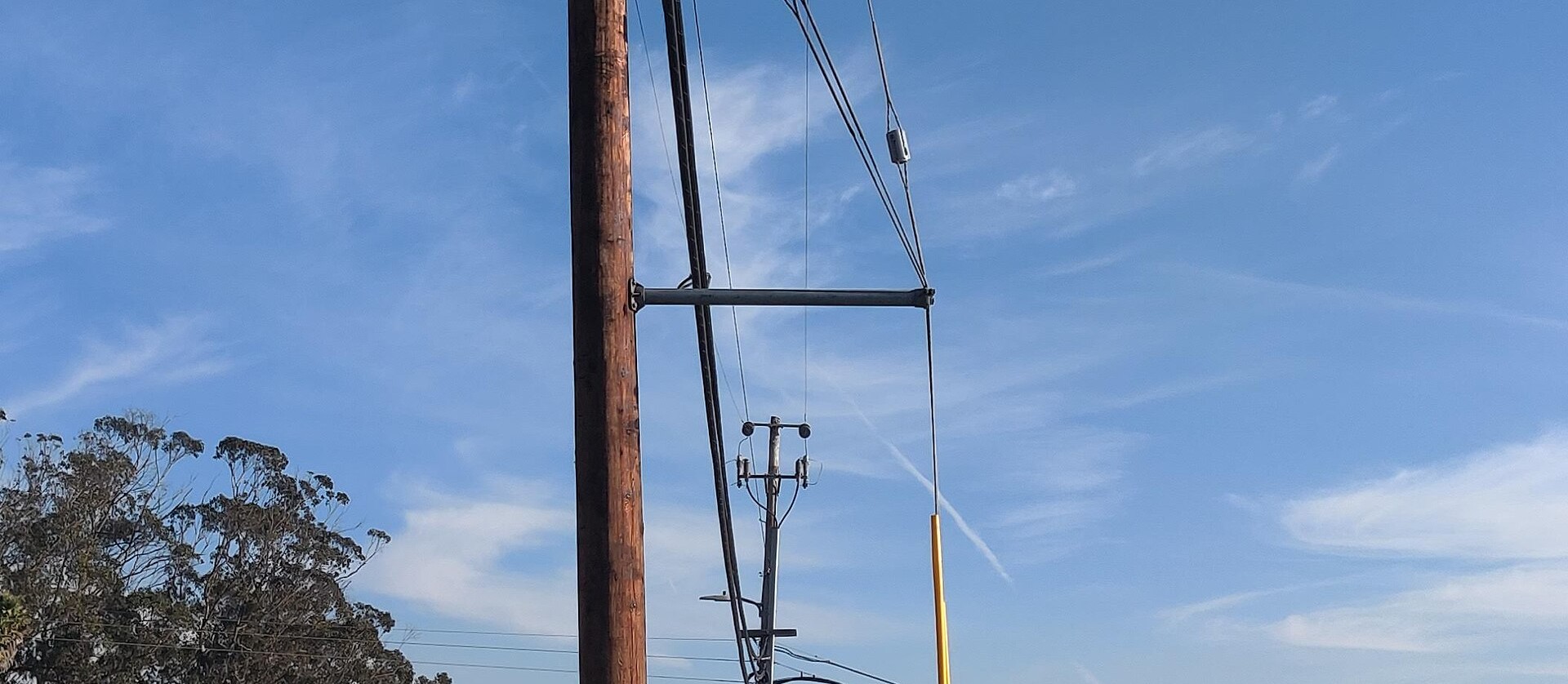
Like a truck hitch, the pigtail loop wants its pull along one axis. The axis is fixed on installation: the loop sits perpendicular to the pole face, and hardware hangs plumb from it. A dead-end clamp that pulls straight out from the pole loads the loop in its plane. That is the intended path.
The same bolt bends quietly under a side pull. Picture the loop as a bottle opener: sideways leverage works the bend open one storm at a time. Until a wind front loads the span unevenly, nothing looks wrong. By the time the loop has opened visibly, the assembly has already been past its rating for months.
Sizing a Pigtail Bolt Against the Real Load
Work the numbers in order. Add conductor tension at the dead-end, wind pressure on the span, and ice load into one design load. Multiply by a safety factor of 2.5 to 4. Then choose the smallest catalog MBL above that result. A quick worked example shows how the pigtail eye bolt load capacity numbers behave. A 3 kN design load times a factor of 4 demands a 12 kN MBL, so a 15 kN bolt at 16 mm fits with margin. A heavier rural dead-end at 6 kN, held to the same factor of 3, calls for the 22 kN of a 20 mm bolt.
Installation protects the rating. Torque the double nuts to roughly 110 to 130 N·m on an M16 shank, seat both washers flat against the pole, and recheck torque after the first month. Overtightening stretches the shank, and a loop knocked sideways in transport arrives pre-fatigued before it ever carries load.

What Counts as a Heavy Load on a Pole Line
On distribution structures, heavy rarely means weight; it means tension. A low-voltage dead-end clamp on a 16 mm pigtail bolt holds a short span of bundled cable, a few hundred newtons of steady pull. A guying point on the same pole can hold several kilonewtons around the clock. The pigtail eye bolt load capacity ceiling sits between those worlds: it owns light clamp and bracket duty, not primary guy loads.
Guy-side hardware earns its heavy rating from a different geometry. Where a pole changes direction or ends a line, the pull runs through a крюк для оттяжек or a thimble eye into an anchor rod buried in tested soil. Those assemblies are sized as a chain, and every link is rated above the strand it holds. The ассортимент крепёжных элементов для тросовой растяжки exists precisely because a bent loop on a wood screw cannot be the last link in that chain.
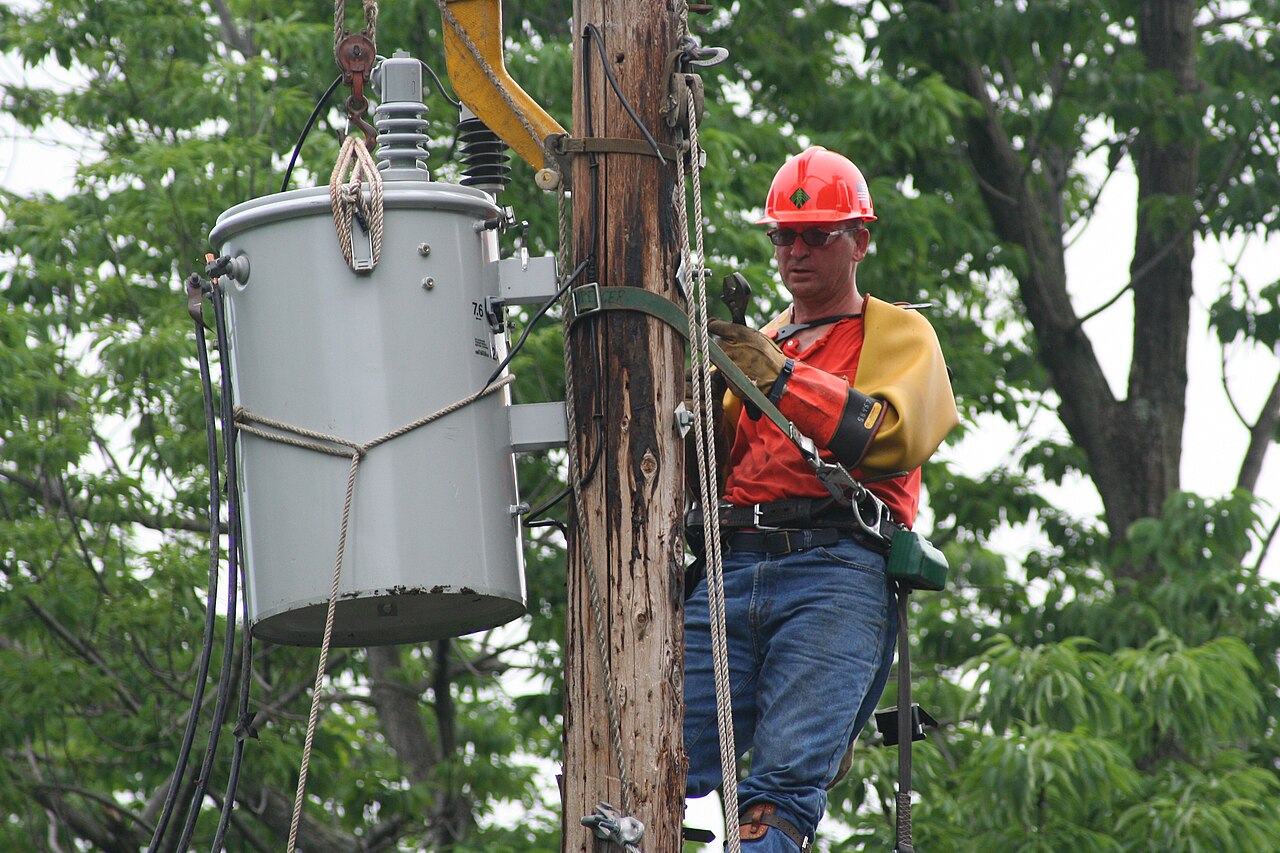
When the job is a transformer change-out or a winched pole setting, that is temporary rigging, and rigging rules take over. Crews hang those loads from rated slings and forged lifting eyes, never from line hardware. The pigtail bolt’s job is to hold clamps, brackets, and cable — and within its MBL, it does that well.
When a Forged Eye Bolt Is the Better Answer
Three signals move a job off a pigtail bolt. First, a side load the assembly cannot avoid, such as a bracket that must hang at an angle. Second, a guy or dead-end point whose design load times the safety factor approaches the pigtail’s MBL. Third, any lift — anything a crane, hoist, or winch raises.
The upgrade path is short. North American catalogs rate a 5/8-inch thimble eye bolt at 13,550 pounds minimum tensile, and its 3/4-inch sibling at 20,050 pounds. Both are forged in straight and 45-degree styles for guy and dead-end work. For true lifting, forged shoulder eye bolts carry published working load limits — 1,800 kilograms for a 16 mm size in line. Match the fitting to the load path and the bolt stops being the question.
Between those two upgrades sits the thimble eye’s real advantage: a broad radius gives guy strand a gentle seat instead of a sharp kink. That is why the style dominates permanent guying while pigtail styles dominate hanging duty. Where vibration takes up slack, a кобыла completes the assembly with an adjustable tension path.

Field Practices That Protect the Load Path
Most pigtail bolt failures trace back to three causes: overload, fatigue, and loosening. None of them start dramatically. A nut backs off a quarter turn, washers creep into soft wood, and the loop begins to work in its hole each time the wind crosses the span.
Inspection is therefore visual and cheap. Look for a loop that has opened, elongated, or lost zinc at the bend. Check that both nuts still take a wrench firmly. Recheck torque one month after installation, inspect after severe weather, and run a comprehensive check at least annually. Crews who set line hardware the way you set a turnbuckle — snug, locked, and documented — rarely see a bent loop in service.
Часто задаваемые вопросы
Подходят ли болты-кольца с резьбовым стержнем для тяжелых нагрузок?
Да — для осевой нагрузки в пределах номинальной MBL и при наличии надлежащего коэффициента запаса. Нет — для боковых нагрузок или строповки свободного подвешивания. Для таких работ правильным выбором является плечевой кованый болт с проушиной, имеющий опубликованную таблицу допустимых нагрузок.
Какой груз может выдержать рым-болт с петлей?
Номинальные нагрузки на разрыв винтов с оком, опубликованные в каталогах, составляют примерно от 15 кН минимальной разрушающей нагрузки при размере 16 мм до 22 кН при размере 20 мм. Прямой стержень прочнее в несколько раз; именно изогнутая петля определяет эту цифру.
Can a pigtail eye bolt take a side load?
No. Rigging guidance for bent-eye hardware says to apply load in the plane of the eye. Eye bolts pulled at an angle are derated to 30 percent of rated load at 45 degrees and 25 percent at 90 degrees.
Which carries more, a pigtail bolt or a thimble eye bolt?
A 5/8-inch thimble eye bolt is listed at 13,550 pounds minimum tensile strength, while a finished 16 mm pigtail bolt sits near 15 kN, about 3,400 pounds. Thimble eyes take the heavier guy and dead-end points.
How should I size a pigtail bolt for my line?
Build a design load from line tension, wind, and ice, apply a safety factor of 2.5 to 4, then choose the next MBL above that figure. Confirm the value on the batch test certificate, not the rod grade.