
Picture the same polished aluminum toroid bolted to a transmission insulator string and mounted at the top of a transformer bushing. The physics has not changed between those two jobs. The ring bonds to the high-voltage conductor and pushes the surface gradient below the corona threshold wherever it wraps. What changes is everything around the ring: the geometry it must clear, the hardware it bolts to, and the engineer who sized it. Corona ring application is therefore decided by the host equipment, not by the ring alone.
RaxPower has manufactured pole line hardware since 2003, and the company’s 170+ specialists ship line fittings and insulator assemblies to utility, contractor, and distributor buyers worldwide. That factory vantage point shapes this guide. Most corona ring writing treats the ring as a line-string accessory and gives station apparatus a passing sentence. This guide reverses the order: it starts at the substation fence, where bushings, breakers, instrument transformers, cable terminations, and arresters each impose their own selection logic.
Why Equipment Type Changes Corona Ring Application
On an overhead line the ground rules are compact. Manufacturers suggest a ring on the line end of an insulator string above 230 kV, and rings at both ends above 500 kV. The discs down the string share the operating voltage, and the ring shields the end fitting where the conductor arrives. If you need the line-string playbook, the existing application practice guide, the installation walkthrough, and the design parameter guide cover it in depth.
The physics stays identical on every host. Air breaks down at roughly 30 kV per centimeter at sea level, so curvature, not raw voltage, decides whether a surface stays quiet. A toroid is a curvature machine: it replaces sharp fittings with one smooth equipotential surface, as the function explainer details. Corona rings appear on very high voltage insulators, bushings, and switchgear for exactly this reason.
Three variables move when the host changes. First, geometry: the ring must wrap a bushing terminal, a breaker stud, or a termination connector instead of a string fitting. Second, interface: the mounting collar must match host drawings, not generic clamp hardware. Third, ownership: a line-string ring is utility-specified catalog hardware, while an apparatus ring is engineered with the equipment it dresses. Those three variables organize corona ring application on every host below.

Transformer Bushings: Grading Inside and Outside
A bushing is a hollow insulator that carries a conductor through a grounded barrier, and a high-voltage transformer bushing does double duty in field control. Inside, the condenser core does the quiet work: very fine metallic foil layers are inserted during winding, forming concentric capacitors. This capacitance grading distributes the electrical stress over the entire length of the bushing, and the approach has proven itself at service voltages above one million volts. The paper insulation is impregnated with oil historically and with resin more commonly today.
The internal core, however, cannot help the air side. Where the top terminal meets the flange and the yard, the geometry turns sharp again, and that transition is corona ring territory. Grading rings on transformer bushings are documented practice: one toroid at the energized terminal, bonded to the conductor path, smoothing the field that the condenser core cannot reach. The way you match a ring to a bushing parallels the way you size a lug to a conductor, not to the bolt beside it.
IEC 60137:2017, the bushing standard, “specifies the characteristics and tests for insulated bushings” and “is applicable to bushings made and sold separately.” Its ratings now reach Um = 1200 kV, and dry lightning impulse testing is a routine test for all transformer bushings with Um above 72.5 kV.
Two selection consequences follow. Because bushings are sold as separately tested components, the ring is specified with the bushing and matched to its top-terminal geometry rather than picked from a line catalog. And where a bushing serves converter duty on DC circuits, resistive grading joins the capacitive grading inside the core, which changes the external field picture the ring must handle.
Instrument Transformers: Rings on Tall Terminals
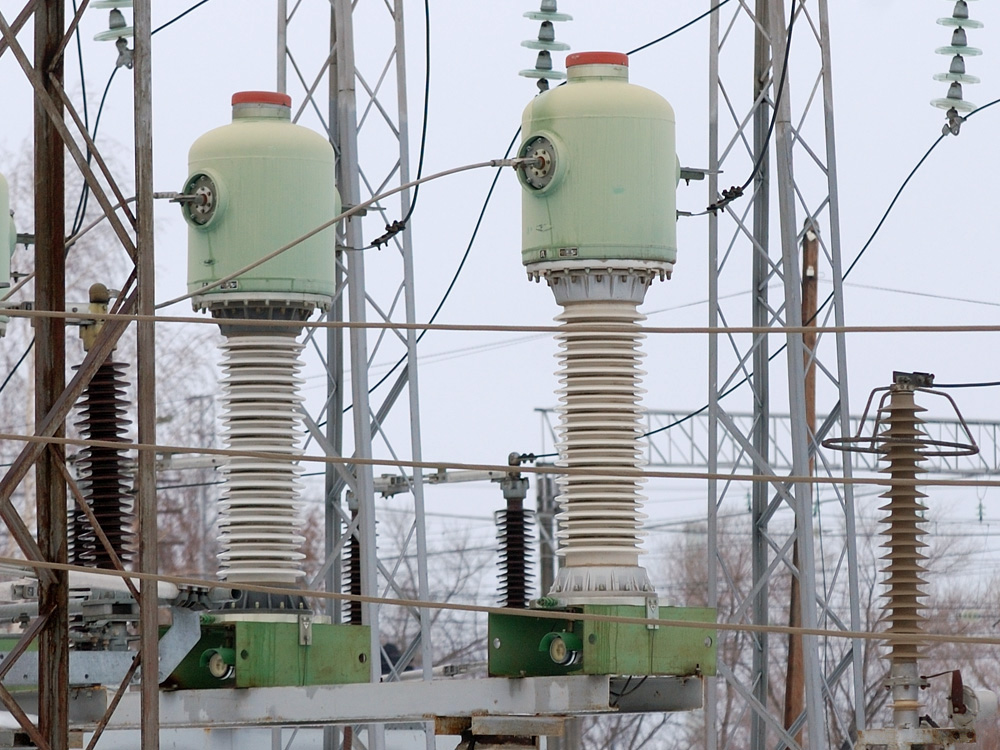
Current transformers and voltage transformers are instrument transformers: they scale primary current or voltage to small standardized values and isolate metering and protection circuits from primary high voltage. They stand in generating stations and substations as tall, slender units, and commercial families reach 550 kV and 800 kV classes. The insulation column is long, but the terminal at the top is small, compact, and exposed.
That combination makes the corona ring application simple in shape and strict in fit: a single compact toroid at the top terminal, concentric with the housing axis. The ring, terminal, and housing form one geometry, so the arrangement tolerates little improvisation. In our experience these rings arrive already mounted, because the apparatus manufacturer controls all three dimensions at once. A field-fabricated substitute rarely clears the housing profile without creating a new stress point.
Cable Terminations: Stress Control and Corona Suppression
A high-voltage cable termination solves a problem no line fitting has. The metallic shield must end somewhere, and the voltage that built up across the cable insulation must reach free air gradually. Hand-taped stress cones have addressed this on cables of about 2.5 kV and upward, and modern practice slips a pre-molded rubber stress cone over the cable end. In today’s accessories, the main component is a stress control element with a semi-conductive electrode of silicone rubber or EPDM. One basic design family spans rated voltages from 60 kV to 500 kV, under a porcelain or composite outer housing.
The cone and the ring protect different surfaces, and confusing them wastes money. The cone manages the longitudinal gradient inside the accessory, from cable insulation to air, with no help from any external hardware. A ring does nothing for that gradient; its only job is to smooth the field at the air-side terminal hardware where the connector, bolted joints, and mounting plate sit. A termination that needs terminal treatment borrows bushing practice, and nothing else.
Qualification reflects this split. Extruded cable accessories are type-tested as parts of complete cable systems, and the standards cover the accessories alone as well as the cables. IEC 60840:2020 governs the range from above 30 kV up to 150 kV, and IEC 62067:2022 governs above 150 kV up to 500 kV. Anything added at the terminal belongs inside that tested assembly, not bolted on afterwards as an afterthought.
Insulator Strings Built for Graded Service
Overhead line insulators and string hardware for transmission and distribution, supplied to your project drawings.

Surge Arresters: Top Ring and Housing Grading
Modern station arresters are gapless metal-oxide units covered by IEC 60099-4:2014 for systems above 1 kV. When the arrester grows section by section toward EHV service, the hardware grows with it. Published substation engineering notes record that at system voltages of 420 kV and greater, the arrester may be more complex due to use of larger grading and corona rings. Those two words name two different components.
The corona ring at the top terminal does the job this guide keeps returning to: it wraps the energized terminal and keeps the housing surface below inception. The grading ring along the housing is a different animal with a different customer. It redistributes voltage sharing along the varistor column so no section of the stack works harder than its neighbors. The corona versus grading comparison covers that mechanics in depth for line hardware; on arresters the split is simply sharper, because both rings can appear on one nameplate.
Switchgear Terminals: Breakers and Disconnectors
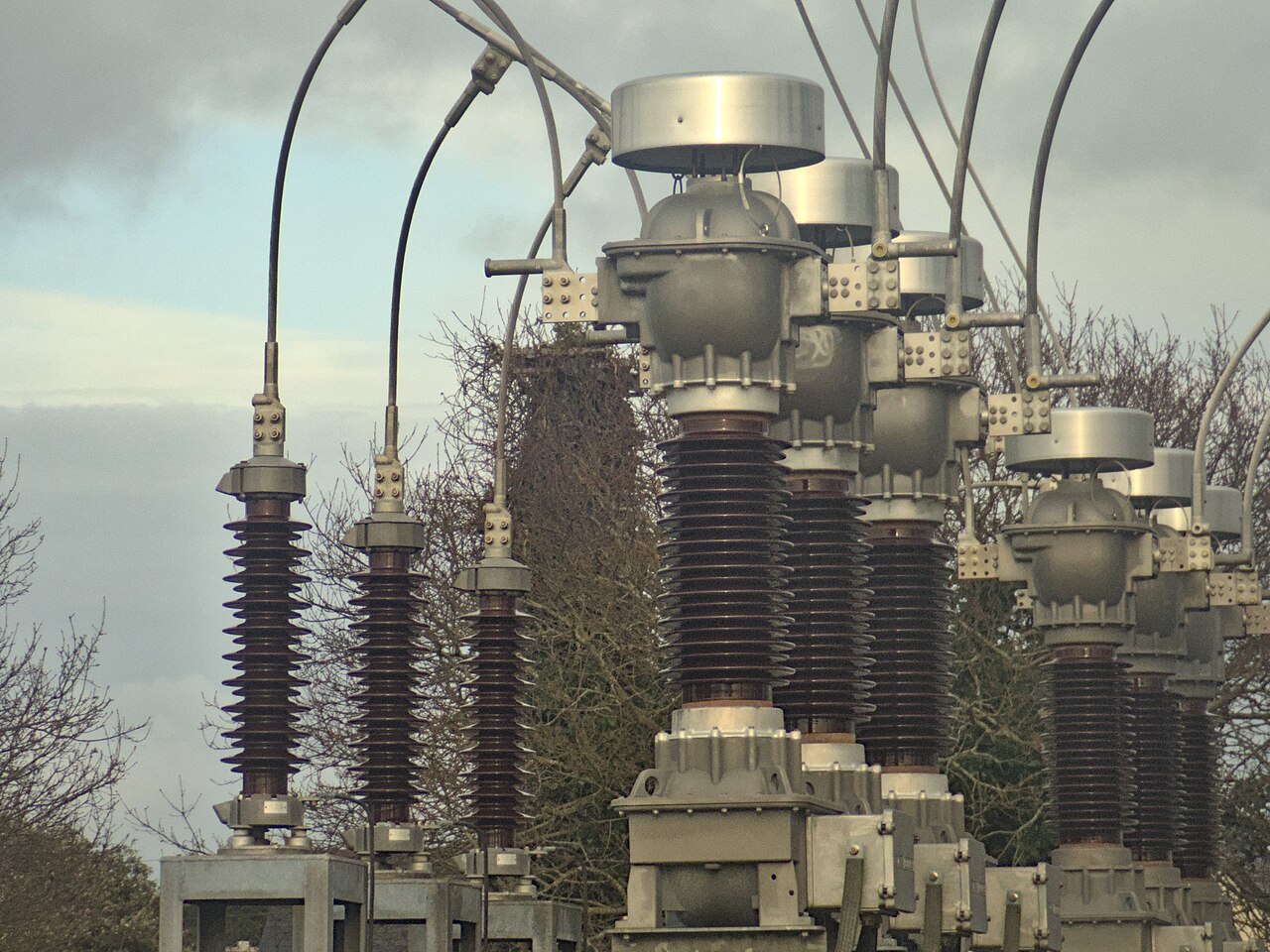
High-voltage circuit breakers come as live tank, with the interrupter enclosure at line potential, or dead tank, with the enclosure grounded. Ratings run routinely to 765 kV, and most new units quench the arc in sulfur hexafluoride gas. Either way, each phase must reach air through a bushing-like insulator, and the air-side terminal sits at full line voltage beside grounded structures. That terminal receives the same treatment as a transformer bushing top: a ring, bonded to the conductor path, clearing the porcelain or composite profile.
Disconnectors state the case plainly. Laboratory pollution tests on disconnector test objects are run with the structure, live part, and corona rings fitted, so the tested configuration matches service hardware. The stated reason is to make each test as representative as possible, which tells you the rings are expected equipment, not decoration. For selection, the constraint is clearance. The ring must wrap the terminal without crowding the interrupter geometry or the moving contact path, so these rings follow switchgear drawings rather than catalog pages.
Matching Rings to Equipment: A Selection Matrix
The sections above justify one compact corona ring application table. Read each row as a specification conversation: where the stress concentrates, what the ring arrangement looks like, what it bolts to, and who owns the geometry.
| Host equipment | Where stress concentrates | Typical ring arrangement | Mounting interface | Ring engineered by |
|---|---|---|---|---|
| Line insulator string (baseline) | End fitting at the conductor | Line end above 230 kV; both ends above 500 kV | Clamps onto string hardware | Utility-specified catalog fitting |
| Transformer bushing | Top terminal to flange, air side | Single toroid at the HV terminal | Bolted to bushing top hardware | Specified with the bushing |
| Instrument transformer | Small top terminal on tall housing | Compact single toroid | Terminal collar, delivered mounted | Apparatus manufacturer |
| Cable termination | Air-side connector; shield cutback handled inside | Ring at the connector where specified | Matched to termination hardware | Accessory supplier, inside tested assembly |
| Surge arrester | Top terminal; voltage sharing along column | Top corona ring, plus grading rings at EHV | Clamps matched to housing sections | Arrester manufacturer |
| Breaker or disconnector terminal | Air-side terminal beside grounded frame | Ring around the live terminal | Apparatus terminal drawing | Switchgear OEM |
Catalog Line Hardware Versus OEM Ring Packages
Line-string rings live in fittings catalogs: select by voltage class and string hardware, then install per the torque and alignment rules. Station rings live elsewhere: they are geometry-locked to a host apparatus. IEC 60137:2017 treats bushings as components made and sold separately, and the same logic applies to their terminal rings. The bushing and its ring travel as one engineering package, because diameter, tube, and collar all key off the bushing drawing.
In our view, the practical corona ring application question in a substation is not which ring to order but whose drawing to order against. Nameplate data, drawing numbers, terminal dimensions, and orientation all come from the host apparatus. A ring specified that way arrives with hardware that fits and clearances that hold. A ring specified from a generic table fits only by luck, and luck is not a commissioning plan.
Conclusión
One toroid, six hosts, six sets of rules. The ring on a line string is catalog hardware selected by voltage class. The ring on a transformer bushing shares an order with the bushing because the condenser core inside sets the field it must finish. Instrument transformers carry compact top rings they were delivered with. Cable terminations separate the cone’s internal job from the ring’s terminal job.
Arresters and switchgear mount rings that belong to the apparatus nameplate. The engineers at RaxPower build fittings for the line side of that boundary every day. The station side rewards the same discipline: match the ring to its host, and the ring disappears into quiet service.
Preguntas frecuentes
Do corona rings come with transformer bushings?
IEC 60137:2017 treats bushings as components made and sold separately, with ratings to Um = 1200 kV. A terminal ring is matched to each bushing’s top-terminal geometry, so it is specified with the bushing, not pulled from a generic catalog line.
Can a line-string corona ring be reused on station equipment?
Usually no. A line-string ring clamps onto string hardware, while a station ring bolts to an apparatus terminal whose geometry, clearances, and drawings differ. Reusing one invites mechanical mismatch and field peaks the original design never saw.
What standards govern corona rings on station equipment?
No standard writes ring-only rules. Bushings fall under IEC 60137:2017, gapless arresters under IEC 60099-4:2014, and extruded cable accessories under IEC 60840:2020 and IEC 62067:2022. The ring is validated inside those apparatus tests.
Do high-voltage cable terminations need corona rings?
The stress cone controls the shield-cutback gradient inside the accessory. A ring only smooths the field at the air-side connector. Terminations are qualified as complete accessories from above 30 kV up to 500 kV under IEC 60840 and IEC 62067.
How are corona rings attached to station apparatus?
The ring bonds to the high-voltage conductor path and encircles the stress points, then locks to the host apparatus through bolted collars or clamps matched to its terminal drawings. Orientation stays concentric around the terminal axis.