
Picture the moment a line post inquiry lands on a manufacturer's desk. The first buyer specifies "Class 57-2 per ANSI C29.7". The second asks for a composite post "tested to IEC 61952, SCL 8 kN". The third just wants "a post like the last order, but for 33 kV". All three mean the same hardware family. It is a rigid insulator bolted to a crossarm or bracket, carrying the conductor in bending. Yet each phrase routes the order into a different rating system, a different test regime and a different certificate set.
The RaxPower order desk sees that split every week. Line Stützisolator standards appear in the drawing notes of some inquiries and are missing from others. The orders without them take the longest to quote, because no cantilever figure can be tied to a defined test. This page maps the standards that govern line posts. It covers the ANSI C29 family, the IEC ceramic-post pair, the composite-specific IEC 61952 and its neighbors. It closes with tender wording that holds up in a project file.
Two Standards Dialects for One Insulator
A line post sits at the junction of two standardization worlds. North American utilities buy against the ANSI C29 series. In that series, one shared test-methods volume supports the product documents for porcelain line posts, station posts and composite line posts. Utilities in the IEC tradition buy against a different stack. It separates test methods from characteristics and adds a dedicated document for composite construction. Neither system is more modern in practice. They encode different purchasing habits.
The table below is the whole map of line post insulator standards. Most line post orders resolve to exactly one row. The fastest way to stall a quotation is to cite two rows at once.
| Norm | Baufamilie | What it governs |
|---|---|---|
| ANSI C29.1 | ANSI, shared | Test methods for electric power insulators |
| ANSI/NEMA C29.7 | ANSI, porcelain | Wet-process Porzellanisolatoren, high-voltage line-post type |
| ANSI/NEMA C29.9 | ANSI, porcelain | Post-type apparatus and station columns, TR-number classes |
| ANSI/NEMA C29.17 | ANSI, composite | Composite line post insulators and their qualification tests |
| IEC 60168 + IEC 60273 | IEC, ceramic/glass | Tests on post insulators; their printed characteristics |
| IEC 61952 | IEC, composite | Composite line post insulators: definitions, test methods, acceptance criteria |
| IEC 61466-1 / -2 | IEC, composite | Composite string units: strength classes and end fittings; dimensional and electrical values |
| IEC 62231 | IEC, composite | Composite station post insulators for substations |
In the field the two dialects look alike, which is exactly why the paperwork matters. The photograph below shows line post insulators doing their job on wood transmission poles. Horizontal units sit on side brackets with the conductor tied at the top. The pole carries what the insulator does not.

The rest of this page walks the rows in the order a buyer meets them. First porcelain in North America, then porcelain under IEC, then composite under IEC. The test and selection layers follow.
ANSI C29.7: The Porcelain Line Post Rulebook
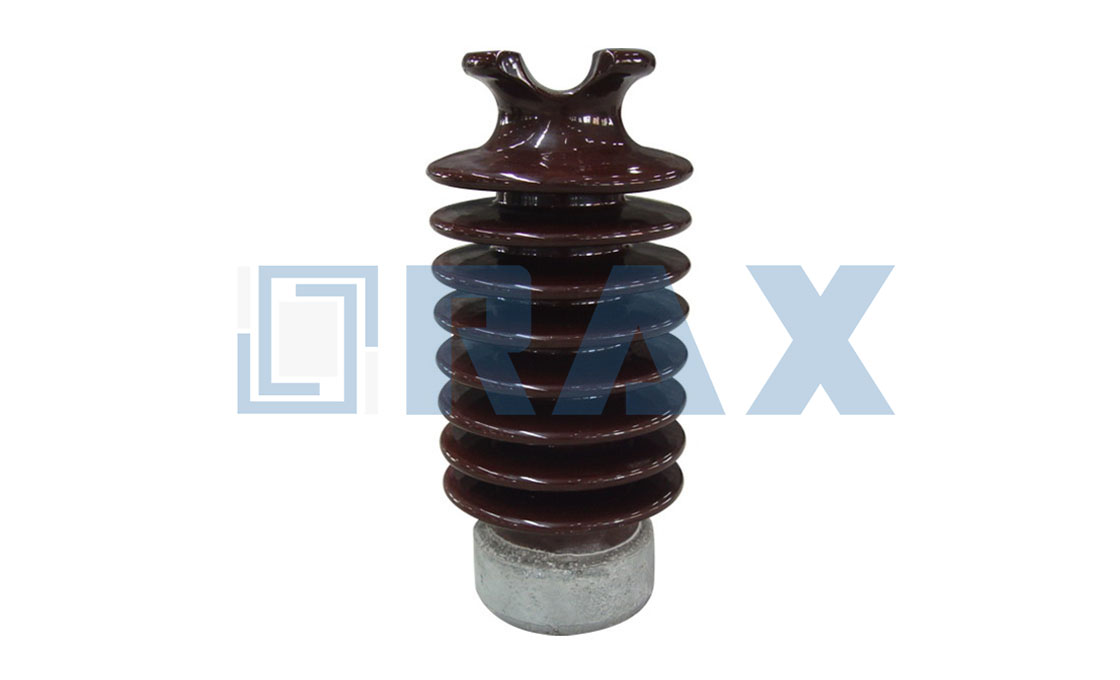
ANSI/NEMA C29.7 carries the plainest title in the family. It is an American National Standard for wet-process porcelain insulators of the high-voltage line-post type. A federal procurement specification for distribution work shows how it is used in practice. The specification asks for line post type insulators to "NEMA/ANSI C29.7, Class 57-2, 57-22", and nothing more. Inside the standard, each class number keys a fixed package of electrical and cantilever ratings.
Those 57-numbers are the class language of the market. A distributor cross-reference table lines up six manufacturers against the same ANSI numbers. Newell, PPC, NGK, LAPP, A.B. Chance and Victor all map to 57-1, 57-2, 57-3 and onward. That is only possible because the class, not the catalog part number, carries the meaning. When an engineer writes "line post, ANSI C29.7, Class 57-14", every supplier in that table knows the object being bought.
Keep C29.7 separate from its neighbor C29.9. The TR-numbers, TR-202 through TR-391 in one station-post cross-reference, belong to post-type apparatus insulators. Those are the rigid columns that support buses and equipment in substations. They resemble line posts in photographs and share wet-process porcelain manufacture. But the mounting, the ratings and the standard all differ. The 132 kV post insulator dimension guide walks that station-side family in detail.
Porcelain is not the only material a line post takes. The C29 family holds a composite answer too, ANSI C29.17. The IEC world reached the same point through a different door.
IEC 60168 and IEC 60273 for Ceramic Posts
The IEC splits line post insulator standards for ceramic material into two documents. The first is IEC 60168. Its title is "Tests on indoor and outdoor post insulators of ceramic material or glass for systems with nominal voltages greater than 1000 V". It applies to post insulators and post insulator units for indoor and outdoor service on alternating-current systems above 1,000 V and up to 100 Hz. It is the test manual: what gets measured, how, and what counts as failure.
The numbers on the drawing come from its partner. IEC 60273 applies to the same post insulators of ceramic or glass, and to organic-material posts indoors. It supplies the characteristics: the heights, creepages and strength values a data sheet prints. IEC 60168 says as much in its own scope. It directs readers to IEC 60273 for numerical values of insulator characteristics. It points to IEC 60437 and IEC 60507 for radio-interference and artificial-pollution tests.
For a buyer the consequence is simple. Citing IEC 60168 alone buys the tests but not the sizes. A complete ceramic line post line item names both documents.

The photograph shows the same ceramic post family at work in a bus support role. Stacked units carry an aluminum pipe on clamp fittings. The duty may change from crossarm to bus, yet the document pair behind the column stays the same.
IEC 61952: Composite Line Post Insulators
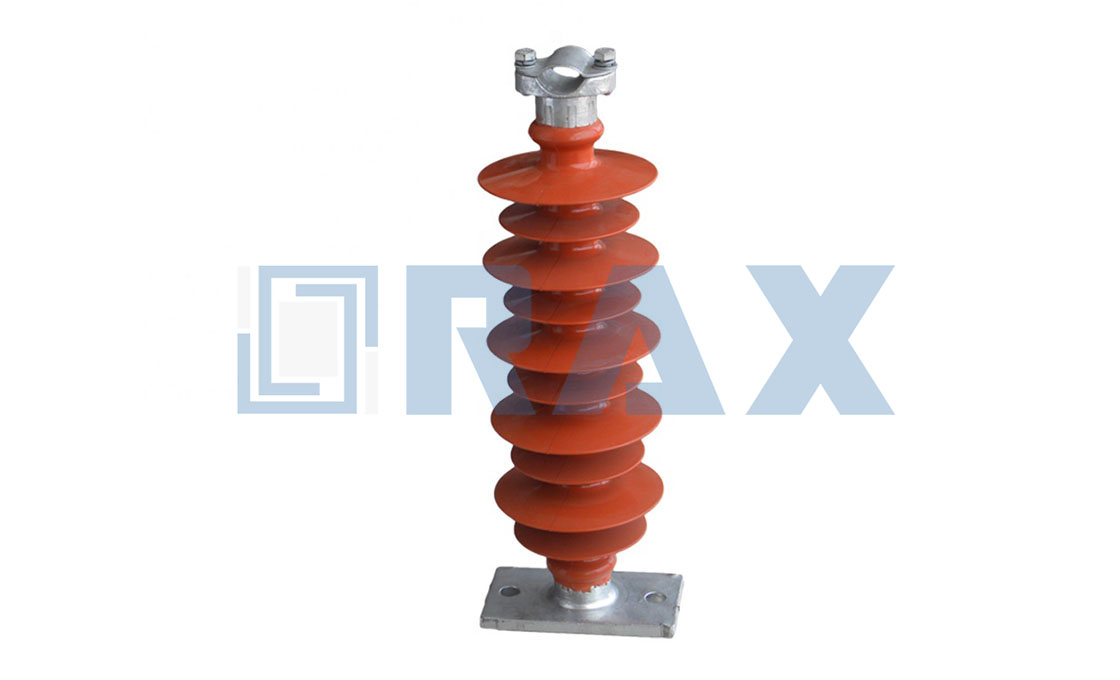
Composite line posts have their own standard because their construction raises questions porcelain never asks. IEC 61952 applies to composite line post insulators built in three parts. There is a load-bearing cylindrical solid core of fibres, usually glass, in a resin-based matrix. Over it sits a housing of elastomer material such as silicone. End fittings are permanently attached to the core. The standard's stated object is threefold: define the terms used, prescribe the test methods, prescribe the acceptance or failure criteria.
Just as revealing is what the standard refuses to do. IEC 61952 states that it includes no requirements dealing with the choice of insulators for specific operating conditions. Pollution selection, in other words, lives elsewhere in the IEC framework. It belongs to the IEC TS 60815 series covered further down this page.
Europe adopted the identical text as EN 61952:2008. The general document for polymeric insulators, IEC 62217, carries the design tests on interfaces and core material. IEC 61952 invokes those tests instead of repeating them. The layering matters when a purchaser assembles a test requirement list. Some clauses point rather than stand alone. The composite insulator structure guide explains the core-and-housing anatomy behind those clauses.
Design, Type, Sample, Routine: The Test Matrix
Open IEC 61952 at its classification clause and the test system appears in four rows. Design tests prove a new geometry and its materials. They cover the interfaces and end-fitting connections, the tracking and erosion test, and the tests on the core material. Posts add verification of the maximum design cantilever load, MDCL, plus a tensile load test on the assembled core.
Type tests then qualify production. They are electrical, taken with defined vertical and horizontal mounting arrangements. They add the mechanical headline of the whole standard, the cantilever failing load test. Sample tests run on specimens drawn from delivery lots. They cover verification of dimensions, the galvanizing test, and verification of the SCL, the specified cantilever load the rating promises. Routine tests close the loop on every unit shipped. Each unit takes a tensile load test and a visual examination.
| Test group | Coverage under IEC 61952 |
|---|---|
| Ausführung | Interfaces and end-fitting connections; tracking and erosion; core material; MDCL verification; tensile load on the assembled core |
| Typ | Electrical tests, vertical and horizontal mounting; cantilever failing load test |
| Sample | Verification of dimensions; galvanizing test; verification of the SCL |
| Routine | Tensile load test; visual examination, on every insulator |
An ANSI-world composite line post answers the same questions with a different spine. ANSI C29.17 governs the product and its qualification tests, drawing its methods from the shared C29 volume. The vocabulary shifts, with SCL on one side and class strength on the other. But this sequence from design proof to routine check is what line post insulator standards share across materials.
Citing Line Post Insulator Standards in Tenders
In our experience, the tender line that quotes a standard, an edition and a class is the line that never grows a change order. Compare two entries. "Post insulator, 24 kV, strong" invites interpretation. "Line post insulator, wet-process porcelain, ANSI/NEMA C29.7, Class 57-2; sample and routine test reports with the shipment" closes the door on it. In IEC markets the equivalent entry names the composite line post to IEC 61952 with its SCL in kilonewtons. It also demands a type test report for the cantilever failing load and routine certificates per unit.
Three habits keep the citation clean. Name the edition, because C29 documents revise on a decade rhythm. Name the class or the SCL explicitly instead of writing "equivalent". State which documents must travel with the goods. Test reports are cheaper to demand in the tender than to extract after delivery. Where mounting hardware enters the same line item, the Säulenisolator-Halterung family carries its own dimensional checks worth naming alongside.

How ANSI and IEC Classes Correspond
Buyers arriving from the other system ask the same first question: what is Class 57-2 in IEC terms? No clause-for-clause conversion exists, and no standard writes one. The two families grew up in separate markets. They kept separate test voltages, safety factors and sampling plans. A 57-class bundles its ratings differently than an IEC data sheet does.
What the market offers instead is cross-reference at the part level. Distributor tables line up ANSI 57-numbers across six manufacturers. Station post TR-numbers line up across four makers. It works the way you would match two catalogs selling the same bolt. Those tables prove interchangeability of hardware, not equivalence of standards. The test report behind each part still follows the standard named on its drawing. The safe project rule is to pick one system as primary and carry the other as reference information.
Creepage and Pollution: The Selection Layer
None of the line post insulator standards above says how far a post must creep at a coastal site. IEC splits that job out deliberately. IEC 60168 itself points to IEC 60507 for artificial pollution tests. The selection logic lives in the IEC TS 60815 series. Its Part 2 is titled "Selection and dimensioning of high-voltage insulators intended for use in polluted conditions - Part 2: Ceramic and glass insulators for a.c. systems". That part assigns the site a pollution severity. It converts the severity into a unified specific creepage distance. The product standard then proves the insulator built to that figure.
In North American line post practice the creepage expectation rides inside the class selected. That is why a procurement text can cite "Class 57-2, 57-22" alone. When a project must satisfy both worlds, the leakage distance travels with the line item as a spelled-out millimetre value. Never carry it as a class number converted by rule of thumb.
IEC 61466 and IEC 62231: The Adjacent Documents
Two more IEC documents border the map, and tender writers reach for them by mistake. The first is IEC 61466-1. It defines standard strength classes and end fittings for composite string insulator units. The couplings covered are ball, socket, tongue, clevis, Y-clevis or eye types, or a combination. Its declared purpose is that insulators and fittings from different manufacturers assemble together and interchange with existing installations. It also fixes a designation system for those units. Its Part 2 prints the dimensional and electrical characteristics for composite string units of 40 kN and 70 kN SML on distribution lines. It also covers insulators of similar design used in substations or on electric traction lines.
IEC 62231 is the station-side sibling of IEC 61952. It covers composite station post insulators for substations above 1,000 V up to 245 kV. The construction uses the same resin-impregnated fibre core with an elastomer housing. A composite column ordered for a substation bay cites IEC 62231. The crossarm-mounted post beside it cites IEC 61952. The boundary is the application, and the standard follows the application. The Pfosten-Isolator-Leitfaden sorts those overhead-line roles in plain terms.
The Standard Is the Specification
When the second quotation for the same line post arrives with a different cantilever figure, the cause is almost never the factory. It is a specification that named a number without naming the system behind it. The remedy costs one line of text. Choose the row of the map that matches the project's market and material. Take ANSI/NEMA C29.7 with its 57-classes for porcelain line posts in North America. Take IEC 60168 together with IEC 60273 for ceramic posts in IEC markets. Take IEC 61952 for composite line posts. Reserve the IEC 61466 pair for string-type composite units and IEC 62231 for composite station columns.
RaxPower manufactures line post and station post insulators in porcelain and composite construction against both systems. Every quotation leaves the order desk with a proposed standard citation attached. That fixes the class, the test list and the certificate set before the first unit is built. That habit, more than any single number on a data sheet, is what the line post insulator standards are for.
Häufig gestellte Fragen
Welche Norm deckt Porzellan-Leitungsmastisolatoren ab?
ANSI/NEMA C29.7, der amerikanische Nationalstandard für Porzellanisolatoren des Hochspannungs-Leitungsmasttyps nach dem Nassverfahren, mit Klassennummern wie 57-2, die aus dessen Klassentabellen entnommen sind.
Welche IEC-Normen gelten für Freileitungswandisolatoren?
Keramik- und Glasstangenisolatoren unterliegen IEC 60168 für Prüfungen und IEC 60273 für Kennwerte. Verbund-Hochspannungsdurchführungs-Isolatoren unterliegen IEC 61952, wobei die Verschmutzungsgruppe nach IEC TS 60815 ausgewählt wird.
Welche Prüfungen fordert IEC 61952 für ein faserverstärktes Spannglied?
Konstruktionsprüfungen an Schnittstellen, Tracking, Kern und MDCL. Typenprüfungen umfassen elektrische Lastbemessung und die Konsolbruchlast. Stichprobenprüfungen überprüfen Maße, Verzinkung und SCL. Regelmäßige Zug- und Sichtprüfungen gelten für jedes Teil.
Is an ANSI 57-class equal to an IEC line post class?
No. The systems were built separately and no conversion standard exists. Cross-reference tables match part numbers between makers, while the test report follows whichever standard the drawing names.
How do ANSI C29.7 and C29.9 differ?
C29.7 covers high-voltage line-post type porcelain for crossarm and bracket duty. C29.9 covers post-type apparatus and station columns identified by TR-numbers such as TR-216.